A Citi report sounds the alarm: Even if the Taiwan Strait reopens, supply chain damage will persist until 2027.
2026-06-30 15:47:18
On Tuesday (June 30) during the European session, Brent crude oil futures fluctuated at low levels and are currently trading around $73.50 per barrel.
Whether oil prices around $73 represent a temporary bottom or a continuation of a new round of decline depends on the sustainability of the resumption of shipping in the Strait of Hormuz—and the Citi report precisely points out the multiple uncertainties along this path.
Nathan Hitz, Citigroup’s global chief economist, led a team to release a new report that systematically assesses the ongoing impact of Middle East conflicts on global supply chains.
The report points out that although the interim agreement between the US and Iran and the reopening of the Strait of Hormuz have provided a respite for the global economy, supply chain pressures are far from over—damaged infrastructure, high transportation costs, and ongoing disruptions continue to constrain normal operations. While the global economy has shown resilience, its growth rate has slowed from approximately 2.9% before the conflict to 2.5%, while inflation has climbed to around 3.5%.
The report warns that oil price trends remain a key variable determining the economic outlook: if the agreement is maintained, Brent crude is expected to remain around $75 per barrel in the second half of the year; however, if the situation deteriorates again and oil prices surge to $120 per barrel, global growth will fall below 2%, and inflation will approach 5%. The normalization of supply chains may take 18 months or even longer.
The global economy has shown greater resilience than expected after being impacted by the Middle East conflict.
Citigroup forecasts global growth of around 2.5% this year, down from 2.9% at the beginning of the conflict, but the global manufacturing PMI still recorded its strongest reading in recent years.
However, the impact on inflation is more significant – the global inflation rate is projected to reach around 3.5%, about 1 percentage point higher than before the conflict.
Oil prices are the key variable in all of this. Brent crude fell back to around $80 a barrel after the agreement was reached, the lowest level since the conflict began, but the impact of oil prices remaining above $100 a barrel for several months had already been absorbed by the economy.
The Citi report paints two starkly contrasting pictures of the global economy, with oil price movements being a key variable in determining the ultimate path.
In the baseline scenario, if shipping through the Strait of Hormuz returns to normal, Citigroup expects Brent crude oil to average around $75 per barrel in the second half of the year. While this level is significantly lower than during the conflict, it remains above pre-war baselines, reflecting structural support from damaged production capacity and restocking demand; however, increased Iranian exports may provide some marginal offset. Under this scenario, global growth is broadly in line with current expectations.
In a risk scenario, if renewed conflict pushes oil prices up to $120 per barrel in the second half of the year, global growth will fall below 2%, and overall inflation will approach 5%.
The report points out that while this may not constitute stagflation in the full sense, it will have a significant impact on consumer purchasing power, the labor market, and central bank policy paths, while also exacerbating global fiscal pressures.
Fortunately, there is a significant counterbalancing force in the current cycle – the robust growth of AI-related investments. In the US, such investments surged to over $400 billion annualized in the first quarter and are expected to surpass $600 billion for the full year, and are spilling over into Asian economies, providing additional support for global growth.
The Citi Global Supply Chain Stress Index surged in March and April, and while it leveled off slightly in May, it remained nearly one standard deviation above the pre-pandemic average. Excluding the pandemic period, the current level is the highest since the disruptions of 2021-2022, indicating that supply chain tensions are far from abating.
The pressure comes mainly from three aspects: rising transportation costs and increased input prices reflected in the PMI; energy costs (diesel and aviation fuel) play a key role; and although container freight rates have risen, they have not yet reached the peak during the Red Sea disruption in 2024, thanks to the expansion of global shipping capacity.
A relatively positive sign is that inventory pressure and order backlogs remain within a manageable range, and some companies have already built up buffer inventory to cope with uncertainties. This provides some absorption capacity for the supply chain in the event of further shocks, but it is difficult to fundamentally reverse the overall tense situation.
Even if the Strait of Hormuz remains open, Citi expects some supply chain frictions to persist. Shipping volumes are unlikely to return to normal levels in the short term, damaged production facilities will require time to rebuild, and existing supply chain tensions cannot be resolved quickly with a single agreement.
The report uses the COVID-19 pandemic as a reference—the normalization process for global supply chains at that time took approximately 18 months. Although the severity of this shock is less than that of the pandemic, its damage to production capacity and logistics networks will also require a considerable amount of time to repair and rebuild.
Citigroup predicts that some industries may face residual pressures that could last until 2027. This means that even if the worst-case scenario at the macro level is avoided, structural damage at the micro level will still constrain the operational efficiency and cost structure of some industries for years to come.
The Citi report uses a rule of thumb to estimate the macroeconomic impact of oil price shocks: for every 10% increase in oil prices, global growth decreases by approximately 15-20 basis points, and overall inflation rises by approximately 30-40 basis points (core inflation is slightly lower). Compared to the past few decades, these effects have weakened, reflecting decreased energy intensity and increased economic flexibility.
However, the report warns that supply chain disruptions could amplify these effects. In particular, a second round of price pressures—such as rising transportation costs impacting commodity prices and soaring airfares—could push core inflation to levels higher than the rule of thumb predicted. Historically, there has been a strong correlation between supply chain stress and core inflation, meaning the current risk of disruption should not be underestimated.
More alarmingly, this transmission mechanism may be non-linear: in the early stages of the shock, companies can absorb costs by compressing profit margins and depleting inventory; however, as pressure intensifies, companies may be forced to restructure supply chains, cut production, or more aggressively pass on costs, resulting in a tiered macroeconomic shock effect. The ultimate trajectory of inflation may be far more severe than linearly estimated.
Supported by prior oversupply, long-term contract guarantees, and recycling capabilities, the helium and semiconductor industries have demonstrated strong resilience in this round of supply chain disruptions. Even with the ongoing tensions in the Middle East, these industries still have buffer space and are unlikely to face a substantial supply crisis in the short term.
The petrochemical industry faces a more profound impact. A significant proportion of global production capacity is already shut down or disrupted, and the path to normalization is expected to be quite slow. Even if navigation across the strait resumes, the repair of production facilities and the reconstruction of supply chains will still take a considerable amount of time, and the industry's pressure is unlikely to subside in the short term.
Fertilizer prices have risen sharply, raising concerns about the impact on agricultural costs and downstream food prices. The aluminum industry faces the risk of prolonged disruptions – restarting damaged capacity will take a considerable amount of time, and the tight supply situation may continue until 2027.
The airline industry is extremely sensitive to fuel costs and, constrained by fare competition and consumer price sensitivity, has a relatively limited ability to pass on significant cost shocks. Significant differences exist between different business models—low-cost carriers and large, full-service airlines exhibit marked differences in their flexibility and resilience in responding to fuel cost shocks.
The North American transportation and logistics industry has shown some resilience, largely thanks to the effective operation of the fuel cost pass-through mechanism. However, the pressure has not disappeared but has been transferred to downstream industries—manufacturing and retail sectors that rely on transportation services are continuing to suffer from rising costs and shrinking profit margins.
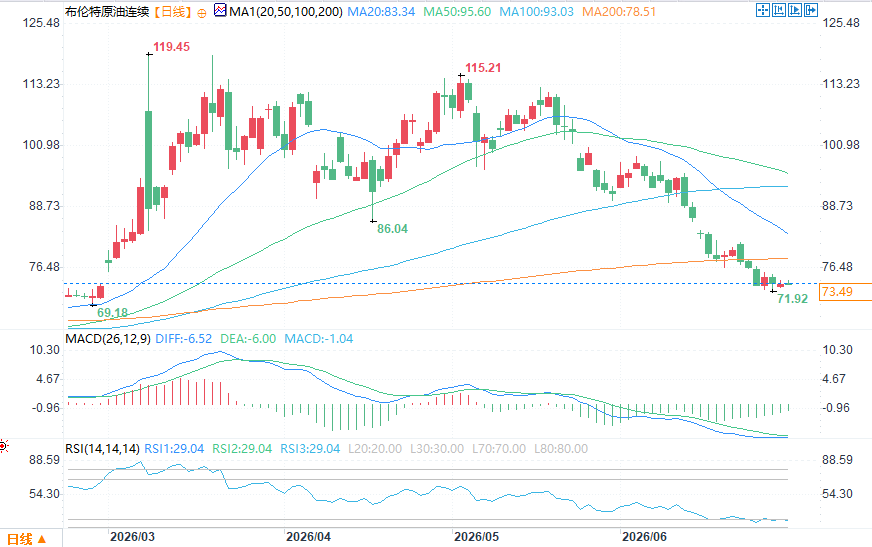
(Brent crude oil futures daily chart, source: FX678)
At 15:21 Beijing time on June 30, US crude oil futures were trading at $73.50 per barrel.
Whether oil prices around $73 represent a temporary bottom or a continuation of a new round of decline depends on the sustainability of the resumption of shipping in the Strait of Hormuz—and the Citi report precisely points out the multiple uncertainties along this path.
Nathan Hitz, Citigroup’s global chief economist, led a team to release a new report that systematically assesses the ongoing impact of Middle East conflicts on global supply chains.
The report points out that although the interim agreement between the US and Iran and the reopening of the Strait of Hormuz have provided a respite for the global economy, supply chain pressures are far from over—damaged infrastructure, high transportation costs, and ongoing disruptions continue to constrain normal operations. While the global economy has shown resilience, its growth rate has slowed from approximately 2.9% before the conflict to 2.5%, while inflation has climbed to around 3.5%.
The report warns that oil price trends remain a key variable determining the economic outlook: if the agreement is maintained, Brent crude is expected to remain around $75 per barrel in the second half of the year; however, if the situation deteriorates again and oil prices surge to $120 per barrel, global growth will fall below 2%, and inflation will approach 5%. The normalization of supply chains may take 18 months or even longer.
Macro picture: Resilience remains, but weaker than before the conflict.
The global economy has shown greater resilience than expected after being impacted by the Middle East conflict.
Citigroup forecasts global growth of around 2.5% this year, down from 2.9% at the beginning of the conflict, but the global manufacturing PMI still recorded its strongest reading in recent years.
However, the impact on inflation is more significant – the global inflation rate is projected to reach around 3.5%, about 1 percentage point higher than before the conflict.
Oil prices are the key variable in all of this. Brent crude fell back to around $80 a barrel after the agreement was reached, the lowest level since the conflict began, but the impact of oil prices remaining above $100 a barrel for several months had already been absorbed by the economy.
Two scenarios: Oil prices determine the fate of the global economy
The Citi report paints two starkly contrasting pictures of the global economy, with oil price movements being a key variable in determining the ultimate path.
In the baseline scenario, if shipping through the Strait of Hormuz returns to normal, Citigroup expects Brent crude oil to average around $75 per barrel in the second half of the year. While this level is significantly lower than during the conflict, it remains above pre-war baselines, reflecting structural support from damaged production capacity and restocking demand; however, increased Iranian exports may provide some marginal offset. Under this scenario, global growth is broadly in line with current expectations.
In a risk scenario, if renewed conflict pushes oil prices up to $120 per barrel in the second half of the year, global growth will fall below 2%, and overall inflation will approach 5%.
The report points out that while this may not constitute stagflation in the full sense, it will have a significant impact on consumer purchasing power, the labor market, and central bank policy paths, while also exacerbating global fiscal pressures.
Fortunately, there is a significant counterbalancing force in the current cycle – the robust growth of AI-related investments. In the US, such investments surged to over $400 billion annualized in the first quarter and are expected to surpass $600 billion for the full year, and are spilling over into Asian economies, providing additional support for global growth.
Supply chain pressures re-emerge: near the highest level since the pandemic
The Citi Global Supply Chain Stress Index surged in March and April, and while it leveled off slightly in May, it remained nearly one standard deviation above the pre-pandemic average. Excluding the pandemic period, the current level is the highest since the disruptions of 2021-2022, indicating that supply chain tensions are far from abating.
The pressure comes mainly from three aspects: rising transportation costs and increased input prices reflected in the PMI; energy costs (diesel and aviation fuel) play a key role; and although container freight rates have risen, they have not yet reached the peak during the Red Sea disruption in 2024, thanks to the expansion of global shipping capacity.
A relatively positive sign is that inventory pressure and order backlogs remain within a manageable range, and some companies have already built up buffer inventory to cope with uncertainties. This provides some absorption capacity for the supply chain in the event of further shocks, but it is difficult to fundamentally reverse the overall tense situation.
Structural scars: Normalization takes time
Even if the Strait of Hormuz remains open, Citi expects some supply chain frictions to persist. Shipping volumes are unlikely to return to normal levels in the short term, damaged production facilities will require time to rebuild, and existing supply chain tensions cannot be resolved quickly with a single agreement.
The report uses the COVID-19 pandemic as a reference—the normalization process for global supply chains at that time took approximately 18 months. Although the severity of this shock is less than that of the pandemic, its damage to production capacity and logistics networks will also require a considerable amount of time to repair and rebuild.
Citigroup predicts that some industries may face residual pressures that could last until 2027. This means that even if the worst-case scenario at the macro level is avoided, structural damage at the micro level will still constrain the operational efficiency and cost structure of some industries for years to come.
Rules and Nonlinearity: How to Quantify Oil Price Shocks
The Citi report uses a rule of thumb to estimate the macroeconomic impact of oil price shocks: for every 10% increase in oil prices, global growth decreases by approximately 15-20 basis points, and overall inflation rises by approximately 30-40 basis points (core inflation is slightly lower). Compared to the past few decades, these effects have weakened, reflecting decreased energy intensity and increased economic flexibility.
However, the report warns that supply chain disruptions could amplify these effects. In particular, a second round of price pressures—such as rising transportation costs impacting commodity prices and soaring airfares—could push core inflation to levels higher than the rule of thumb predicted. Historically, there has been a strong correlation between supply chain stress and core inflation, meaning the current risk of disruption should not be underestimated.
More alarmingly, this transmission mechanism may be non-linear: in the early stages of the shock, companies can absorb costs by compressing profit margins and depleting inventory; however, as pressure intensifies, companies may be forced to restructure supply chains, cut production, or more aggressively pass on costs, resulting in a tiered macroeconomic shock effect. The ultimate trajectory of inflation may be far more severe than linearly estimated.
Industry Differentiation: Who is the Most Vulnerable?
Supported by prior oversupply, long-term contract guarantees, and recycling capabilities, the helium and semiconductor industries have demonstrated strong resilience in this round of supply chain disruptions. Even with the ongoing tensions in the Middle East, these industries still have buffer space and are unlikely to face a substantial supply crisis in the short term.
The petrochemical industry faces a more profound impact. A significant proportion of global production capacity is already shut down or disrupted, and the path to normalization is expected to be quite slow. Even if navigation across the strait resumes, the repair of production facilities and the reconstruction of supply chains will still take a considerable amount of time, and the industry's pressure is unlikely to subside in the short term.
Fertilizer prices have risen sharply, raising concerns about the impact on agricultural costs and downstream food prices. The aluminum industry faces the risk of prolonged disruptions – restarting damaged capacity will take a considerable amount of time, and the tight supply situation may continue until 2027.
The airline industry is extremely sensitive to fuel costs and, constrained by fare competition and consumer price sensitivity, has a relatively limited ability to pass on significant cost shocks. Significant differences exist between different business models—low-cost carriers and large, full-service airlines exhibit marked differences in their flexibility and resilience in responding to fuel cost shocks.
The North American transportation and logistics industry has shown some resilience, largely thanks to the effective operation of the fuel cost pass-through mechanism. However, the pressure has not disappeared but has been transferred to downstream industries—manufacturing and retail sectors that rely on transportation services are continuing to suffer from rising costs and shrinking profit margins.
(Brent crude oil futures daily chart, source: FX678)
At 15:21 Beijing time on June 30, US crude oil futures were trading at $73.50 per barrel.
- Risk Warning and Disclaimer
- The market involves risk, and trading may not be suitable for all investors. This article is for reference only and does not constitute personal investment advice, nor does it take into account certain users’ specific investment objectives, financial situation, or other needs. Any investment decisions made based on this information are at your own risk.