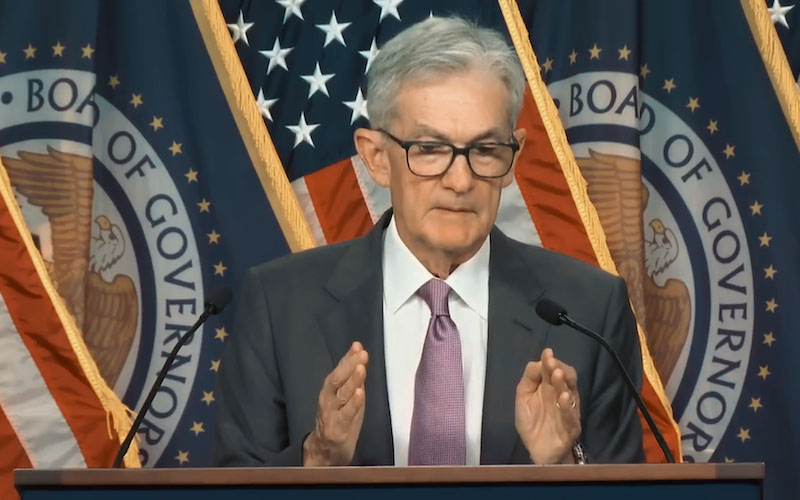
The Doha talks saw the US and Iran sticking to their own versions of events, while lower real interest rates signaled a potential rebound in gold prices.
2026-06-30 15:49:03
On Tuesday (June 30), spot gold experienced a significant bottoming-out and rebound, holding above 4,000 and currently trading around 4,029. As mentioned in yesterday's article, with overall inflation expectations declining sharply, gold's safe-haven logic and hedging function are beginning to return to the mainstream narrative.
The current geopolitical standoff between the United States and Iran has yet to see a substantial breakthrough. With less than 60 days left for negotiations, both sides need to finalize a permanent ceasefire agreement. However, regarding the temporary memorandum of understanding that was to be implemented this month, there are comprehensive differences in understanding and disputes over its implementation. The superposition of multiple core contradictions makes it difficult to completely resolve this long-standing conflict.
The timing of the next round of talks between the two sides has not yet been finalized. Iranian senior negotiator Qazem Gharibabadi stated that the current regional situation is highly sensitive and the game is complex, making it difficult to ease tensions quickly in the short term.

The core contradictions in the current US-Iran rivalry are concentrated in three dimensions: differences in the negotiation process, the struggle for control of the Strait of Hormuz, and the ceasefire dispute on the Lebanese front.
The two sides had previously engaged in days of military standoff and strikes over the rules governing the Taiwan Strait. Although the military conflict temporarily ended on Monday, the parties have not reached a consensus on their positions, and the ceasefire is only a temporary respite, with great uncertainty remaining.
Multiple uncertainties continue to loom over the Middle East geopolitical landscape, but with the Strait of Hormuz substantially open, the greater the variables, the stronger the demand for safe-haven assets.
At the negotiation process level, the official information released by the US and Iran is completely contradictory, and the situation is shrouded in mystery.
US President Trump publicly declared that Iran has proactively requested to restart negotiations, and the two sides will meet in Doha, Qatar, the following day.
However, Iranian Foreign Ministry spokesman Bagaei immediately denied the rumors, clarifying that there were no plans for any US-Iran negotiations at any level in the coming days, and completely refuting the US claims.
According to the established plan, both sides need to complete negotiations on a permanent peace agreement by mid-August. The core issues cover key aspects such as the handling of Iran's nuclear program, the management of highly enriched uranium stockpiles, and waivers of US sanctions.
According to multiple mediators, this round of negotiations will follow a "technical first, high-level later" approach, with lower-level diplomats conducting technical consultations first to pave the way for subsequent high-level negotiations.
Pakistan and Qatar, as the core mediators, officially announced that negotiations will resume on Tuesday. The US has also dispatched a special envoy team to Qatar, planning to advance technical consultations on the sidelines.
However, Iran has been extremely cautious, only confirming that it will send a technical delegation to Qatar to verify the implementation of the memorandum, and has no plans for any political talks with the United States.
More importantly, the interim agreement explicitly states that "a complete ceasefire is a prerequisite for negotiations." After the exchange of fire last weekend, Iran threatened to completely suspend negotiations. Although there is currently a temporary ceasefire, Iran is still observing the stability of the ceasefire, and the pace of resuming negotiations remains highly uncertain.
As a core global energy shipping route, the struggle for control of the Strait of Hormuz is the core issue in the US-Iran conflict and a key trigger for the current turmoil.
Based on the interim agreement, the U.S. side determined that the Strait of Hormuz is fully open and that all ships can navigate freely without interference.
Iran insists on its legal sovereignty over the Straits and has made it clear that any actions that deviate from Iran's existing control system and formulate separate navigation rules will exacerbate regional tensions and delay the normalization of the waterway's operation.
Judging from the details of the agreement, the interim agreement allows Iran to work with the Gulf states to jointly safeguard freedom of navigation in the Straits in accordance with international law. However, Iran has clear autonomous rules for its implementation, requiring all vessels to navigate the Straits to take its designated routes and report in advance.
The US-led initiative to open a new, independent shipping route off the coast of Oman without consulting Iran was deemed a violation of regulations by Iran and was a direct trigger for the military conflict last weekend.
Although shipping across the strait is gradually recovering, the volume of traffic is far from returning to pre-war levels. The deep-rooted differences between the US and Iran in interpreting Article 5 of the memorandum on waterway control are difficult to reconcile in the short term.
The ceasefire stalemate on the Lebanese front has further complicated the situation between the US and Iran, creating a nested pattern of multi-party competition.
Iran insists on a complete ceasefire across the region and demands that Israel completely withdraw from Lebanon, otherwise it will refuse to proceed with further negotiations.
However, Israeli Prime Minister Netanyahu took a hard line, making it clear that the Israeli army will continue to be stationed in southern Lebanon as long as Hezbollah and armed groups within the country are not completely disarmed and the security threat to Israel cannot be eliminated.
It is worth noting that the agreements reached by all parties contain obvious contradictions and loopholes. The interim US-Iran agreement requires a complete ceasefire in Lebanon and the withdrawal of Israeli troops, while the independence agreement reached between Israel and the Lebanese government under US leadership allows Israeli troops to remain in Lebanon until Hezbollah disarms.
Hezbollah did not participate in the negotiations of the agreement and firmly opposed any clauses that tied its own disarmament to the Israeli withdrawal, continuing to resist the Israeli occupation.
Following the outbreak of military conflict between the US and Iran at the end of February this year, Hezbollah attacked Israel, triggering a large-scale war between Lebanon and Israel. Sporadic clashes continued in Lebanon afterward, greatly slowing down the pace of US-Iran negotiations.
Meanwhile, the Lebanese government's lack of the ability to disarm Hezbollah has led to an intractable stalemate in the Lebanese-Israeli ceasefire.
Based on the core demands disclosed by Iranian officials, Iran currently has multiple core objections to the implementation of the US memorandum, which is the fundamental reason for the stalemate between the two sides.
Besides disagreements over waterway control and the interpretation of the ceasefire terms in Lebanon, Iran is also seriously dissatisfied with the inefficient pace at which the US is pushing for the implementation of the agreement, and is paying close attention to the unfreezing of overseas assets, especially the details of the first round of $6 billion in frozen Qatari assets promised by the US.
Overall, the current round of technical consultations between the US and Iran has many unresolved issues, including nuclear issues, sanctions waivers, sovereignty over shipping lanes, asset unfreezing, and regional ceasefires. These multiple conflicts are intertwined, making the negotiations extremely difficult and unlikely to reach a substantial consensus in the short term.
From a financial market perspective, the recent drop in oil prices has significantly eased global inflation concerns, allowing gold to regain its safe-haven function after being freed from inflationary constraints. The ongoing geopolitical rivalry between the US and Iran has become the core disruptive factor for recent short-term fluctuations in international gold prices, creating a pattern of "escalating tensions leading to increased safe-haven demand for gold, and temporary easing of tensions causing gold prices to fall under pressure."
With the Strait of Hormuz now open to traffic, the traditional hedging logic of "buying gold during times of turmoil" is making a comeback, and the prospect of back-and-forth negotiations between the US and Iran will provide support for gold prices.
The formula Real Interest Rate = Nominal Interest Rate - Inflation Expectations shows that, due to low and rigid inflation expectations, the nominal interest rate fell rapidly due to oil prices, and the real interest rate also fell rapidly. This can also be verified through TIPS.
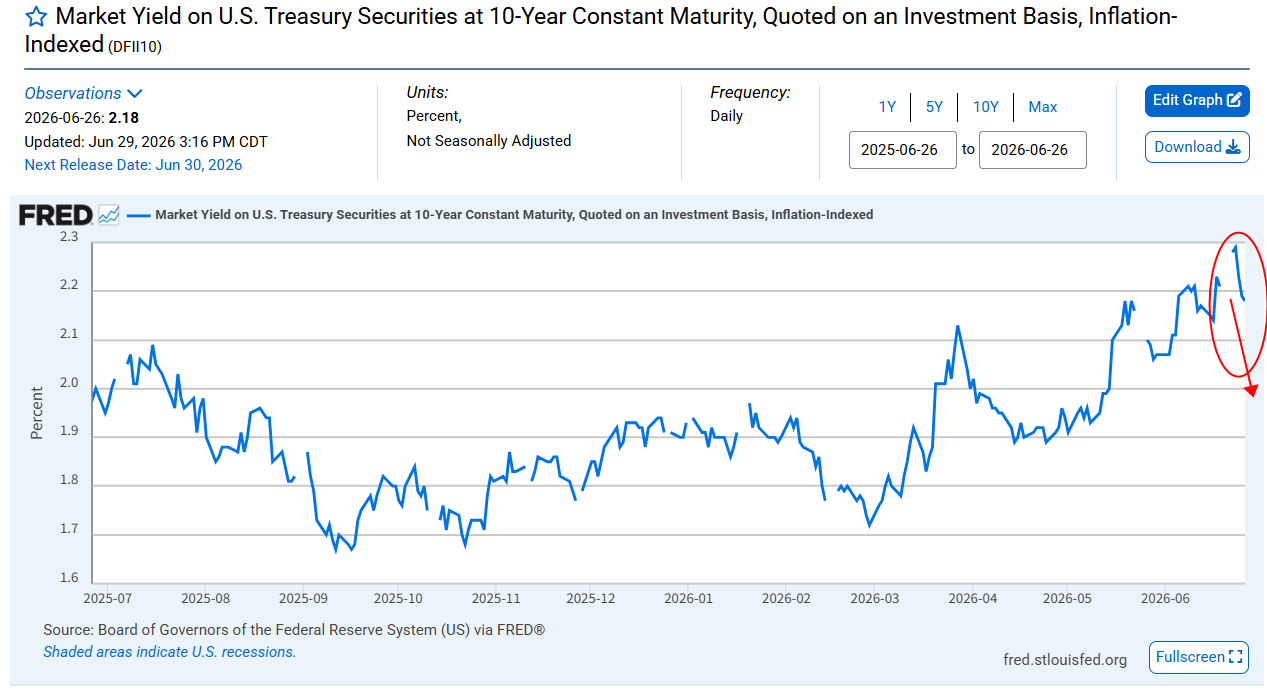
(The yield trend of the US 10-year inflation-resistant bond, source: Federal Reserve)
However, the medium- to long-term trend of gold prices is still dominated by the Federal Reserve's monetary policy and the real interest rate of the US dollar. When there are signs of a phased ceasefire between the US and Iran and a easing of negotiations, the risk aversion sentiment will quickly subside. Coupled with the fluctuations in the US dollar and US Treasury yields, gold prices will experience a correction.
The current conflict between the US and Iran is in a tug-of-war state of alternating fighting and truce, with unresolved differences. The long-term uncertainty of the situation means that gold prices will continue to maintain a high volatility pattern. The recurring geopolitical risks will continue to offset some of the negative factors and limit the downside potential of gold prices. Before the Fed's policy is implemented, the geopolitical game between the US and Iran will continue to dominate the short-term trading rhythm of gold and become a key fundamental variable that investors should pay close attention to.
From a technical perspective, spot gold has formed a single-day bottom, coupled with a global stock market rebound and improved risk appetite, suggesting a potential rebound is on the horizon.
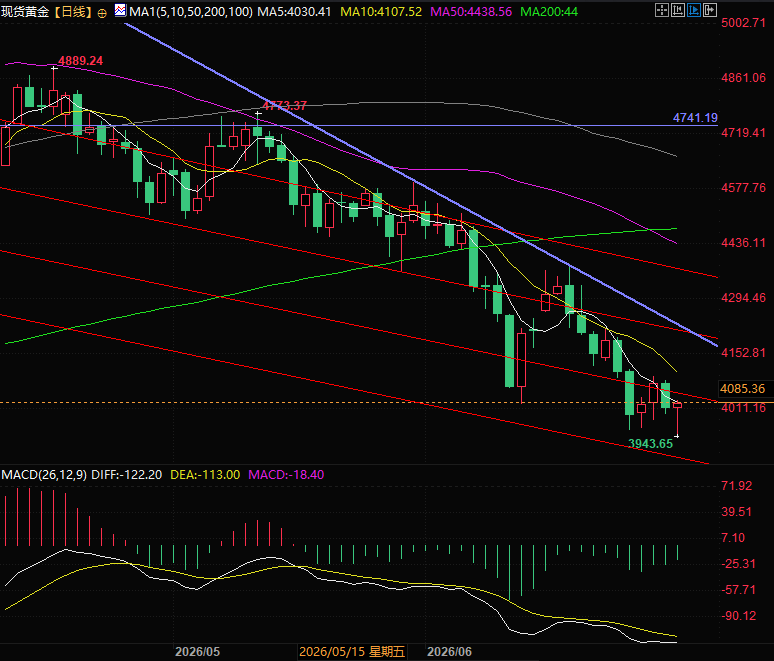
(Spot gold daily chart, source: FX678)
At 15:43 Beijing time, spot gold was trading at $4,028 per ounce.
The current geopolitical standoff between the United States and Iran has yet to see a substantial breakthrough. With less than 60 days left for negotiations, both sides need to finalize a permanent ceasefire agreement. However, regarding the temporary memorandum of understanding that was to be implemented this month, there are comprehensive differences in understanding and disputes over its implementation. The superposition of multiple core contradictions makes it difficult to completely resolve this long-standing conflict.
The timing of the next round of talks between the two sides has not yet been finalized. Iranian senior negotiator Qazem Gharibabadi stated that the current regional situation is highly sensitive and the game is complex, making it difficult to ease tensions quickly in the short term.
Core of the game: Three key disagreements sow the seeds of market volatility.
The core contradictions in the current US-Iran rivalry are concentrated in three dimensions: differences in the negotiation process, the struggle for control of the Strait of Hormuz, and the ceasefire dispute on the Lebanese front.
The two sides had previously engaged in days of military standoff and strikes over the rules governing the Taiwan Strait. Although the military conflict temporarily ended on Monday, the parties have not reached a consensus on their positions, and the ceasefire is only a temporary respite, with great uncertainty remaining.
Multiple uncertainties continue to loom over the Middle East geopolitical landscape, but with the Strait of Hormuz substantially open, the greater the variables, the stronger the demand for safe-haven assets.
Negotiation Progress: US and Iran's official announcements contradict each other, making the pace of resumption highly uncertain.
At the negotiation process level, the official information released by the US and Iran is completely contradictory, and the situation is shrouded in mystery.
US President Trump publicly declared that Iran has proactively requested to restart negotiations, and the two sides will meet in Doha, Qatar, the following day.
However, Iranian Foreign Ministry spokesman Bagaei immediately denied the rumors, clarifying that there were no plans for any US-Iran negotiations at any level in the coming days, and completely refuting the US claims.
According to the established plan, both sides need to complete negotiations on a permanent peace agreement by mid-August. The core issues cover key aspects such as the handling of Iran's nuclear program, the management of highly enriched uranium stockpiles, and waivers of US sanctions.
According to multiple mediators, this round of negotiations will follow a "technical first, high-level later" approach, with lower-level diplomats conducting technical consultations first to pave the way for subsequent high-level negotiations.
Pakistan and Qatar, as the core mediators, officially announced that negotiations will resume on Tuesday. The US has also dispatched a special envoy team to Qatar, planning to advance technical consultations on the sidelines.
However, Iran has been extremely cautious, only confirming that it will send a technical delegation to Qatar to verify the implementation of the memorandum, and has no plans for any political talks with the United States.
More importantly, the interim agreement explicitly states that "a complete ceasefire is a prerequisite for negotiations." After the exchange of fire last weekend, Iran threatened to completely suspend negotiations. Although there is currently a temporary ceasefire, Iran is still observing the stability of the ceasefire, and the pace of resuming negotiations remains highly uncertain.
The Strait of Hormuz: Disputes over control are irreconcilable.
As a core global energy shipping route, the struggle for control of the Strait of Hormuz is the core issue in the US-Iran conflict and a key trigger for the current turmoil.
Based on the interim agreement, the U.S. side determined that the Strait of Hormuz is fully open and that all ships can navigate freely without interference.
Iran insists on its legal sovereignty over the Straits and has made it clear that any actions that deviate from Iran's existing control system and formulate separate navigation rules will exacerbate regional tensions and delay the normalization of the waterway's operation.
Judging from the details of the agreement, the interim agreement allows Iran to work with the Gulf states to jointly safeguard freedom of navigation in the Straits in accordance with international law. However, Iran has clear autonomous rules for its implementation, requiring all vessels to navigate the Straits to take its designated routes and report in advance.
The US-led initiative to open a new, independent shipping route off the coast of Oman without consulting Iran was deemed a violation of regulations by Iran and was a direct trigger for the military conflict last weekend.
Although shipping across the strait is gradually recovering, the volume of traffic is far from returning to pre-war levels. The deep-rooted differences between the US and Iran in interpreting Article 5 of the memorandum on waterway control are difficult to reconcile in the short term.
Lebanon-Israel Front: Loopholes in Multi-Party Agreements Lead to Ceasefire Stalemate
The ceasefire stalemate on the Lebanese front has further complicated the situation between the US and Iran, creating a nested pattern of multi-party competition.
Iran insists on a complete ceasefire across the region and demands that Israel completely withdraw from Lebanon, otherwise it will refuse to proceed with further negotiations.
However, Israeli Prime Minister Netanyahu took a hard line, making it clear that the Israeli army will continue to be stationed in southern Lebanon as long as Hezbollah and armed groups within the country are not completely disarmed and the security threat to Israel cannot be eliminated.
It is worth noting that the agreements reached by all parties contain obvious contradictions and loopholes. The interim US-Iran agreement requires a complete ceasefire in Lebanon and the withdrawal of Israeli troops, while the independence agreement reached between Israel and the Lebanese government under US leadership allows Israeli troops to remain in Lebanon until Hezbollah disarms.
Hezbollah did not participate in the negotiations of the agreement and firmly opposed any clauses that tied its own disarmament to the Israeli withdrawal, continuing to resist the Israeli occupation.
Following the outbreak of military conflict between the US and Iran at the end of February this year, Hezbollah attacked Israel, triggering a large-scale war between Lebanon and Israel. Sporadic clashes continued in Lebanon afterward, greatly slowing down the pace of US-Iran negotiations.
Meanwhile, the Lebanese government's lack of the ability to disarm Hezbollah has led to an intractable stalemate in the Lebanese-Israeli ceasefire.
Key Dispute: Several of Iran's demands have not been met, and negotiations face numerous obstacles.
Based on the core demands disclosed by Iranian officials, Iran currently has multiple core objections to the implementation of the US memorandum, which is the fundamental reason for the stalemate between the two sides.
Besides disagreements over waterway control and the interpretation of the ceasefire terms in Lebanon, Iran is also seriously dissatisfied with the inefficient pace at which the US is pushing for the implementation of the agreement, and is paying close attention to the unfreezing of overseas assets, especially the details of the first round of $6 billion in frozen Qatari assets promised by the US.
Overall, the current round of technical consultations between the US and Iran has many unresolved issues, including nuclear issues, sanctions waivers, sovereignty over shipping lanes, asset unfreezing, and regional ceasefires. These multiple conflicts are intertwined, making the negotiations extremely difficult and unlikely to reach a substantial consensus in the short term.
Market Interaction: US-Iran Geopolitical Rivalry Dominates Short-Term Gold Price Fluctuations
From a financial market perspective, the recent drop in oil prices has significantly eased global inflation concerns, allowing gold to regain its safe-haven function after being freed from inflationary constraints. The ongoing geopolitical rivalry between the US and Iran has become the core disruptive factor for recent short-term fluctuations in international gold prices, creating a pattern of "escalating tensions leading to increased safe-haven demand for gold, and temporary easing of tensions causing gold prices to fall under pressure."
With the Strait of Hormuz now open to traffic, the traditional hedging logic of "buying gold during times of turmoil" is making a comeback, and the prospect of back-and-forth negotiations between the US and Iran will provide support for gold prices.
The formula Real Interest Rate = Nominal Interest Rate - Inflation Expectations shows that, due to low and rigid inflation expectations, the nominal interest rate fell rapidly due to oil prices, and the real interest rate also fell rapidly. This can also be verified through TIPS.
(The yield trend of the US 10-year inflation-resistant bond, source: Federal Reserve)
However, the medium- to long-term trend of gold prices is still dominated by the Federal Reserve's monetary policy and the real interest rate of the US dollar. When there are signs of a phased ceasefire between the US and Iran and a easing of negotiations, the risk aversion sentiment will quickly subside. Coupled with the fluctuations in the US dollar and US Treasury yields, gold prices will experience a correction.
The current conflict between the US and Iran is in a tug-of-war state of alternating fighting and truce, with unresolved differences. The long-term uncertainty of the situation means that gold prices will continue to maintain a high volatility pattern. The recurring geopolitical risks will continue to offset some of the negative factors and limit the downside potential of gold prices. Before the Fed's policy is implemented, the geopolitical game between the US and Iran will continue to dominate the short-term trading rhythm of gold and become a key fundamental variable that investors should pay close attention to.
From a technical perspective, spot gold has formed a single-day bottom, coupled with a global stock market rebound and improved risk appetite, suggesting a potential rebound is on the horizon.
(Spot gold daily chart, source: FX678)
At 15:43 Beijing time, spot gold was trading at $4,028 per ounce.
- Risk Warning and Disclaimer
- The market involves risk, and trading may not be suitable for all investors. This article is for reference only and does not constitute personal investment advice, nor does it take into account certain users’ specific investment objectives, financial situation, or other needs. Any investment decisions made based on this information are at your own risk.