Copper prices are under pressure from both uncertain tariff prospects and expectations of a Federal Reserve interest rate hike.
2026-07-01 18:08:10
On Wednesday (July 1st) during the European session, the main US copper futures price traded around $6.122 per pound, a significant drop from the intraday high of $6.25 per pound. The market action fully reflected the tug-of-war between bulls and bears driven by macroeconomic data and expectations of policy changes. A series of recent US economic data exceeded expectations, with labor market, manufacturing, and consumer data all showing resilience. This has further solidified market confidence that the Federal Reserve will maintain its tight monetary policy stance. The persistently high interest rate environment has significantly increased upward resistance for industrial metals, limiting the upside potential of copper prices.

Meanwhile, uncertainty surrounding tariff policies has become another key negative factor constraining copper prices. Previously, refined copper had consistently been exempted from multiple rounds of import tariffs on copper products issued by the United States, remaining outside the scope of additional tariffs. However, the US government has now officially launched a special review, proposing a phased implementation plan to impose tariffs on imported refined copper starting in 2027. This expectation of policy changes continues to disrupt the market.
The final review recommendations and policy proposals issued by the U.S. Secretary of Commerce will directly affect the flow of refined copper imports across the United States, the inventory layout and stockpiling pace of the industrial chain, and at the same time completely reshape the price difference structure between U.S. domestic copper prices and global international copper prices, bringing new trading logic to cross-market arbitrage.
The core logic of trading closely monitoring copper prices
The reason copper prices have become the core of trading in the industrial metals sector is that they are at a sensitive intersection of macroeconomic monetary policy and trade policy. Changes in both directions will directly reshape the supply and demand pattern of the copper market. On the one hand, adjustments to tariff policies will completely change the supply and demand balance of refined copper in the United States, affecting domestic inventory and import supply. On the other hand, the continued rise in expectations of high interest rates from the Federal Reserve will suppress end-user industrial demand such as manufacturing and infrastructure, dragging down copper prices from a fundamental perspective.
In addition, the overall supply and demand fundamentals of the global copper market should not be ignored. Changes in demand from major copper-consuming economies such as China and Europe, as well as supply disruptions from core copper-exporting countries such as Chile and Peru, will directly affect the direction of fund positions in the futures and CFD markets, and dominate short-term price fluctuations.
(Chart source: EasyForex)
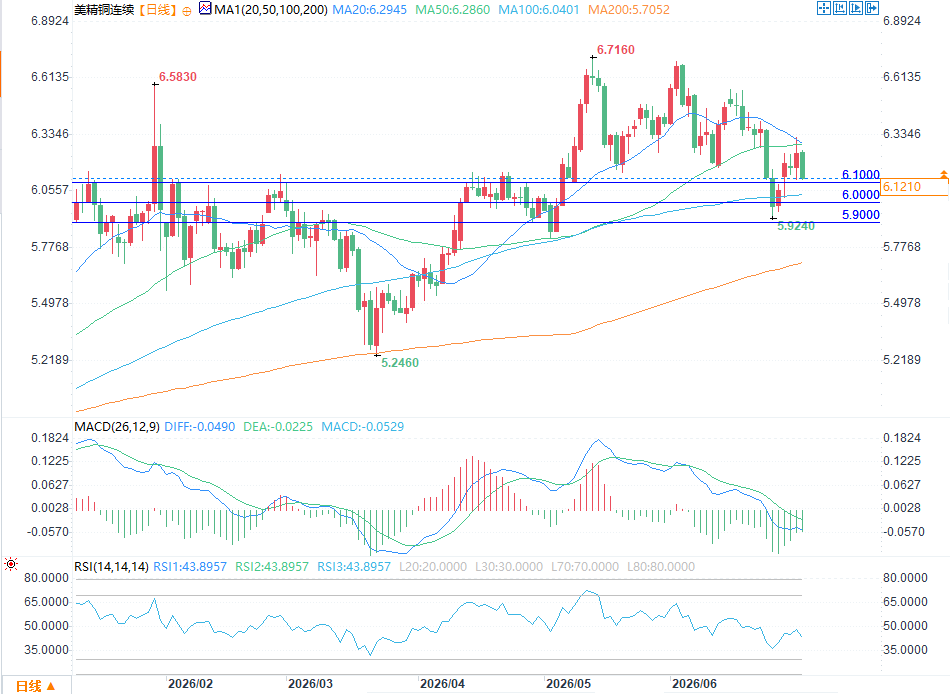
For short-term traders, the core market focus is clear: can refined copper prices stabilize and recover above the $6.10/lb level, or will a new downward trend begin, moving further towards $6.00/lb and then $5.90/lb? Because policy news and economic data are highly unpredictable and can easily trigger rapid price fluctuations and accelerated volatility, strict risk management and position sizing are crucial in short-term trading.
Technical Analysis and Key Price Levels
From a technical perspective, copper prices are currently trading closely around the short-term moving average system, with various moving averages highly converged: the 5-period moving average is at $6.13/lb, the 10-period moving average is at $6.12/lb, and the 20-period moving average provides support at $6.10/lb. This technical pattern clearly indicates that after a rapid decline from the intraday high of $6.25/lb, copper prices have entered a consolidation phase, a period of digestion and tug-of-war between bulls and bears, with no clear trend yet.
The key resistance levels for the market are clearly defined: $6.20/lb, $6.25/lb, and $6.30/lb represent a triple resistance level. Once the price breaks through these levels, buying momentum will gradually recover, and the market is expected to begin a rebound. Meanwhile, the core support levels are concentrated at $6.10/lb, $6.00/lb, and $5.90/lb, which are crucial levels for future price defense.
The technical signals provide a clear rationale: if copper prices can sustain a hold above $6.20/lb and form a valid breakout, it will signify the end of short-term bearish sentiment and a formal stabilization and rebound in the market. Conversely, if prices break below the key support level of $6.10/lb, it will open up new downside potential, significantly increasing the overall downside risk. Meanwhile, the MACD indicator's movement and changes in trading volume can provide important auxiliary evidence for judging short-term market reversals and trend continuations.
Market Outlook
Overall, under the dual pressure of tariff policy uncertainty and expectations of tighter monetary policy from the Federal Reserve, short-term trading sentiment in the copper market is cautious and conservative, with prices continuing to exhibit high volatility and a weak trend. Traders should focus on three key variables: the latest announcements regarding the implementation of the US Department of Commerce's tariff policy, monthly core US economic data, and global copper inventory change reports, to accurately determine market fund flows and subsequent price movements.
The market signals are clear: a decisive break above $6.20/lb for copper would be an early sign of a short-term market recovery and a return of buying interest, potentially initiating a corrective rebound. Conversely, if prices continue to weaken and break below the $6.10/lb support level, bearish momentum will strengthen, further solidifying the downward trend. With ongoing updates to macroeconomic data and the gradual implementation of trade policies, market funds will continuously adjust their holdings, and high volatility in copper prices is expected to persist in the short term.
Meanwhile, uncertainty surrounding tariff policies has become another key negative factor constraining copper prices. Previously, refined copper had consistently been exempted from multiple rounds of import tariffs on copper products issued by the United States, remaining outside the scope of additional tariffs. However, the US government has now officially launched a special review, proposing a phased implementation plan to impose tariffs on imported refined copper starting in 2027. This expectation of policy changes continues to disrupt the market.
The final review recommendations and policy proposals issued by the U.S. Secretary of Commerce will directly affect the flow of refined copper imports across the United States, the inventory layout and stockpiling pace of the industrial chain, and at the same time completely reshape the price difference structure between U.S. domestic copper prices and global international copper prices, bringing new trading logic to cross-market arbitrage.
The core logic of trading closely monitoring copper prices
The reason copper prices have become the core of trading in the industrial metals sector is that they are at a sensitive intersection of macroeconomic monetary policy and trade policy. Changes in both directions will directly reshape the supply and demand pattern of the copper market. On the one hand, adjustments to tariff policies will completely change the supply and demand balance of refined copper in the United States, affecting domestic inventory and import supply. On the other hand, the continued rise in expectations of high interest rates from the Federal Reserve will suppress end-user industrial demand such as manufacturing and infrastructure, dragging down copper prices from a fundamental perspective.
In addition, the overall supply and demand fundamentals of the global copper market should not be ignored. Changes in demand from major copper-consuming economies such as China and Europe, as well as supply disruptions from core copper-exporting countries such as Chile and Peru, will directly affect the direction of fund positions in the futures and CFD markets, and dominate short-term price fluctuations.
(Chart source: EasyForex)
For short-term traders, the core market focus is clear: can refined copper prices stabilize and recover above the $6.10/lb level, or will a new downward trend begin, moving further towards $6.00/lb and then $5.90/lb? Because policy news and economic data are highly unpredictable and can easily trigger rapid price fluctuations and accelerated volatility, strict risk management and position sizing are crucial in short-term trading.
Technical Analysis and Key Price Levels
From a technical perspective, copper prices are currently trading closely around the short-term moving average system, with various moving averages highly converged: the 5-period moving average is at $6.13/lb, the 10-period moving average is at $6.12/lb, and the 20-period moving average provides support at $6.10/lb. This technical pattern clearly indicates that after a rapid decline from the intraday high of $6.25/lb, copper prices have entered a consolidation phase, a period of digestion and tug-of-war between bulls and bears, with no clear trend yet.
The key resistance levels for the market are clearly defined: $6.20/lb, $6.25/lb, and $6.30/lb represent a triple resistance level. Once the price breaks through these levels, buying momentum will gradually recover, and the market is expected to begin a rebound. Meanwhile, the core support levels are concentrated at $6.10/lb, $6.00/lb, and $5.90/lb, which are crucial levels for future price defense.
The technical signals provide a clear rationale: if copper prices can sustain a hold above $6.20/lb and form a valid breakout, it will signify the end of short-term bearish sentiment and a formal stabilization and rebound in the market. Conversely, if prices break below the key support level of $6.10/lb, it will open up new downside potential, significantly increasing the overall downside risk. Meanwhile, the MACD indicator's movement and changes in trading volume can provide important auxiliary evidence for judging short-term market reversals and trend continuations.
Market Outlook
Overall, under the dual pressure of tariff policy uncertainty and expectations of tighter monetary policy from the Federal Reserve, short-term trading sentiment in the copper market is cautious and conservative, with prices continuing to exhibit high volatility and a weak trend. Traders should focus on three key variables: the latest announcements regarding the implementation of the US Department of Commerce's tariff policy, monthly core US economic data, and global copper inventory change reports, to accurately determine market fund flows and subsequent price movements.
The market signals are clear: a decisive break above $6.20/lb for copper would be an early sign of a short-term market recovery and a return of buying interest, potentially initiating a corrective rebound. Conversely, if prices continue to weaken and break below the $6.10/lb support level, bearish momentum will strengthen, further solidifying the downward trend. With ongoing updates to macroeconomic data and the gradual implementation of trade policies, market funds will continuously adjust their holdings, and high volatility in copper prices is expected to persist in the short term.
- Risk Warning and Disclaimer
- The market involves risk, and trading may not be suitable for all investors. This article is for reference only and does not constitute personal investment advice, nor does it take into account certain users’ specific investment objectives, financial situation, or other needs. Any investment decisions made based on this information are at your own risk.