Why is the US dollar index holding above 101 and refusing to retreat as the non-farm payrolls report is due to be released ahead of schedule?
2026-06-30 17:56:33
On Tuesday, June 30th, the US dollar index traded around 101.35, not far from its 52-week high of 101.80. Before July, the core variable in the foreign exchange market is not a single data point, but rather the rebalancing between the Federal Reserve's new communication framework, inflation stickiness, employment resilience, and falling energy prices. The US June non-farm payroll report will be released earlier, on July 2nd (Thursday) at 8:30 PM due to the market holiday on July 3rd. Traders are facing a window of compressed data, heightened expectations, and amplified volatility.
The current rebound in the US dollar index is not solely driven by safe-haven demand. More crucially, it's the repricing of short-term interest rate expectations, coupled with the weakening of heavyweight currencies like the euro and yen, keeping the index near its year-to-date high. On June 30th, the euro was trading around 1.139 against the dollar, and the dollar rose to around 162 against the yen, indicating strong structural support within the dollar index's basket.
Looking at asset correlations, the 10-year US Treasury yield is around 4.38%, while Brent crude oil has fallen back to around $73. The decline in oil prices has weakened the sustainability of the energy shock, but it hasn't immediately removed inflationary constraints, as service prices, wages, and core consumption continue to provide sticky support for policy rates. The US dollar is therefore in a delicate position; the decline in energy prices has reduced safe-haven premiums, but it has also extended the tolerable period of a high-interest-rate environment by easing growth pressures.
On June 17, the Federal Reserve maintained its target range for the federal funds rate at 3.50% to 3.75%, stating that economic activity continued to expand at a solid pace, inflation remained above the 2% target, and emphasizing that the Committee would pursue price stability. For foreign exchange traders, this was not just a routine policy statement, but rather a shift in the dollar's pricing focus from expectations of easing to inflationary constraints.
Kevin Warsh recently emphasized that high inflation is a burden on residents, and the Federal Reserve's commitment to price stability is clear. More importantly, with the new chairman downplaying forward guidance, the market can no longer rely on the central bank to pave the way in advance to smooth expectations. Data itself will have a more direct impact on the yield curve; non-farm payrolls, wages, job openings, manufacturing activity, and consumer confidence will all be incorporated into the same reaction function, making the dollar index more prone to rapid rises or falls.
The U.S. added 172,000 nonfarm jobs in May, with the unemployment rate remaining at 4.3% and the labor force participation rate at 61.8%. The significance of this data lies not only in the stronger-than-expected employment figures, but also in the fact that job growth has spread from a single industry to sectors such as leisure and hospitality, local government, and healthcare, indicating that the labor market has not yet entered a phase of significant slowdown.
The upcoming June non-farm payrolls report is expected to show an increase of approximately 107,000 to 110,000 jobs, with the unemployment rate likely to be around 4.3% to 4.4%. If job creation slows but wages remain around 3.5% year-on-year, the dollar may not weaken significantly, as wage stickiness will continue to limit the Federal Reserve's room for further easing. Conversely, if both employment and wages cool down simultaneously, the dollar index's high support level may loosen.
The US PCE price index rose 4.1% year-on-year in May, while the core PCE rose 3.4% year-on-year, both significantly higher than the 2% target. The CPI rose 4.2% year-on-year during the same period, with rising energy prices contributing significantly to overall inflation. Although oil prices have retreated from their previous highs, and Brent crude has returned to around $73, inflation data will not immediately reflect the full effect of the easing measures. Policymakers still need to observe the transmission path of inflation through services, housing, and wages.
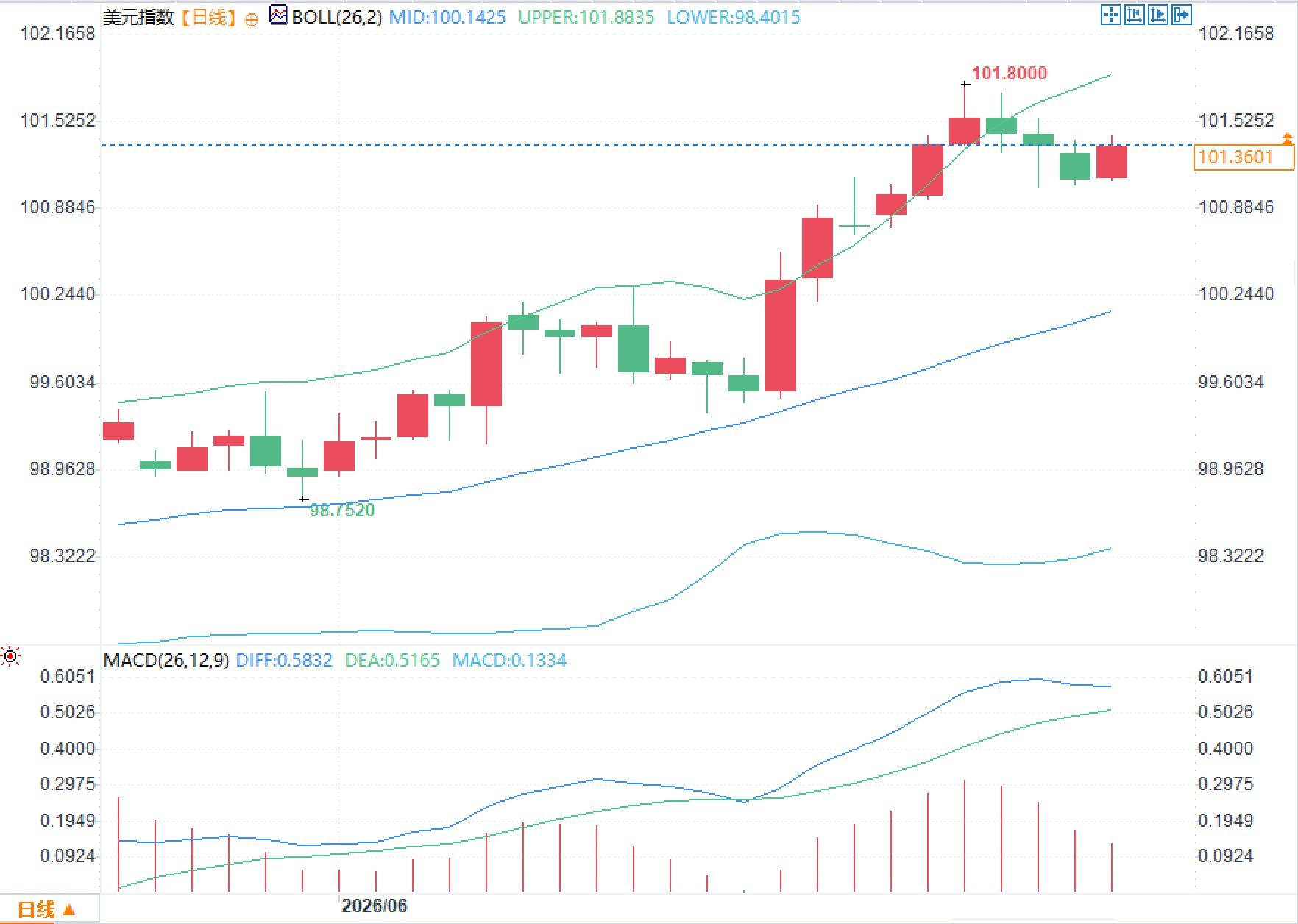
This is also why the short-term performance of the US dollar index is difficult to explain with a single logic. Strong data will boost expectations of interest rate hikes, which is usually good for the dollar, but may also suppress risk appetite and increase stock and bond volatility. Weak data will weaken the dollar's interest rate advantage, but may activate safe-haven demand. What truly determines the direction is not a single numerical value, but whether employment, wages, inflation, and the Fed's rhetoric all point to the same conclusion.
Question 1: Why has the US dollar index remained strong after oil prices fell?
A: Lower oil prices reduce the risk of a second wave of inflation, but PCE and CPI remain significantly above target, making it difficult for the Federal Reserve to quickly signal easing. As long as interest rate differential expectations persist, the US dollar will continue to be supported.
Question 2: What is the most crucial data this week?
A: The June non-farm payrolls report is key, but average hourly earnings and the unemployment rate are equally important. If employment slows while wages remain strong, the market may continue to bet on higher interest rates for longer.
Question 3: What are the main risks to the US dollar index?
A: The risk lies in Warsh's neutral remarks, coupled with a simultaneous slowdown in non-farm payrolls and wages, which would weaken expectations of an interest rate hike and trigger a concentrated correction in the dollar's bullish positions.
The current rebound in the US dollar index is not solely driven by safe-haven demand. More crucially, it's the repricing of short-term interest rate expectations, coupled with the weakening of heavyweight currencies like the euro and yen, keeping the index near its year-to-date high. On June 30th, the euro was trading around 1.139 against the dollar, and the dollar rose to around 162 against the yen, indicating strong structural support within the dollar index's basket.
Looking at asset correlations, the 10-year US Treasury yield is around 4.38%, while Brent crude oil has fallen back to around $73. The decline in oil prices has weakened the sustainability of the energy shock, but it hasn't immediately removed inflationary constraints, as service prices, wages, and core consumption continue to provide sticky support for policy rates. The US dollar is therefore in a delicate position; the decline in energy prices has reduced safe-haven premiums, but it has also extended the tolerable period of a high-interest-rate environment by easing growth pressures.
On June 17, the Federal Reserve maintained its target range for the federal funds rate at 3.50% to 3.75%, stating that economic activity continued to expand at a solid pace, inflation remained above the 2% target, and emphasizing that the Committee would pursue price stability. For foreign exchange traders, this was not just a routine policy statement, but rather a shift in the dollar's pricing focus from expectations of easing to inflationary constraints.
Kevin Warsh recently emphasized that high inflation is a burden on residents, and the Federal Reserve's commitment to price stability is clear. More importantly, with the new chairman downplaying forward guidance, the market can no longer rely on the central bank to pave the way in advance to smooth expectations. Data itself will have a more direct impact on the yield curve; non-farm payrolls, wages, job openings, manufacturing activity, and consumer confidence will all be incorporated into the same reaction function, making the dollar index more prone to rapid rises or falls.
The U.S. added 172,000 nonfarm jobs in May, with the unemployment rate remaining at 4.3% and the labor force participation rate at 61.8%. The significance of this data lies not only in the stronger-than-expected employment figures, but also in the fact that job growth has spread from a single industry to sectors such as leisure and hospitality, local government, and healthcare, indicating that the labor market has not yet entered a phase of significant slowdown.
The upcoming June non-farm payrolls report is expected to show an increase of approximately 107,000 to 110,000 jobs, with the unemployment rate likely to be around 4.3% to 4.4%. If job creation slows but wages remain around 3.5% year-on-year, the dollar may not weaken significantly, as wage stickiness will continue to limit the Federal Reserve's room for further easing. Conversely, if both employment and wages cool down simultaneously, the dollar index's high support level may loosen.
The US PCE price index rose 4.1% year-on-year in May, while the core PCE rose 3.4% year-on-year, both significantly higher than the 2% target. The CPI rose 4.2% year-on-year during the same period, with rising energy prices contributing significantly to overall inflation. Although oil prices have retreated from their previous highs, and Brent crude has returned to around $73, inflation data will not immediately reflect the full effect of the easing measures. Policymakers still need to observe the transmission path of inflation through services, housing, and wages.
This is also why the short-term performance of the US dollar index is difficult to explain with a single logic. Strong data will boost expectations of interest rate hikes, which is usually good for the dollar, but may also suppress risk appetite and increase stock and bond volatility. Weak data will weaken the dollar's interest rate advantage, but may activate safe-haven demand. What truly determines the direction is not a single numerical value, but whether employment, wages, inflation, and the Fed's rhetoric all point to the same conclusion.
Frequently Asked Questions
Question 1: Why has the US dollar index remained strong after oil prices fell?
A: Lower oil prices reduce the risk of a second wave of inflation, but PCE and CPI remain significantly above target, making it difficult for the Federal Reserve to quickly signal easing. As long as interest rate differential expectations persist, the US dollar will continue to be supported.
Question 2: What is the most crucial data this week?
A: The June non-farm payrolls report is key, but average hourly earnings and the unemployment rate are equally important. If employment slows while wages remain strong, the market may continue to bet on higher interest rates for longer.
Question 3: What are the main risks to the US dollar index?
A: The risk lies in Warsh's neutral remarks, coupled with a simultaneous slowdown in non-farm payrolls and wages, which would weaken expectations of an interest rate hike and trigger a concentrated correction in the dollar's bullish positions.
- Risk Warning and Disclaimer
- The market involves risk, and trading may not be suitable for all investors. This article is for reference only and does not constitute personal investment advice, nor does it take into account certain users’ specific investment objectives, financial situation, or other needs. Any investment decisions made based on this information are at your own risk.