Yen Analysis: Continued appreciation of the exchange rate reignites concerns about intervention.
2026-06-30 19:41:47
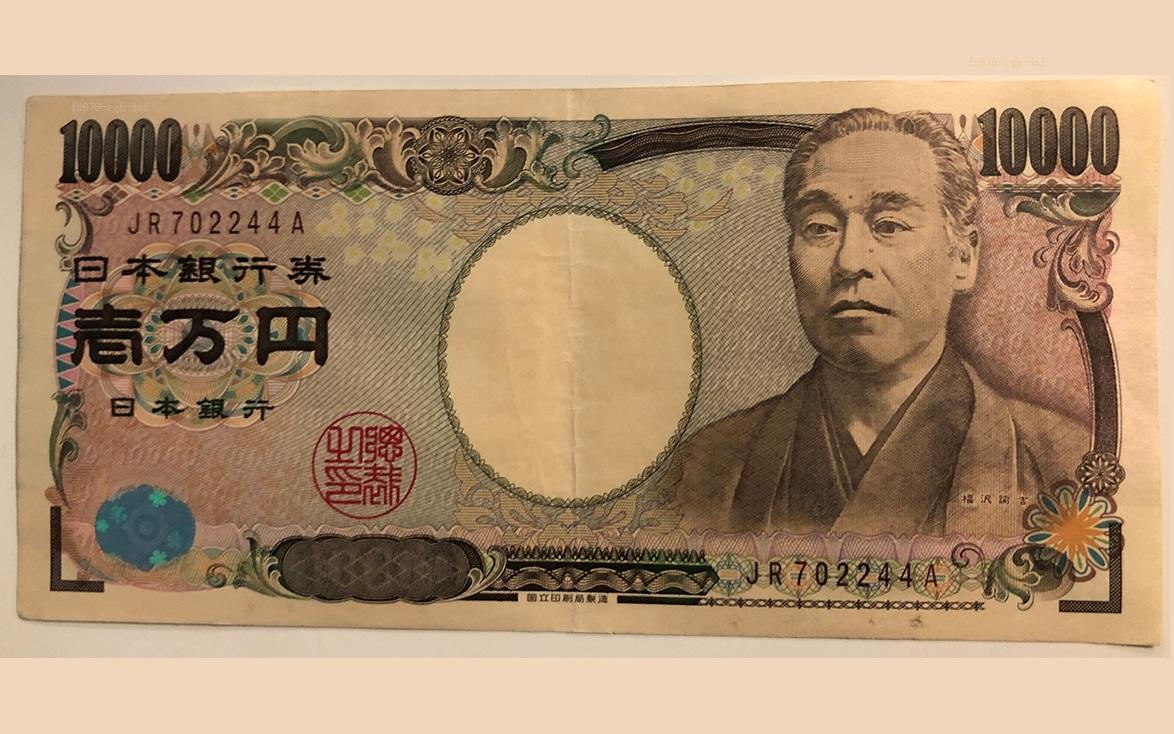
On Tuesday (June 30), during the European session, the USD/JPY pair continued its upward trend for the second consecutive day, with the exchange rate stabilizing around 162.30 after the European market opened. This level is close to the 40-year high reached recently.
The significant interest rate differential between the two major economies of the US and Japan continues to suppress the yen's performance: the Bank of Japan raised its policy rate to 1% in June, a new high since 1995; while the Federal Reserve maintained its benchmark interest rate in the range of 3.5% to 3.75%. The interest rate differential of nearly 250 basis points has kept yen carry trades running and has continued to push up the USD/JPY exchange rate.
Meanwhile, new dollar buying halted the dollar's decline that began from its May 2025 high. Increased geopolitical tensions between the US and Iran exacerbated market concerns about inflation, further raising expectations of a Federal Reserve rate hike; data from the CME Group's FedWatch tool showed that traders widely bet on a possible Fed rate hike this year, supporting the dollar and driving it higher against the yen.
Multiple positive fundamentals for the US dollar have significantly weakened market expectations for renewed intervention by Japanese authorities to support the yen. Chief Cabinet Secretary Minoru Kihara reiterated at a press conference today that the government is ready to take necessary measures to regulate the foreign exchange market at any time, and Finance Minister Satoshi Katayama added that measures will be introduced as needed based on exchange rate movements. Even the Bank of Japan's hawkish stance failed to boost confidence among yen bulls, and the upside potential for the USD/JPY exchange rate remains. The minutes of Japan's June policy meeting showed that participating officials focused on the persistently rising inflation risk, with some members calling for a faster pace of interest rate hikes to bring rates to the neutral range for the economy. While the current state of rising inflation in Japan provides a basis for the central bank's tightening policy, it is unlikely to reverse the yen's weakness.
The market's focus has shifted from "whether Japan will intervene in the foreign exchange market" to "when Japan will intervene again." Historical data shows that pre-emptive interventions have failed to narrow the US-Japan interest rate differential, providing only temporary support for the yen. Japan intervened twice, in late February and early May, but these interventions only provided short-term support for the yen. Once the market repriced in expectations of a Fed rate hike, the USD/JPY exchange rate resumed its upward trend. As long as US Treasury yields remain higher than Japanese government bond yields, carry trades driven by interest rate differentials will continue to put pressure on the yen.
The Federal Reserve’s interest rate meeting this month released a strong hawkish signal, coupled with the rise in US core PCE inflation to 3.4%, a three-year high. Current market pricing indicates a probability of about 60% for a 25 basis point rate hike in September, with expectations of up to three rate hikes this year.
Chris Turner, an analyst at ING Group, said the continued rise in the USD/JPY exchange rate has raised concerns that Japanese authorities may intervene in the foreign exchange market again. He recalled that in late April and early May, when the USD/JPY exchange rate began to break through the 160 level, the Bank of Japan sold approximately $70 billion in dollar assets. The 162 level is generally considered another key threshold (i.e., the highest exchange rate level in 2024), but Tokyo may choose to wait until Friday's US holiday, when market activity decreases, before taking intervention measures.
Meanwhile, the market has had time to react to Warsh's comments on Wednesday and the US jobs data released on Thursday. If a repeat of 2024 occurs, Tokyo may again hold off on taking action until just before the next Japanese public holiday. In that case, action would likely occur between July 16th and 17th, coinciding with Japan's Marine Day holiday. However, Japanese authorities should understand that any intervention can only slow, not reverse, the current upward trend of the dollar against the yen. A trend reversal would require not only a significant interest rate hike by the Bank of Japan, but also a change in the overall trajectory of the dollar—the latter of which will likely occur later this year, after the Federal Reserve's hawkish stance has ceased.
Several key data releases and speeches this week will guide the future trends of US Treasury bonds and the US dollar, thereby affecting the USD/JPY exchange rate: On Wednesday, Federal Reserve Chairman Kevin Walsh will deliver a speech at the European Central Bank's Sintra Forum, and on Thursday, the US non-farm payroll data will be released, both of which will release key signals about the outlook for US interest rates; prior to that, the US consumer confidence index and JOLTS job openings survey released on Tuesday will also be closely watched by the market.
Technical Analysis
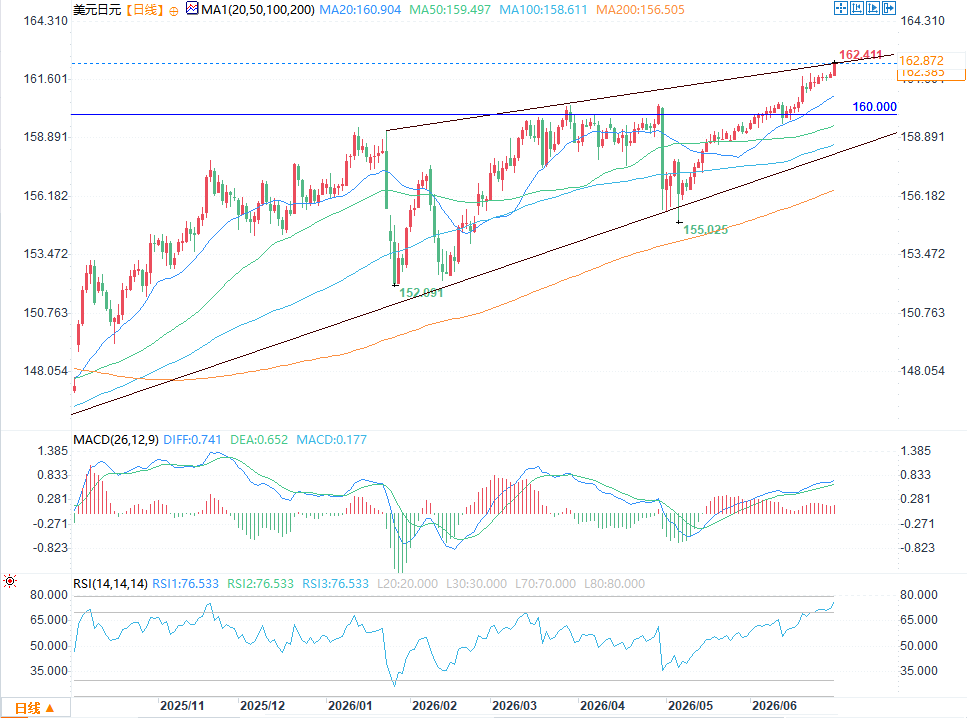
(USD/JPY daily chart source: FX678)
The USD/JPY pair broke through the upper trendline of an ascending wedge pattern on the daily chart, reaching a 40-year high of 162.40, completely invalidating the previously predicted reversal pattern.
The simultaneous entry of multi-period RSI indicators into the overbought zone suggests that the currency pair is likely to enter a period of consolidation before attempting to rise further.
The bulls' short-term upside target is 165, while the key medium- to long-term resistance level is 170.
The first short-term support level is 160.20, followed by the psychological level of 160.00. If this level is broken, the next support level is the 50-day moving average at 159.50, and below that, 157.90 is a strong support zone formed by the convergence of the upward trend line and the horizontal support.
The significant interest rate differential between the two major economies of the US and Japan continues to suppress the yen's performance: the Bank of Japan raised its policy rate to 1% in June, a new high since 1995; while the Federal Reserve maintained its benchmark interest rate in the range of 3.5% to 3.75%. The interest rate differential of nearly 250 basis points has kept yen carry trades running and has continued to push up the USD/JPY exchange rate.
Meanwhile, new dollar buying halted the dollar's decline that began from its May 2025 high. Increased geopolitical tensions between the US and Iran exacerbated market concerns about inflation, further raising expectations of a Federal Reserve rate hike; data from the CME Group's FedWatch tool showed that traders widely bet on a possible Fed rate hike this year, supporting the dollar and driving it higher against the yen.
Multiple positive fundamentals for the US dollar have significantly weakened market expectations for renewed intervention by Japanese authorities to support the yen. Chief Cabinet Secretary Minoru Kihara reiterated at a press conference today that the government is ready to take necessary measures to regulate the foreign exchange market at any time, and Finance Minister Satoshi Katayama added that measures will be introduced as needed based on exchange rate movements. Even the Bank of Japan's hawkish stance failed to boost confidence among yen bulls, and the upside potential for the USD/JPY exchange rate remains. The minutes of Japan's June policy meeting showed that participating officials focused on the persistently rising inflation risk, with some members calling for a faster pace of interest rate hikes to bring rates to the neutral range for the economy. While the current state of rising inflation in Japan provides a basis for the central bank's tightening policy, it is unlikely to reverse the yen's weakness.
The market's focus has shifted from "whether Japan will intervene in the foreign exchange market" to "when Japan will intervene again." Historical data shows that pre-emptive interventions have failed to narrow the US-Japan interest rate differential, providing only temporary support for the yen. Japan intervened twice, in late February and early May, but these interventions only provided short-term support for the yen. Once the market repriced in expectations of a Fed rate hike, the USD/JPY exchange rate resumed its upward trend. As long as US Treasury yields remain higher than Japanese government bond yields, carry trades driven by interest rate differentials will continue to put pressure on the yen.
The Federal Reserve’s interest rate meeting this month released a strong hawkish signal, coupled with the rise in US core PCE inflation to 3.4%, a three-year high. Current market pricing indicates a probability of about 60% for a 25 basis point rate hike in September, with expectations of up to three rate hikes this year.
Chris Turner, an analyst at ING Group, said the continued rise in the USD/JPY exchange rate has raised concerns that Japanese authorities may intervene in the foreign exchange market again. He recalled that in late April and early May, when the USD/JPY exchange rate began to break through the 160 level, the Bank of Japan sold approximately $70 billion in dollar assets. The 162 level is generally considered another key threshold (i.e., the highest exchange rate level in 2024), but Tokyo may choose to wait until Friday's US holiday, when market activity decreases, before taking intervention measures.
Meanwhile, the market has had time to react to Warsh's comments on Wednesday and the US jobs data released on Thursday. If a repeat of 2024 occurs, Tokyo may again hold off on taking action until just before the next Japanese public holiday. In that case, action would likely occur between July 16th and 17th, coinciding with Japan's Marine Day holiday. However, Japanese authorities should understand that any intervention can only slow, not reverse, the current upward trend of the dollar against the yen. A trend reversal would require not only a significant interest rate hike by the Bank of Japan, but also a change in the overall trajectory of the dollar—the latter of which will likely occur later this year, after the Federal Reserve's hawkish stance has ceased.
Several key data releases and speeches this week will guide the future trends of US Treasury bonds and the US dollar, thereby affecting the USD/JPY exchange rate: On Wednesday, Federal Reserve Chairman Kevin Walsh will deliver a speech at the European Central Bank's Sintra Forum, and on Thursday, the US non-farm payroll data will be released, both of which will release key signals about the outlook for US interest rates; prior to that, the US consumer confidence index and JOLTS job openings survey released on Tuesday will also be closely watched by the market.
Technical Analysis
(USD/JPY daily chart source: FX678)
The USD/JPY pair broke through the upper trendline of an ascending wedge pattern on the daily chart, reaching a 40-year high of 162.40, completely invalidating the previously predicted reversal pattern.
The simultaneous entry of multi-period RSI indicators into the overbought zone suggests that the currency pair is likely to enter a period of consolidation before attempting to rise further.
The bulls' short-term upside target is 165, while the key medium- to long-term resistance level is 170.
The first short-term support level is 160.20, followed by the psychological level of 160.00. If this level is broken, the next support level is the 50-day moving average at 159.50, and below that, 157.90 is a strong support zone formed by the convergence of the upward trend line and the horizontal support.
- Risk Warning and Disclaimer
- The market involves risk, and trading may not be suitable for all investors. This article is for reference only and does not constitute personal investment advice, nor does it take into account certain users’ specific investment objectives, financial situation, or other needs. Any investment decisions made based on this information are at your own risk.