Declining inflation and high interest rates coexist: Consumer confidence is "weak but not collapsing," and the dollar's volatile pattern is unlikely to break.
2026-07-01 10:23:27
On Wednesday (July 1) in early Asian trading, the US dollar index fluctuated higher and is currently trading around 101.30.
However, the consumer confidence data released overnight sent a weak signal that cannot be ignored.
Data released Tuesday by The Conference Board showed that its consumer confidence index fell to 91.2 from 93.1 in May, below market expectations of 94.2. This decline indicates that while consumer expectations for the business environment and personal income prospects have improved slightly, their assessment of the current economic situation has weakened.
In terms of sub-indices, the current situation index fell from 119.4 to 116.4, reflecting that consumers are becoming more cautious in their assessment of the current economic environment; the expectation index rose slightly from 71.4 to 74.4, but is still far below the 80 threshold associated with recession risk in historical experience.

The most noteworthy changes in this report come from the employment market dimension.
Dana Petersen, chief economist at The Conference Board, pointed out that while the drop in oil prices "has eased consumer concerns about inflation to some extent," the perception of the job market has "softened significantly."
The percentage of respondents who felt jobs were "difficult to obtain" rose to 22.5%, the highest level since January 2021. This data suggests that American households are becoming increasingly cautious about the current employment environment.
Although official employment data has not yet shown a significant deterioration, consumers' perception of the job market is often forward-looking—when people believe that jobs are becoming increasingly difficult to find, their spending behavior tends to be conservative.
Regarding inflation expectations, consumer concerns about future inflation eased further this month as the extension of the US-Iran ceasefire agreement led to a decline in energy prices. However, it is worth noting that the easing of inflation concerns did not simultaneously translate into interest rate expectations.
The survey shows that 61.5% of respondents still expect interest rates to continue to rise in the next 12 months. This high percentage reflects that consumers generally believe that the Federal Reserve's monetary policy is unlikely to change in the short term.
The coexistence of declining inflation expectations and high interest rate expectations explains, to some extent, why consumer confidence has failed to rebound more significantly—while falling energy prices have brought an immediate sense of relief to household spending, concerns about persistently high borrowing costs continue to suppress consumer spending.
Overall, the consumer confidence data for June presents a complex picture of "weakening current situation, slightly rising expectations, deteriorating employment perception, easing inflation concerns, and persistent interest rate anxiety."
This aligns with the current transition phase of the US economy—inflation is falling, but the resilience of the labor market is beginning to show signs of weakening, and the path of monetary policy remains unclear.
For the market, the deterioration of employment perception indicators is particularly noteworthy. If the perception of "jobs being hard to find" continues to rise and translates into a contraction in actual consumer spending, it could trigger the market to price in an economic slowdown ahead of time.
However, the slight rebound in the expectations index also indicates that consumers are not pessimistic about the outlook, and confidence remains in a state of "weak but not collapsed".
In the coming months, the actual performance of the job market and the policy signals from the Federal Reserve will be key variables in determining whether consumer confidence can stabilize.
According to the daily chart, the US dollar index started an upward trend from the April low of 97.62, reaching a high of 101.80. The moving average system is in a bullish alignment, with the price steadily trading above the 20-day, 50-day, 100-day, and 200-day moving averages. The medium- to long-term upward trend remains intact, with the 20-day moving average at 100.53 providing strong short-term support, and the medium-term moving averages continuing to rise providing further support.
In terms of indicators, the MACD maintains its red bars, and the DIFF (0.5595) is stable above the DEA (0.5228), indicating that the bullish momentum still exists. However, the height of the red bars has narrowed, and the upward momentum is weakening in the short term. The RSI value is 67.12, close to the 70 overbought threshold. It has not entered the extreme overbought zone, but the bullish strength has become sluggish, and there is a need for a short-term pullback to digest profit-taking.
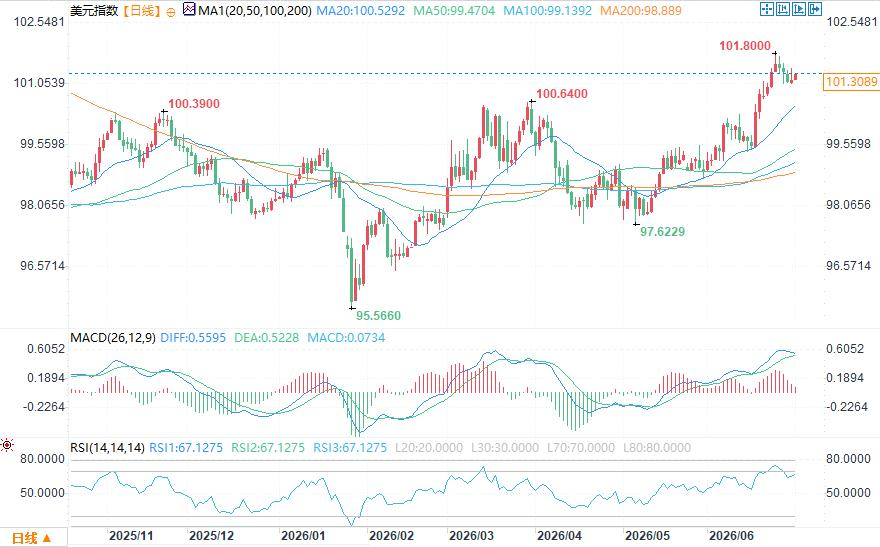
(US Dollar Index Daily Chart, Source: FX678)
At 10:23 AM Beijing time on July 1, the US dollar index was at 101.28.
However, the consumer confidence data released overnight sent a weak signal that cannot be ignored.
Data released Tuesday by The Conference Board showed that its consumer confidence index fell to 91.2 from 93.1 in May, below market expectations of 94.2. This decline indicates that while consumer expectations for the business environment and personal income prospects have improved slightly, their assessment of the current economic situation has weakened.
In terms of sub-indices, the current situation index fell from 119.4 to 116.4, reflecting that consumers are becoming more cautious in their assessment of the current economic environment; the expectation index rose slightly from 71.4 to 74.4, but is still far below the 80 threshold associated with recession risk in historical experience.
Perceived worsening of employment: Finding a job is becoming more difficult
The most noteworthy changes in this report come from the employment market dimension.
Dana Petersen, chief economist at The Conference Board, pointed out that while the drop in oil prices "has eased consumer concerns about inflation to some extent," the perception of the job market has "softened significantly."
The percentage of respondents who felt jobs were "difficult to obtain" rose to 22.5%, the highest level since January 2021. This data suggests that American households are becoming increasingly cautious about the current employment environment.
Although official employment data has not yet shown a significant deterioration, consumers' perception of the job market is often forward-looking—when people believe that jobs are becoming increasingly difficult to find, their spending behavior tends to be conservative.
Divergence between inflation and interest rate expectations
Regarding inflation expectations, consumer concerns about future inflation eased further this month as the extension of the US-Iran ceasefire agreement led to a decline in energy prices. However, it is worth noting that the easing of inflation concerns did not simultaneously translate into interest rate expectations.
The survey shows that 61.5% of respondents still expect interest rates to continue to rise in the next 12 months. This high percentage reflects that consumers generally believe that the Federal Reserve's monetary policy is unlikely to change in the short term.
The coexistence of declining inflation expectations and high interest rate expectations explains, to some extent, why consumer confidence has failed to rebound more significantly—while falling energy prices have brought an immediate sense of relief to household spending, concerns about persistently high borrowing costs continue to suppress consumer spending.
Data Meaning and Outlook
Overall, the consumer confidence data for June presents a complex picture of "weakening current situation, slightly rising expectations, deteriorating employment perception, easing inflation concerns, and persistent interest rate anxiety."
This aligns with the current transition phase of the US economy—inflation is falling, but the resilience of the labor market is beginning to show signs of weakening, and the path of monetary policy remains unclear.
For the market, the deterioration of employment perception indicators is particularly noteworthy. If the perception of "jobs being hard to find" continues to rise and translates into a contraction in actual consumer spending, it could trigger the market to price in an economic slowdown ahead of time.
However, the slight rebound in the expectations index also indicates that consumers are not pessimistic about the outlook, and confidence remains in a state of "weak but not collapsed".
In the coming months, the actual performance of the job market and the policy signals from the Federal Reserve will be key variables in determining whether consumer confidence can stabilize.
Technical Analysis
According to the daily chart, the US dollar index started an upward trend from the April low of 97.62, reaching a high of 101.80. The moving average system is in a bullish alignment, with the price steadily trading above the 20-day, 50-day, 100-day, and 200-day moving averages. The medium- to long-term upward trend remains intact, with the 20-day moving average at 100.53 providing strong short-term support, and the medium-term moving averages continuing to rise providing further support.
In terms of indicators, the MACD maintains its red bars, and the DIFF (0.5595) is stable above the DEA (0.5228), indicating that the bullish momentum still exists. However, the height of the red bars has narrowed, and the upward momentum is weakening in the short term. The RSI value is 67.12, close to the 70 overbought threshold. It has not entered the extreme overbought zone, but the bullish strength has become sluggish, and there is a need for a short-term pullback to digest profit-taking.
(US Dollar Index Daily Chart, Source: FX678)
At 10:23 AM Beijing time on July 1, the US dollar index was at 101.28.
- Risk Warning and Disclaimer
- The market involves risk, and trading may not be suitable for all investors. This article is for reference only and does not constitute personal investment advice, nor does it take into account certain users’ specific investment objectives, financial situation, or other needs. Any investment decisions made based on this information are at your own risk.