After the yen fell below a 40-year low, Japanese officials issued verbal warnings of escalation, but Mitsubishi UFJ said "one step away."
2026-07-01 11:09:25
On Wednesday (July 1) in early Asian trading, the US dollar continued its upward trend against the Japanese yen, currently trading around 162.75.
On Tuesday, after the dollar hit a 40-year high against the yen, Japanese officials issued another strong verbal warning.
However, Mitsubishi UFJ believes that, based on historical experience, the current statements are not sufficient to constitute a sufficient condition for actual intervention—the Federal Reserve's policies are the fundamental driver of the dollar's strength, and unilateral actions by Japan are unlikely to reverse the trend.

The US dollar continued its upward trend against the Japanese yen, hitting a new high since 1986 yesterday. This movement has quickly triggered a new round of concerns at the Japanese policy level.
Japanese Finance Minister Kadaya said on Tuesday that Japan will respond appropriately to exchange rate fluctuations at any time, adding that Tokyo has confirmed with Washington that bold action remains an option, and that everything comes down to taking the right exchange rate measures when necessary. Chief Cabinet Secretary Minoru Kihara also expressed a similar view, stating that Japan will take appropriate action on foreign exchange if necessary.
The two officials issued strong statements on the same day, sending a clear signal to the market that the Japanese government is uneasy about the current level of the yen exchange rate and does not rule out the possibility of taking substantive intervention measures.
In a research report released on Tuesday, Mitsubishi UFJ Financial Group pointed out that the above statement continues to signal that Japan is prepared to intervene again to support the yen, but in terms of the strength of the wording, it has not yet reached the level of tone and intensity that preceded actual intervention in the past.
The bank's analysis suggests that Japanese officials' language remains at the level of "being ready" rather than "about to take action." This subtle difference in wording is crucial for assessing the probability of short-term intervention. Looking back at the record intervention in late April and early May of this year, the Japanese authorities' statements before the action were more direct and urgent.
Mitsubishi UFJ emphasized that the current verbal warnings have had an effect in at least two ways: first, they have helped slow the pace of the yen's depreciation; and second, they have conveyed the Japanese government's bottom-line mentality to the market. However, there is insufficient evidence to bet that the Bank of Japan or the Ministry of Finance will actually intervene in the short term.
Mitsubishi UFJ Financial Group pointed out the fundamental difficulties facing Japan's intervention: the Federal Reserve's hawkish policy shift has simultaneously pushed up US Treasury yields and the dollar exchange rate, creating an insurmountable backdrop for Japan's efforts to combat the dollar's rise against the yen.
The bank cited the record intervention in late April and early May of this year as an example—when Japanese authorities injected a record amount of money to buy yen, but the effect was only a temporary boost to the yen's exchange rate, after which the broader trend of yen depreciation resumed. This experience shows that in a macroeconomic environment where the US-Japan interest rate differential continues to widen, unilateral intervention cannot change the direction of the trend.
In other words, the root cause of the yen's weakness lies not in Japan, but in the United States. As long as the Federal Reserve maintains its high interest rate stance, any intervention by Japan's Ministry of Finance will simply be "going against the current."
Mitsubishi UFJ Financial Group also specifically pointed out that the recent weakness of the yen is mainly concentrated in the USD/JPY currency pair, while other yen cross rates have remained relatively stable. This structural characteristic reinforces the judgment that the current market trend is essentially due to the strengthening of the US dollar, rather than a loss of market confidence in the yen itself.
This observation is important for assessing the potential strength of the Japanese government's response. A broad-based sell-off of the yen—meaning simultaneous weakening against all major currencies—would point to deeper problems, putting much greater pressure on Tokyo to react. However, the current "dollar-dominated" nature of the situation means that Japanese authorities have greater leeway, as long as the depreciation is gradual rather than disorderly.
In summary, MUFG believes that Japan may show greater tolerance for a weaker yen in the short term, provided that the depreciation is gradual and orderly.
The bank expects that the tough stance of Japanese officials will help slow the pace of the yen's depreciation, at least in the short term, but this will not be enough to completely stop the trend from continuing.
For the market, the key variable is not in Tokyo, but in Washington. The Federal Reserve's policy path, the performance of US economic data, and the market's adjustment of expectations regarding the timing of interest rate cuts are the core drivers determining the medium-term direction of the USD/JPY exchange rate. While the risk of intervention by the Japanese authorities cannot be ignored, viewing it as a signal of a trend reversal rather than a short-term "speed bump" may overestimate the effectiveness of unilateral intervention.
According to the daily chart, the USD/JPY pair maintains a long-term bullish trend, with the price currently experiencing a slight pullback after reaching a new high of 162.77. The moving average system is in a complete bullish alignment, with the price firmly above the MA20, MA50, MA100, and MA200, indicating a healthy medium- to long-term uptrend. The short-term MA20 (161.042) forms the first key support level, while the medium-term moving averages continue to support the bullish trend.
In terms of indicators, the MACD maintains a red bar, and the DIFF (0.793) continues to be above the DEA (0.682), indicating that the bullish momentum still exists, but the increase in the red bar is limited, and the upward momentum has slowed down. The RSI reached 78.08, approaching the overbought critical range of 80, indicating obvious signs of overheating of the bulls, and there is pressure for a short-term pullback to digest profit-taking.
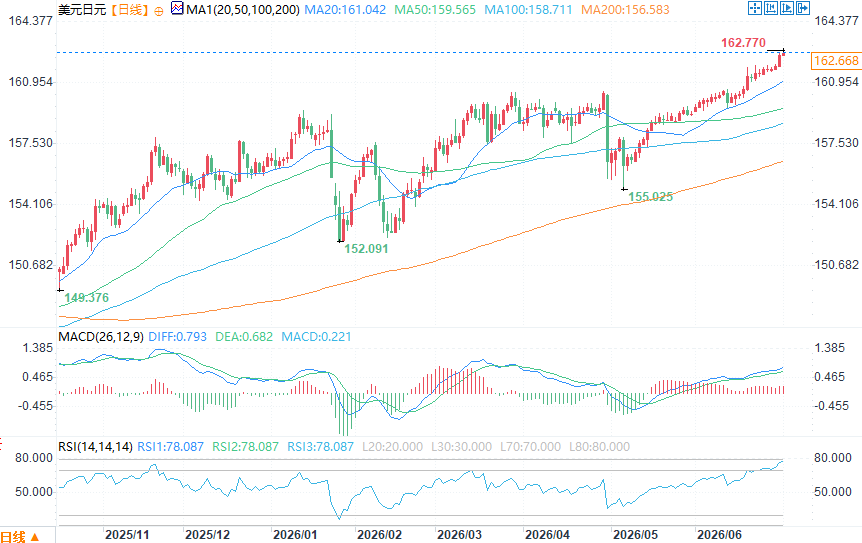
(USD/JPY daily chart, source: FX678)
At 11:09 Beijing time on July 1, the USD/JPY exchange rate was 162.73/74.
On Tuesday, after the dollar hit a 40-year high against the yen, Japanese officials issued another strong verbal warning.
However, Mitsubishi UFJ believes that, based on historical experience, the current statements are not sufficient to constitute a sufficient condition for actual intervention—the Federal Reserve's policies are the fundamental driver of the dollar's strength, and unilateral actions by Japan are unlikely to reverse the trend.
The dollar broke through previous highs against the yen as Japanese officials issued escalating verbal warnings.
The US dollar continued its upward trend against the Japanese yen, hitting a new high since 1986 yesterday. This movement has quickly triggered a new round of concerns at the Japanese policy level.
Japanese Finance Minister Kadaya said on Tuesday that Japan will respond appropriately to exchange rate fluctuations at any time, adding that Tokyo has confirmed with Washington that bold action remains an option, and that everything comes down to taking the right exchange rate measures when necessary. Chief Cabinet Secretary Minoru Kihara also expressed a similar view, stating that Japan will take appropriate action on foreign exchange if necessary.
The two officials issued strong statements on the same day, sending a clear signal to the market that the Japanese government is uneasy about the current level of the yen exchange rate and does not rule out the possibility of taking substantive intervention measures.
Mitsubishi UFJ: The wording has not yet reached the historical intervention threshold.
In a research report released on Tuesday, Mitsubishi UFJ Financial Group pointed out that the above statement continues to signal that Japan is prepared to intervene again to support the yen, but in terms of the strength of the wording, it has not yet reached the level of tone and intensity that preceded actual intervention in the past.
The bank's analysis suggests that Japanese officials' language remains at the level of "being ready" rather than "about to take action." This subtle difference in wording is crucial for assessing the probability of short-term intervention. Looking back at the record intervention in late April and early May of this year, the Japanese authorities' statements before the action were more direct and urgent.
Mitsubishi UFJ emphasized that the current verbal warnings have had an effect in at least two ways: first, they have helped slow the pace of the yen's depreciation; and second, they have conveyed the Japanese government's bottom-line mentality to the market. However, there is insufficient evidence to bet that the Bank of Japan or the Ministry of Finance will actually intervene in the short term.
The core contradiction: Federal Reserve policy is the fundamental driver.
Mitsubishi UFJ Financial Group pointed out the fundamental difficulties facing Japan's intervention: the Federal Reserve's hawkish policy shift has simultaneously pushed up US Treasury yields and the dollar exchange rate, creating an insurmountable backdrop for Japan's efforts to combat the dollar's rise against the yen.
The bank cited the record intervention in late April and early May of this year as an example—when Japanese authorities injected a record amount of money to buy yen, but the effect was only a temporary boost to the yen's exchange rate, after which the broader trend of yen depreciation resumed. This experience shows that in a macroeconomic environment where the US-Japan interest rate differential continues to widen, unilateral intervention cannot change the direction of the trend.
In other words, the root cause of the yen's weakness lies not in Japan, but in the United States. As long as the Federal Reserve maintains its high interest rate stance, any intervention by Japan's Ministry of Finance will simply be "going against the current."
Key observation: Weakness is concentrated in USD/JPY, rather than a broad-based yen sell-off.
Mitsubishi UFJ Financial Group also specifically pointed out that the recent weakness of the yen is mainly concentrated in the USD/JPY currency pair, while other yen cross rates have remained relatively stable. This structural characteristic reinforces the judgment that the current market trend is essentially due to the strengthening of the US dollar, rather than a loss of market confidence in the yen itself.
This observation is important for assessing the potential strength of the Japanese government's response. A broad-based sell-off of the yen—meaning simultaneous weakening against all major currencies—would point to deeper problems, putting much greater pressure on Tokyo to react. However, the current "dollar-dominated" nature of the situation means that Japanese authorities have greater leeway, as long as the depreciation is gradual rather than disorderly.
Market Outlook: Verbal warnings may slow the pace, but they are unlikely to change the overall trend.
In summary, MUFG believes that Japan may show greater tolerance for a weaker yen in the short term, provided that the depreciation is gradual and orderly.
The bank expects that the tough stance of Japanese officials will help slow the pace of the yen's depreciation, at least in the short term, but this will not be enough to completely stop the trend from continuing.
For the market, the key variable is not in Tokyo, but in Washington. The Federal Reserve's policy path, the performance of US economic data, and the market's adjustment of expectations regarding the timing of interest rate cuts are the core drivers determining the medium-term direction of the USD/JPY exchange rate. While the risk of intervention by the Japanese authorities cannot be ignored, viewing it as a signal of a trend reversal rather than a short-term "speed bump" may overestimate the effectiveness of unilateral intervention.
Technical Analysis
According to the daily chart, the USD/JPY pair maintains a long-term bullish trend, with the price currently experiencing a slight pullback after reaching a new high of 162.77. The moving average system is in a complete bullish alignment, with the price firmly above the MA20, MA50, MA100, and MA200, indicating a healthy medium- to long-term uptrend. The short-term MA20 (161.042) forms the first key support level, while the medium-term moving averages continue to support the bullish trend.
In terms of indicators, the MACD maintains a red bar, and the DIFF (0.793) continues to be above the DEA (0.682), indicating that the bullish momentum still exists, but the increase in the red bar is limited, and the upward momentum has slowed down. The RSI reached 78.08, approaching the overbought critical range of 80, indicating obvious signs of overheating of the bulls, and there is pressure for a short-term pullback to digest profit-taking.
(USD/JPY daily chart, source: FX678)
At 11:09 Beijing time on July 1, the USD/JPY exchange rate was 162.73/74.
- Risk Warning and Disclaimer
- The market involves risk, and trading may not be suitable for all investors. This article is for reference only and does not constitute personal investment advice, nor does it take into account certain users’ specific investment objectives, financial situation, or other needs. Any investment decisions made based on this information are at your own risk.