A sudden cooling of European inflation reveals deeper divergence behind the euro/dollar exchange rate of 1.139.
2026-07-01 17:56:37
On Wednesday, July 1st, Eurozone inflation cooled more than expected in June, with consumer prices rising 2.8% year-on-year, lower than the previous reading of 3.2% and also below the market's median forecast of around 3%. Core inflation, excluding volatile items such as food and energy, also declined, while services inflation fell to 3.2%. This data weakens the need for aggressive tightening by the European Central Bank, but it does not completely eliminate the pricing in another interest rate hike this year, as energy price volatility, wage transmission, and service sector stickiness remain major constraints on policy.
The core implication of the decline in Eurozone inflation in June is not that the European Central Bank (ECB) can quickly shift to easing, but rather that the market's pricing in an extreme tightening path has cooled. While the overall inflation rate fell from 3.2% to 2.8%, superficially indicating a significant easing of price pressures, the ECB is more concerned with the structure of inflation than with changes in the monthly aggregate index.
A drop in services inflation to 3.2% is crucial. Service prices are typically linked to wages, rents, and cost pass-throughs for businesses, and their decline is slower than that of energy and commodity prices. If services continue to fall, the division within the European Central Bank regarding further interest rate hikes will widen; however, if previous volatility in energy prices continues to be transmitted to food and services, the decline in inflation may only be a temporary phenomenon.
European Central Bank (ECB) Chief Economist Philip Lane recently stated that it is crucial to observe how rising energy costs in recent months further transmit to food and service inflation. This statement implies that the ECB will not solely rely on a single month's decline in inflation to determine a policy turning point, but will continue to assess the risks of a second round of transmission. For the currency market, lower-than-expected monthly inflation will suppress the short-term euro interest rate premium, but it will not directly lead to a one-way pricing of the euro.
The money market still sees a greater than 50% probability of a 25 basis point rate hike by the European Central Bank before September, and a full rate hike this year is almost priced in. This pricing itself is not negative for the euro, as it indicates that the ECB's policy rate remains on a tight track. The problem is that the market has already priced in further rate hikes, and new upward momentum for the euro needs to come from stronger inflation stickiness or more hawkish policy signals.
Following the data release, the yield on German 10-year government bonds gave back some of its gains, hovering around 2.88%, down from its previous high of 2.90%. This indicates that the bond market has not completely abandoned expectations of tightening, but has moderated its bets on a more aggressive path. For the euro against the dollar, the interest rate differential is not an isolated variable, but rather works in conjunction with risk sentiment, energy costs, and capital flows.
Bundesbank President Joachim Nagel recently stated that while the drop in oil prices was unexpected, the evolution of the Middle East situation remains to be seen, and that policy options will remain available at the July and September meetings. The key point of such statements is "not pre-setting a path." Given lower-than-expected inflation and lingering geopolitical risks, the European Central Bank is more likely to maintain a data-driven approach rather than providing a clear direction in advance.
The current euro/dollar exchange rate is not simply a matter of "cooling inflation equals a weaker euro." Two factors truly influence the price: first, whether cooling inflation is sufficient to lower expectations of a European Central Bank interest rate hike; and second, whether there is sufficiently strong interest rate or safe-haven support on the dollar side.
From the chart, the euro/dollar pair has broken below the Bollinger Band's middle band and underwent a correction near the lower band. The lower band around 1.1321 is close to the previous low of 1.1324, indicating that the market had already tested the lower boundary of the trading range. After returning to around 1.1390, the price remains below the middle band, suggesting that the rebound is more of a correction after the decline than a confirmation of a trend reversal.
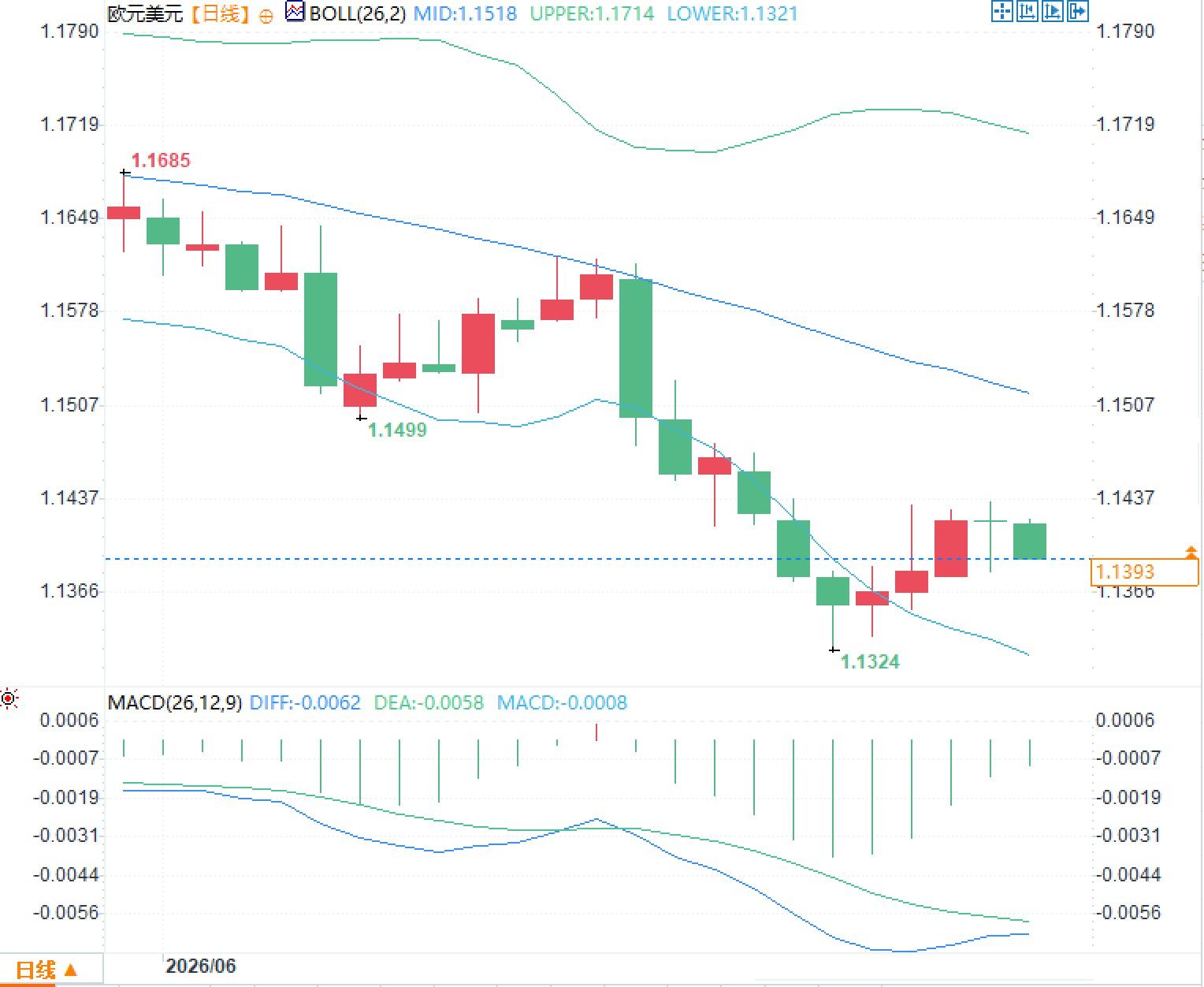
The MACD remains below the zero line, with the DIFF line below the DEA line. While the negative histogram isn't extremely widening, a clear momentum reversal hasn't yet formed. This structure suggests that market pricing remains cautious, and short-term rebounds, lacking support from interest rate expectations or risk sentiment, are likely to be suppressed by the middle band area. In other words, whether the euro can escape its weakness in the short term depends not on a single inflation data point, but on whether the European Central Bank continues to maintain sufficiently strong policy constraints and whether dollar liquidity pricing cools down in tandem.
This decline in inflation is related to the drop in global oil prices following the easing of tensions in the Middle East. Energy prices have a dual impact on the Eurozone: on the one hand, lower oil and gas prices help suppress imported inflation, improving real income for residents and reducing cost pressures on businesses; on the other hand, declining energy prices also reduce the urgency for the European Central Bank to continue raising interest rates, thus lowering interest rate support for the euro.
This explains the current complexity in the pricing of the euro against the dollar. A decline in energy prices provides a buffer for the real economy, but may not directly benefit the exchange rate. If energy prices remain stable, inflation expectations may fall further, and the ECB's pricing for interest rate hikes this year will be re-compressed; if energy prices fluctuate again, inflation risks will rise again, and the ECB may maintain higher interest rates for a longer period, but this will also increase economic pressure.
Therefore, the euro's medium-term performance depends not only on whether inflation falls short of expectations, but also on the quality of the inflation decline. If the decline is primarily driven by energy prices, while service inflation and wage pressures remain resilient, the ECB will find it difficult to quickly release dovish signals. Only if core and service inflation weaken simultaneously will the euro's interest rate support truly diminish.
The cooling of inflation has changed the pace, not the policy constraints.
The core implication of the decline in Eurozone inflation in June is not that the European Central Bank (ECB) can quickly shift to easing, but rather that the market's pricing in an extreme tightening path has cooled. While the overall inflation rate fell from 3.2% to 2.8%, superficially indicating a significant easing of price pressures, the ECB is more concerned with the structure of inflation than with changes in the monthly aggregate index.
A drop in services inflation to 3.2% is crucial. Service prices are typically linked to wages, rents, and cost pass-throughs for businesses, and their decline is slower than that of energy and commodity prices. If services continue to fall, the division within the European Central Bank regarding further interest rate hikes will widen; however, if previous volatility in energy prices continues to be transmitted to food and services, the decline in inflation may only be a temporary phenomenon.
European Central Bank (ECB) Chief Economist Philip Lane recently stated that it is crucial to observe how rising energy costs in recent months further transmit to food and service inflation. This statement implies that the ECB will not solely rely on a single month's decline in inflation to determine a policy turning point, but will continue to assess the risks of a second round of transmission. For the currency market, lower-than-expected monthly inflation will suppress the short-term euro interest rate premium, but it will not directly lead to a one-way pricing of the euro.
Interest rate expectations continue to support the euro, but the marginal strength is weakening.
The money market still sees a greater than 50% probability of a 25 basis point rate hike by the European Central Bank before September, and a full rate hike this year is almost priced in. This pricing itself is not negative for the euro, as it indicates that the ECB's policy rate remains on a tight track. The problem is that the market has already priced in further rate hikes, and new upward momentum for the euro needs to come from stronger inflation stickiness or more hawkish policy signals.
Following the data release, the yield on German 10-year government bonds gave back some of its gains, hovering around 2.88%, down from its previous high of 2.90%. This indicates that the bond market has not completely abandoned expectations of tightening, but has moderated its bets on a more aggressive path. For the euro against the dollar, the interest rate differential is not an isolated variable, but rather works in conjunction with risk sentiment, energy costs, and capital flows.
Bundesbank President Joachim Nagel recently stated that while the drop in oil prices was unexpected, the evolution of the Middle East situation remains to be seen, and that policy options will remain available at the July and September meetings. The key point of such statements is "not pre-setting a path." Given lower-than-expected inflation and lingering geopolitical risks, the European Central Bank is more likely to maintain a data-driven approach rather than providing a clear direction in advance.
The key dilemma for the euro against the dollar has shifted to "declining inflation versus policy resilience".
The current euro/dollar exchange rate is not simply a matter of "cooling inflation equals a weaker euro." Two factors truly influence the price: first, whether cooling inflation is sufficient to lower expectations of a European Central Bank interest rate hike; and second, whether there is sufficiently strong interest rate or safe-haven support on the dollar side.
From the chart, the euro/dollar pair has broken below the Bollinger Band's middle band and underwent a correction near the lower band. The lower band around 1.1321 is close to the previous low of 1.1324, indicating that the market had already tested the lower boundary of the trading range. After returning to around 1.1390, the price remains below the middle band, suggesting that the rebound is more of a correction after the decline than a confirmation of a trend reversal.
The MACD remains below the zero line, with the DIFF line below the DEA line. While the negative histogram isn't extremely widening, a clear momentum reversal hasn't yet formed. This structure suggests that market pricing remains cautious, and short-term rebounds, lacking support from interest rate expectations or risk sentiment, are likely to be suppressed by the middle band area. In other words, whether the euro can escape its weakness in the short term depends not on a single inflation data point, but on whether the European Central Bank continues to maintain sufficiently strong policy constraints and whether dollar liquidity pricing cools down in tandem.
Energy prices remain a latent variable for euro assets.
This decline in inflation is related to the drop in global oil prices following the easing of tensions in the Middle East. Energy prices have a dual impact on the Eurozone: on the one hand, lower oil and gas prices help suppress imported inflation, improving real income for residents and reducing cost pressures on businesses; on the other hand, declining energy prices also reduce the urgency for the European Central Bank to continue raising interest rates, thus lowering interest rate support for the euro.
This explains the current complexity in the pricing of the euro against the dollar. A decline in energy prices provides a buffer for the real economy, but may not directly benefit the exchange rate. If energy prices remain stable, inflation expectations may fall further, and the ECB's pricing for interest rate hikes this year will be re-compressed; if energy prices fluctuate again, inflation risks will rise again, and the ECB may maintain higher interest rates for a longer period, but this will also increase economic pressure.
Therefore, the euro's medium-term performance depends not only on whether inflation falls short of expectations, but also on the quality of the inflation decline. If the decline is primarily driven by energy prices, while service inflation and wage pressures remain resilient, the ECB will find it difficult to quickly release dovish signals. Only if core and service inflation weaken simultaneously will the euro's interest rate support truly diminish.
- Risk Warning and Disclaimer
- The market involves risk, and trading may not be suitable for all investors. This article is for reference only and does not constitute personal investment advice, nor does it take into account certain users’ specific investment objectives, financial situation, or other needs. Any investment decisions made based on this information are at your own risk.