Geopolitical risks in the Middle East have eased significantly, and US crude oil has fallen below the $70 mark.
2026-07-02 00:10:21
On Wednesday (July 1st) during the US trading session, both major benchmark crude oil prices closed lower, with the declines being synchronized: West Texas Intermediate (WTI) crude oil fell by 2.82% intraday; Brent crude oil also weakened, with its intraday decline widening to 3.00%. The rapid fading of geopolitical conflict premiums was the core driving factor behind this round of collective declines in international crude oil prices. Previously, safe-haven buying driven by localized military confrontations in the Middle East was largely withdrawn, and funds rapidly flowed out of the crude oil commodity market, directly suppressing the prices of the two major crude oil benchmarks and causing them to fall below key psychological levels.

Currently, there is a clear portfolio rebalancing activity in global crude oil trading. Institutional investors are gradually reducing their long positions in crude oil, and speculative funds that previously bet on the continued deterioration of the Middle East situation are taking profits and leaving the market. The market's supply and demand pricing logic has returned to the level of global macroeconomic demand, crude oil inventories, and oil-producing countries' supply. The premium effect brought about by geopolitical risks has been almost completely digested.
In-depth technical analysis of WTI crude oil
West Texas Intermediate crude oil prices have continued to trade below the $70 mark. $70 is a widely recognized psychological price level and a key point that global traders, energy agencies, and commodity quantitative trading systems closely monitor. Whether this price level is breached or breached directly affects overall market sentiment.
Looking back at the complete price cycle of crude oil, after the outbreak of conflict in the Middle East, the crude oil market opened sharply higher, forming a significant upward price gap. The market initially experienced a strong upward trend driven by safe-haven demand, accumulating ample profit-taking. As the conflict in the Middle East eased and ceasefire negotiations made substantial progress, the safe-haven logic completely collapsed, and crude oil prices began a sustained correction. Currently, prices have fallen back to the midpoint of the gap from that period, essentially erasing all the gains brought about by the previous geopolitical conflict, completing a full cycle of rise and fall.
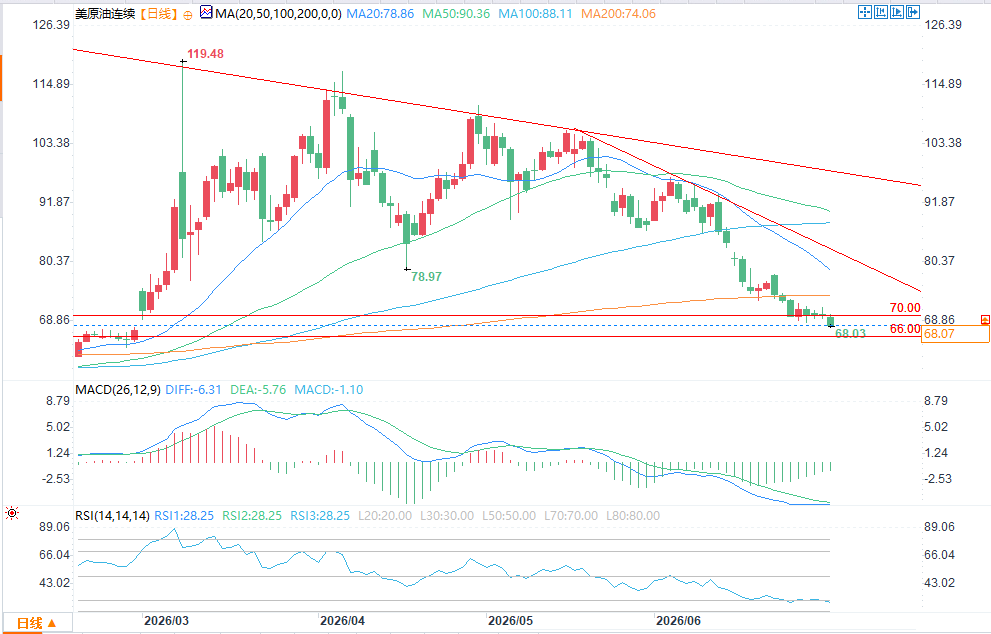
(WTI crude oil daily chart source: FX678)
Judging from the medium- to long-term trend, the market is gradually forming a seasonal fluctuation range for summer. The energy market in summer has unique supply and demand patterns. The peak summer travel season in the Northern Hemisphere will increase refined oil consumption, but the slowdown in global industrial recovery will constrain overall crude oil demand. These two forces, bullish and bearish, are mutually restraining, making a range-bound market highly likely. Technically, the 200-day exponential moving average (EMA) is around $78.75. This moving average is a core indicator for judging the strength of the medium- to long-term trend of crude oil and will also become a strong resistance level at the upper end of this fluctuation range.
Considering various technical indicators and seasonal patterns, buying on dips remains a viable trading strategy for the current crude oil market, but the upside potential in the short term should not be overestimated. Currently, there is significant divergence between bullish and bearish sentiment in the crude oil market. Various macroeconomic news, oil-producing country policies, and US crude oil inventory data can all trigger sharp short-term fluctuations. The market's high volatility is expected to persist for a long time, and sustained one-sided trends are unlikely. Trading requires strict position control to avoid losses from disorderly fluctuations.
In-depth technical analysis of Brent crude oil
Brent crude oil also tested the key support level of $70. The upward gap created by previous geopolitical conflicts has been completely filled, rendering the gap support effect ineffective. The market is currently forming a bottom, with the rate of price decline slowing significantly. Short-selling momentum is weakening, and trading volume is shrinking during the decline, indicating a substantial reduction in aggressive selling at lower levels. The market currently lacks clear one-sided trading signals, so there's no need to rush into buying crude oil at the bottom. Based on the current price range around $70, crude oil is likely to experience a phase of rebound, but the timing of this rebound is highly uncertain. A market reversal could occur within a few trading days, or it could involve several weeks of sideways consolidation before starting to rise; there is no precise time prediction.
Brent crude oil is currently in a neutral-to-fluctuating pattern, with market pricing gradually digesting expectations of a de-escalation of tensions in the Middle East and regional conflicts. However, the Middle East geopolitical situation remains highly unpredictable. Sectarian conflicts, territorial disputes, and armed factional clashes within the region have not been completely eliminated. Even small-scale localized military skirmishes could trigger safe-haven buying, rapidly pushing up oil prices. Geopolitical risks remain a potential variable for price increases in the oil market. If the Middle East can maintain peace and stability in the long term and avoid large-scale military conflicts, oil prices will likely confirm a bottom within the current low range. Historically, summer is typically a period of range-bound trading for crude oil. Seasonal increases in refined oil consumption and weak global manufacturing demand offset each other, making it difficult for prices to break out of a sustained unilateral trend. The market is expected to maintain a range-bound trading pattern for the foreseeable future. Currently, the oil market is in a crucial stage of bottom confirmation and building a summer trading range.
Macroeconomic and Trading Supplementary Tips
With the geopolitical logic receding, the pricing focus of the crude oil market has returned to multiple fundamental data points, requiring investors to continuously monitor market information from multiple dimensions. On one hand, it's crucial to pay close attention to the implementation of production cuts by OPEC+ oil-producing countries. If these countries continue to fulfill their production quotas, it will provide long-term price support from the supply side. On the other hand, weekly US crude oil and refined product inventory data, global major economy manufacturing PMI indices, and fluctuations in the US dollar index will continue to influence short-term crude oil price movements. A stronger dollar will suppress dollar-denominated crude oil prices, while a decline in global manufacturing activity will weaken industrial crude oil consumption demand. These multiple macroeconomic variables will continue to exacerbate crude oil price volatility.
Currently, there is a clear portfolio rebalancing activity in global crude oil trading. Institutional investors are gradually reducing their long positions in crude oil, and speculative funds that previously bet on the continued deterioration of the Middle East situation are taking profits and leaving the market. The market's supply and demand pricing logic has returned to the level of global macroeconomic demand, crude oil inventories, and oil-producing countries' supply. The premium effect brought about by geopolitical risks has been almost completely digested.
In-depth technical analysis of WTI crude oil
West Texas Intermediate crude oil prices have continued to trade below the $70 mark. $70 is a widely recognized psychological price level and a key point that global traders, energy agencies, and commodity quantitative trading systems closely monitor. Whether this price level is breached or breached directly affects overall market sentiment.
Looking back at the complete price cycle of crude oil, after the outbreak of conflict in the Middle East, the crude oil market opened sharply higher, forming a significant upward price gap. The market initially experienced a strong upward trend driven by safe-haven demand, accumulating ample profit-taking. As the conflict in the Middle East eased and ceasefire negotiations made substantial progress, the safe-haven logic completely collapsed, and crude oil prices began a sustained correction. Currently, prices have fallen back to the midpoint of the gap from that period, essentially erasing all the gains brought about by the previous geopolitical conflict, completing a full cycle of rise and fall.
(WTI crude oil daily chart source: FX678)
Judging from the medium- to long-term trend, the market is gradually forming a seasonal fluctuation range for summer. The energy market in summer has unique supply and demand patterns. The peak summer travel season in the Northern Hemisphere will increase refined oil consumption, but the slowdown in global industrial recovery will constrain overall crude oil demand. These two forces, bullish and bearish, are mutually restraining, making a range-bound market highly likely. Technically, the 200-day exponential moving average (EMA) is around $78.75. This moving average is a core indicator for judging the strength of the medium- to long-term trend of crude oil and will also become a strong resistance level at the upper end of this fluctuation range.
Considering various technical indicators and seasonal patterns, buying on dips remains a viable trading strategy for the current crude oil market, but the upside potential in the short term should not be overestimated. Currently, there is significant divergence between bullish and bearish sentiment in the crude oil market. Various macroeconomic news, oil-producing country policies, and US crude oil inventory data can all trigger sharp short-term fluctuations. The market's high volatility is expected to persist for a long time, and sustained one-sided trends are unlikely. Trading requires strict position control to avoid losses from disorderly fluctuations.
In-depth technical analysis of Brent crude oil
Brent crude oil also tested the key support level of $70. The upward gap created by previous geopolitical conflicts has been completely filled, rendering the gap support effect ineffective. The market is currently forming a bottom, with the rate of price decline slowing significantly. Short-selling momentum is weakening, and trading volume is shrinking during the decline, indicating a substantial reduction in aggressive selling at lower levels. The market currently lacks clear one-sided trading signals, so there's no need to rush into buying crude oil at the bottom. Based on the current price range around $70, crude oil is likely to experience a phase of rebound, but the timing of this rebound is highly uncertain. A market reversal could occur within a few trading days, or it could involve several weeks of sideways consolidation before starting to rise; there is no precise time prediction.
Brent crude oil is currently in a neutral-to-fluctuating pattern, with market pricing gradually digesting expectations of a de-escalation of tensions in the Middle East and regional conflicts. However, the Middle East geopolitical situation remains highly unpredictable. Sectarian conflicts, territorial disputes, and armed factional clashes within the region have not been completely eliminated. Even small-scale localized military skirmishes could trigger safe-haven buying, rapidly pushing up oil prices. Geopolitical risks remain a potential variable for price increases in the oil market. If the Middle East can maintain peace and stability in the long term and avoid large-scale military conflicts, oil prices will likely confirm a bottom within the current low range. Historically, summer is typically a period of range-bound trading for crude oil. Seasonal increases in refined oil consumption and weak global manufacturing demand offset each other, making it difficult for prices to break out of a sustained unilateral trend. The market is expected to maintain a range-bound trading pattern for the foreseeable future. Currently, the oil market is in a crucial stage of bottom confirmation and building a summer trading range.
Macroeconomic and Trading Supplementary Tips
With the geopolitical logic receding, the pricing focus of the crude oil market has returned to multiple fundamental data points, requiring investors to continuously monitor market information from multiple dimensions. On one hand, it's crucial to pay close attention to the implementation of production cuts by OPEC+ oil-producing countries. If these countries continue to fulfill their production quotas, it will provide long-term price support from the supply side. On the other hand, weekly US crude oil and refined product inventory data, global major economy manufacturing PMI indices, and fluctuations in the US dollar index will continue to influence short-term crude oil price movements. A stronger dollar will suppress dollar-denominated crude oil prices, while a decline in global manufacturing activity will weaken industrial crude oil consumption demand. These multiple macroeconomic variables will continue to exacerbate crude oil price volatility.
- Risk Warning and Disclaimer
- The market involves risk, and trading may not be suitable for all investors. This article is for reference only and does not constitute personal investment advice, nor does it take into account certain users’ specific investment objectives, financial situation, or other needs. Any investment decisions made based on this information are at your own risk.