Trump claims it's a "record," but shipping data shows only 34 ships—who should we believe when it comes to oil prices?
2026-07-02 10:34:26
Brent crude oil futures traded in a narrow range during the Asian session on Thursday (July 2), currently trading below $71 per barrel.
US President Trump said on July 1 that the latest round of talks between the United States and Iran in Qatar was progressing well.
In an interview that day, Trump said that "Iran's denuclearization process is progressing well" and that U.S. and Iranian officials held a "very good meeting" in Qatar.
However, the Strait of Hormuz remains a major point of friction in the fragile temporary ceasefire agreement between the two sides. Recently, fighting broke out again in the waterway after an attack on a cargo ship.

US President Trump claimed that the number of ships passing through the Strait of Hormuz is "setting a record." However, data from Marine Traffic, an independent global ship tracking service, shows only 34 verifiable passages in the most recent day, compared to over 120 before the conflict. Amid ongoing security concerns, the actual number of passages remains far below pre-conflict levels.
Trump later posted on social media: "As I promised, oil prices are falling rapidly, and gas station prices are also falling, but not fast enough." He added, "America has never been stronger, and gas prices will soon be back to the record lows Americans enjoyed before our actions against Iran."
Lifting Iran's blockade of the sea route—which has disrupted global oil and gas supplies and driven up fuel and food prices—has been a key demand in the negotiations.
The initial agreement reached between the US and Iran—known as the "Islamabad Memorandum of Understanding"—only guarantees safe and free passage through the Strait for 60 days, pending a final agreement on Iran's controversial nuclear program.
The agreement also leaves the definition of the "future management and maritime services" of the Strait to be agreed upon by Iran, Oman, and other Gulf member states.
Meanwhile, Iran continues to attempt to exert influence over the Strait, including requiring ships to apply for passage permits and raising the possibility of future tolls.
Iran also insists that it can only carry out mine-clearing work in the Strait of Hormuz itself, casting a shadow over plans led by Britain and France to secure this crucial sea lane and reassure operators.
U.S. Vice President JD Vance, during a visit to a naval air station, stated that the U.S. is "negotiating from a position of strength" due to its military power. He confirmed that separate talks held in Doha, the capital of Qatar, through mediators, primarily focused on the issue of commercial navigation in the Strait of Hormuz.
Vance said, "Obviously, we are concerned about the nuclear issue. We will begin discussions on this matter."
A spokesperson for the Qatari Ministry of Foreign Affairs posted on social media: "The Qatari and Pakistani mediators concluded separate meetings with US and Iranian negotiators in Doha today, making positive progress on issues related to the Islamabad Memorandum of Understanding, building on the outcomes of the Lucerne Summit. Both sides agreed to continue discussions in the coming period, with the next meeting to be arranged as soon as possible after the funeral of Iran's Supreme Leader."
The funeral of the late Iranian Supreme Leader Ayatollah Ali Khamenei, who was killed in the initial stages of the Israeli-American attack on Iran in late February, is scheduled for July 9, and he will be succeeded by his son Mojtaba.
Increased energy transport through the Strait of Hormuz has prompted international institutions to reassess the outlook for oil prices. UBS, a prominent institution, lowered its 2026-2027 oil price forecasts on Wednesday, reducing its average Brent crude price forecast for this year from $93 per barrel to $84, and its 2027 forecast from $85 to $75.
UBS stated that reduced geopolitical risks and a rapid rebound in transportation volumes led to a larger-than-expected drop in oil prices.
However, the agency also predicts that oil prices will rebound slightly to $80 per barrel in the second half of this year as floating storage facilities in the Gulf of Mexico return to normal and demand recovers.
UBS also believes that risk premiums will be higher as the road to recovery may remain bumpy.
The agency stated that the need to replenish inventories should continue to support oil prices until 2027, but the required scale of inventory rebuilding is less than the previously expected 1 billion barrels.
According to the daily chart, the medium-term downtrend for Brent crude oil is clear. After reaching double highs of 119.11 and 115.21, it has continued to weaken. The 20-day moving average (MA20) (80.79), 50-day moving average (MA50) (94.28), 100-day moving average (MA100) (93.06), and 200-day moving average (MA200) (78.55) are all above the price, and the price has fallen below the 200-day moving average. The medium-to-long-term bullish trend has completely reversed, and the current 70 level is a key short-term support.
In terms of indicators, the MACD lines are running below the zero axis, with DIFF at -6.57 lower than DEA at -6.21, continuously outputting green bearish bars, indicating that the downward momentum has not yet exhausted and there is no bottoming golden cross stabilization signal; the RSI value is 26.52, entering the 20-30 oversold range, indicating a short-term need for a slight technical rebound, but there are no signs of turning upwards, and the rebound strength is limited.
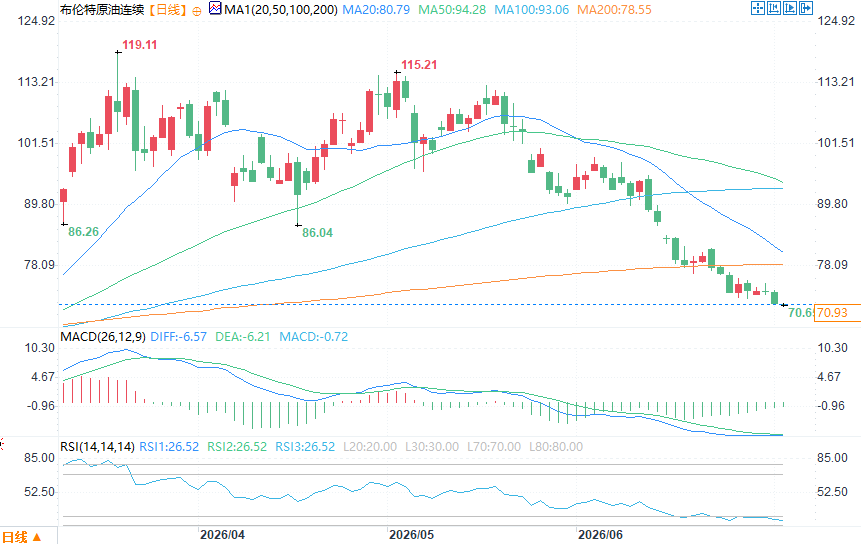
(Brent crude oil futures daily chart, source: EasyForex)
At 10:33 AM Beijing time on July 2, Brent crude oil futures were trading at $70.91 per barrel.
US President Trump said on July 1 that the latest round of talks between the United States and Iran in Qatar was progressing well.
In an interview that day, Trump said that "Iran's denuclearization process is progressing well" and that U.S. and Iranian officials held a "very good meeting" in Qatar.
However, the Strait of Hormuz remains a major point of friction in the fragile temporary ceasefire agreement between the two sides. Recently, fighting broke out again in the waterway after an attack on a cargo ship.
Cross-Strait Navigation: Trump Claims "Record-Breaking," Monitoring Data Contradicts Him
US President Trump claimed that the number of ships passing through the Strait of Hormuz is "setting a record." However, data from Marine Traffic, an independent global ship tracking service, shows only 34 verifiable passages in the most recent day, compared to over 120 before the conflict. Amid ongoing security concerns, the actual number of passages remains far below pre-conflict levels.
Trump later posted on social media: "As I promised, oil prices are falling rapidly, and gas station prices are also falling, but not fast enough." He added, "America has never been stronger, and gas prices will soon be back to the record lows Americans enjoyed before our actions against Iran."
Lifting Iran's blockade of the sea route—which has disrupted global oil and gas supplies and driven up fuel and food prices—has been a key demand in the negotiations.
60-Day Islamabad Memorandum of Understanding: Temporarily Approved, Core Issues Remain Unresolved
The initial agreement reached between the US and Iran—known as the "Islamabad Memorandum of Understanding"—only guarantees safe and free passage through the Strait for 60 days, pending a final agreement on Iran's controversial nuclear program.
The agreement also leaves the definition of the "future management and maritime services" of the Strait to be agreed upon by Iran, Oman, and other Gulf member states.
Meanwhile, Iran continues to attempt to exert influence over the Strait, including requiring ships to apply for passage permits and raising the possibility of future tolls.
Iran also insists that it can only carry out mine-clearing work in the Strait of Hormuz itself, casting a shadow over plans led by Britain and France to secure this crucial sea lane and reassure operators.
High-level statements: The US says it has a "strong negotiating stance" as the Iranian leader's funeral approaches.
U.S. Vice President JD Vance, during a visit to a naval air station, stated that the U.S. is "negotiating from a position of strength" due to its military power. He confirmed that separate talks held in Doha, the capital of Qatar, through mediators, primarily focused on the issue of commercial navigation in the Strait of Hormuz.
Vance said, "Obviously, we are concerned about the nuclear issue. We will begin discussions on this matter."
A spokesperson for the Qatari Ministry of Foreign Affairs posted on social media: "The Qatari and Pakistani mediators concluded separate meetings with US and Iranian negotiators in Doha today, making positive progress on issues related to the Islamabad Memorandum of Understanding, building on the outcomes of the Lucerne Summit. Both sides agreed to continue discussions in the coming period, with the next meeting to be arranged as soon as possible after the funeral of Iran's Supreme Leader."
The funeral of the late Iranian Supreme Leader Ayatollah Ali Khamenei, who was killed in the initial stages of the Israeli-American attack on Iran in late February, is scheduled for July 9, and he will be succeeded by his son Mojtaba.
UBS lowers oil price forecast
Increased energy transport through the Strait of Hormuz has prompted international institutions to reassess the outlook for oil prices. UBS, a prominent institution, lowered its 2026-2027 oil price forecasts on Wednesday, reducing its average Brent crude price forecast for this year from $93 per barrel to $84, and its 2027 forecast from $85 to $75.
UBS stated that reduced geopolitical risks and a rapid rebound in transportation volumes led to a larger-than-expected drop in oil prices.
However, the agency also predicts that oil prices will rebound slightly to $80 per barrel in the second half of this year as floating storage facilities in the Gulf of Mexico return to normal and demand recovers.
UBS also believes that risk premiums will be higher as the road to recovery may remain bumpy.
The agency stated that the need to replenish inventories should continue to support oil prices until 2027, but the required scale of inventory rebuilding is less than the previously expected 1 billion barrels.
Technical Analysis
According to the daily chart, the medium-term downtrend for Brent crude oil is clear. After reaching double highs of 119.11 and 115.21, it has continued to weaken. The 20-day moving average (MA20) (80.79), 50-day moving average (MA50) (94.28), 100-day moving average (MA100) (93.06), and 200-day moving average (MA200) (78.55) are all above the price, and the price has fallen below the 200-day moving average. The medium-to-long-term bullish trend has completely reversed, and the current 70 level is a key short-term support.
In terms of indicators, the MACD lines are running below the zero axis, with DIFF at -6.57 lower than DEA at -6.21, continuously outputting green bearish bars, indicating that the downward momentum has not yet exhausted and there is no bottoming golden cross stabilization signal; the RSI value is 26.52, entering the 20-30 oversold range, indicating a short-term need for a slight technical rebound, but there are no signs of turning upwards, and the rebound strength is limited.
(Brent crude oil futures daily chart, source: EasyForex)
At 10:33 AM Beijing time on July 2, Brent crude oil futures were trading at $70.91 per barrel.
- Risk Warning and Disclaimer
- The market involves risk, and trading may not be suitable for all investors. This article is for reference only and does not constitute personal investment advice, nor does it take into account certain users’ specific investment objectives, financial situation, or other needs. Any investment decisions made based on this information are at your own risk.