Weak non-farm payrolls + Ministry of Finance intervention = 157? USD/JPY faces double downside risks.
2026-07-02 13:43:41
On Thursday (July 2) during the Asian session, the US dollar continued to fall against the Japanese yen, trading around 162.40, retreating further from the 40-year high reached yesterday.
The yen received support from two sources: first, market expectations for a "silent intervention" by the Japanese Ministry of Finance increased; second, Federal Reserve Chairman Warsh's tone at the Sintra Forum was less hawkish than the market had expected, coupled with weak US economic data, putting overall pressure on the dollar.
Market focus has shifted to tonight's non-farm payroll report, the results of which will determine the short-term direction of the USD/JPY exchange rate.

According to sources familiar with the matter, Japan's Ministry of Finance is abandoning its traditional "preemptive intervention" model in favor of a more targeted "silent intervention" strategy—aimed at squeezing out speculators' positions and raising the cost of shorting the yen. Finance Minister Katsunobu Kato reiterated on Wednesday that the authorities are fully prepared to respond appropriately to developments in the foreign exchange market at any time.
This strategic shift means that Japanese authorities may intervene suddenly, catching the market off guard, to clear out speculative short positions, deliberately avoiding publicly setting any "currency red lines" that could trigger action. This approach makes market participants more cautious—you don't know when intervention will occur, nor where the trigger price will be. Uncertainty itself is a deterrent.
It is noteworthy that US Treasury Secretary Bessant and Japanese Finance Minister Katsunobu Kato are both concerned about the same issue: the dollar/yen exchange rate "looks wrong." Within the G7 consensus framework that "exchange rates should reflect fundamentals," if the yen's weakness reflects more speculative forces in carry trades than changes in economic fundamentals, the legitimacy threshold for intervention by the Japanese Ministry of Finance is lowered.
Another source of pressure on the dollar against the yen comes from the dollar itself. Warsh's speech at the Sintra Forum on Wednesday was more dovish than the market expected – he offered neither clear guidance on the July policy decision nor a strong signal of further rate hikes.
Although he acknowledged that inflation was still too high and reiterated his firm commitment to the 2% target and institutional independence, the market had already fully priced in a hawkish stance, and the actual statement was "below expectations," which triggered profit-taking by dollar bulls.
Evercore analyst Krishna Guha aptly commented: "At least, his remarks did not fuel any speculation about a July rate hike."
U.S. economic data released on Wednesday further cooled hawkish sentiment surrounding the Federal Reserve. The ADP employment report showed that private sector jobs increased by only 98,000 in June, below market expectations of 113,000 and the previous month's figure of 122,000. The ISM manufacturing PMI fell to 53.3 from 54 in May, also missing the expected 54.
These two sets of data together paint a picture of a moderate slowdown in the US economy. While a single month's data is insufficient to alter the Federal Reserve's policy trajectory, under Warsh's new "data-driven" framework, continuously weakening data will gradually erode the foundation of expectations for interest rate hikes.
Tonight's US June non-farm payrolls report will be a key catalyst for the USD/JPY exchange rate. The market expects 110,000 new jobs and an unemployment rate of 4.3%. Combined with Wednesday's weak ADP and ISM data, the non-farm payrolls report faces downside risks.
Furthermore, whether the Japanese Ministry of Finance will intervene after the data release is another significant variable. The G7 consensus that "exchange rates should reflect fundamentals" means that if the non-farm payrolls are strong, intervention by the Ministry of Finance would lack legitimacy given the fundamentals supporting a stronger dollar; conversely, if the data is weak, and the dollar weakens in line with fundamentals, the tactical value of the Ministry of Finance's intervention would increase significantly. Intervening just before the holidays, during a window of weak data, would minimize political costs and maximize effectiveness.
Historical experience shows that unilateral intervention typically results in a 3.0%-3.5% drop. Based on the current USD/JPY exchange rate of around 162.40, the expected buying range after intervention is approximately 157.10-157.90. In the extremely rare event of coordinated intervention, the price could be pushed directly down to 155.00.
According to the daily chart, the medium-to-long-term bullish trend for USD/JPY remains solid. After hitting a low of 155.03 in May, it began a sustained upward trend, with the moving average system showing a standard bullish alignment: the 20-day moving average (MA20) (161.16), 50-day moving average (MA50) (159.62), 100-day moving average (MA100) (158.80), and 200-day moving average (MA200) (156.65) are all below the price, forming layers of support. The price has stabilized above all moving averages, with the previous high of 162.83 acting as a strong short-term resistance level. However, the daily candlestick shows a relatively long upper shadow doji, which warrants caution.
In terms of indicators, the MACD lines are running above the zero axis, the DIFF (0.785) continues to be higher than the DEA (0.701), and the red bars continue to be stable, indicating that the bullish momentum is still being released; the RSI value is 73.81, breaking through the 70 threshold and entering the overbought zone, indicating that the short-term upward momentum has been exhausted and there is a need for a pullback to digest profit-taking.
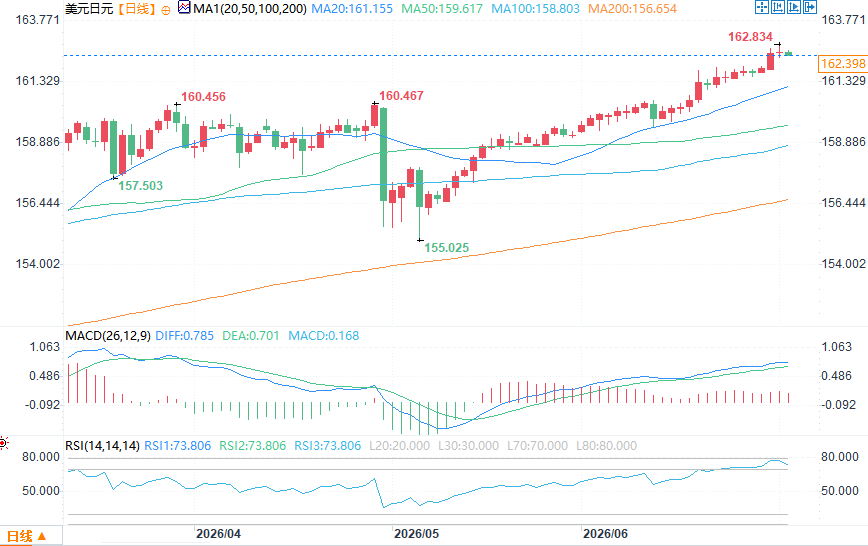
(USD/JPY daily chart, source: FX678)
At 13:43 Beijing time on July 2, the USD/JPY exchange rate was 162.38/39.
The yen received support from two sources: first, market expectations for a "silent intervention" by the Japanese Ministry of Finance increased; second, Federal Reserve Chairman Warsh's tone at the Sintra Forum was less hawkish than the market had expected, coupled with weak US economic data, putting overall pressure on the dollar.
Market focus has shifted to tonight's non-farm payroll report, the results of which will determine the short-term direction of the USD/JPY exchange rate.
"Silent Intervention": Japan's Tactical Shift Leaves Market Nerves Tense
According to sources familiar with the matter, Japan's Ministry of Finance is abandoning its traditional "preemptive intervention" model in favor of a more targeted "silent intervention" strategy—aimed at squeezing out speculators' positions and raising the cost of shorting the yen. Finance Minister Katsunobu Kato reiterated on Wednesday that the authorities are fully prepared to respond appropriately to developments in the foreign exchange market at any time.
This strategic shift means that Japanese authorities may intervene suddenly, catching the market off guard, to clear out speculative short positions, deliberately avoiding publicly setting any "currency red lines" that could trigger action. This approach makes market participants more cautious—you don't know when intervention will occur, nor where the trigger price will be. Uncertainty itself is a deterrent.
It is noteworthy that US Treasury Secretary Bessant and Japanese Finance Minister Katsunobu Kato are both concerned about the same issue: the dollar/yen exchange rate "looks wrong." Within the G7 consensus framework that "exchange rates should reflect fundamentals," if the yen's weakness reflects more speculative forces in carry trades than changes in economic fundamentals, the legitimacy threshold for intervention by the Japanese Ministry of Finance is lowered.
Warsh's tone was less hawkish than expected, putting pressure on the dollar.
Another source of pressure on the dollar against the yen comes from the dollar itself. Warsh's speech at the Sintra Forum on Wednesday was more dovish than the market expected – he offered neither clear guidance on the July policy decision nor a strong signal of further rate hikes.
Although he acknowledged that inflation was still too high and reiterated his firm commitment to the 2% target and institutional independence, the market had already fully priced in a hawkish stance, and the actual statement was "below expectations," which triggered profit-taking by dollar bulls.
Evercore analyst Krishna Guha aptly commented: "At least, his remarks did not fuel any speculation about a July rate hike."
US data shows "double weakness": ADP and ISM combined fall short of expectations.
U.S. economic data released on Wednesday further cooled hawkish sentiment surrounding the Federal Reserve. The ADP employment report showed that private sector jobs increased by only 98,000 in June, below market expectations of 113,000 and the previous month's figure of 122,000. The ISM manufacturing PMI fell to 53.3 from 54 in May, also missing the expected 54.
These two sets of data together paint a picture of a moderate slowdown in the US economy. While a single month's data is insufficient to alter the Federal Reserve's policy trajectory, under Warsh's new "data-driven" framework, continuously weakening data will gradually erode the foundation of expectations for interest rate hikes.
Non-farm payroll report: the biggest short-term variable
Tonight's US June non-farm payrolls report will be a key catalyst for the USD/JPY exchange rate. The market expects 110,000 new jobs and an unemployment rate of 4.3%. Combined with Wednesday's weak ADP and ISM data, the non-farm payrolls report faces downside risks.
Furthermore, whether the Japanese Ministry of Finance will intervene after the data release is another significant variable. The G7 consensus that "exchange rates should reflect fundamentals" means that if the non-farm payrolls are strong, intervention by the Ministry of Finance would lack legitimacy given the fundamentals supporting a stronger dollar; conversely, if the data is weak, and the dollar weakens in line with fundamentals, the tactical value of the Ministry of Finance's intervention would increase significantly. Intervening just before the holidays, during a window of weak data, would minimize political costs and maximize effectiveness.
Historical experience shows that unilateral intervention typically results in a 3.0%-3.5% drop. Based on the current USD/JPY exchange rate of around 162.40, the expected buying range after intervention is approximately 157.10-157.90. In the extremely rare event of coordinated intervention, the price could be pushed directly down to 155.00.
Technical Analysis
According to the daily chart, the medium-to-long-term bullish trend for USD/JPY remains solid. After hitting a low of 155.03 in May, it began a sustained upward trend, with the moving average system showing a standard bullish alignment: the 20-day moving average (MA20) (161.16), 50-day moving average (MA50) (159.62), 100-day moving average (MA100) (158.80), and 200-day moving average (MA200) (156.65) are all below the price, forming layers of support. The price has stabilized above all moving averages, with the previous high of 162.83 acting as a strong short-term resistance level. However, the daily candlestick shows a relatively long upper shadow doji, which warrants caution.
In terms of indicators, the MACD lines are running above the zero axis, the DIFF (0.785) continues to be higher than the DEA (0.701), and the red bars continue to be stable, indicating that the bullish momentum is still being released; the RSI value is 73.81, breaking through the 70 threshold and entering the overbought zone, indicating that the short-term upward momentum has been exhausted and there is a need for a pullback to digest profit-taking.
(USD/JPY daily chart, source: FX678)
At 13:43 Beijing time on July 2, the USD/JPY exchange rate was 162.38/39.
- Risk Warning and Disclaimer
- The market involves risk, and trading may not be suitable for all investors. This article is for reference only and does not constitute personal investment advice, nor does it take into account certain users’ specific investment objectives, financial situation, or other needs. Any investment decisions made based on this information are at your own risk.