Australia's biggest trade deficit in a decade exposes the vulnerability of its resource dependence.
2026-07-02 14:02:31
On Thursday (July 2) during the Asian session, the Australian dollar remained range-bound against the US dollar, currently trading around 0.6890.
According to the latest data, Australia unexpectedly recorded a large trade deficit in May, the largest monthly deficit in more than a decade. A sharp drop in commodity exports coupled with increased imports caused the trade data to plummet from a surplus in April, far below market expectations. The plunge in both gold and iron ore exports highlights the high volatility of Australia's resource-oriented trade flows.

Data released by the Australian Bureau of Statistics shows that the merchandise trade deficit reached A$3.02 billion in May, a stark contrast to the revised A$1.38 billion surplus in April, and far below the market expectation of a A$2.18 billion surplus.
This gap marks Australia's largest monthly trade deficit since the end of 2015.
From a macroeconomic perspective, the Australian economy is highly dependent on resource exports, and fluctuations in the trade balance often serve as an important indicator of its economic resilience. This unexpected turn negative not only reflects short-term supply and demand imbalances but may also signal that the global commodity cycle is entering a period of adjustment.
Market participants believe that if exports fail to recover quickly, the Reserve Bank of Australia may face greater pressure on monetary policy, needing to strike a balance between stimulating domestic demand and preventing inflation risks. Investors should continue to monitor subsequent monthly data revisions and changes in global demand to determine whether this trade deficit is a temporary phenomenon or the beginning of a trend reversal.
The core driver of the deteriorating trade situation is the sharp contraction in exports. Exports plummeted 6.9% month-on-month in May, a stark contrast to the surge in April.
Among them, non-monetary gold exports plummeted by 35%, and iron ore exports fell by 9%. The simultaneous weakening of these two key commodities directly dragged down the overall export performance.
Analysts point out that if the sharp decline in exports continues, it may force the Australian government to intensify its export diversification strategy, promoting the development of high-end manufacturing and service trade to reduce over-reliance on traditional mineral resources. In the short term, weak export data will also be a significant pressure factor on the Australian dollar exchange rate and the resource sector of the stock market.
Contrary to the decline in exports, imports rose 2.6% month-on-month, compared with a 0.2% increase in April.
The growth in imports was primarily driven by increased purchases of automobiles, aircraft, and telecommunications equipment, reflecting the resilience of domestic demand in Australia.
The robust growth in automobile imports reflects a recovery in consumer confidence and a release of pent-up demand for equipment upgrades from businesses. Both household and commercial vehicle purchases increased, driven by earlier improvements in the supply chain, a relatively stable Australian dollar exchange rate, and promotional activities for certain models.
The significant increase in imports of aviation equipment is closely related to the recovery of the aviation industry. As passenger traffic on international routes in Australia gradually recovers, airlines are increasing their fleet renewal and expansion efforts, which directly drives the import of related high-end equipment.
In addition, the growth in telecommunications equipment procurement also reflects the continued advancement of digital infrastructure construction, with enterprises and governments maintaining active investment in areas such as 5G and data centers.
May's trade data served as a wake-up call for Australia—its trade balance's heavy reliance on commodity prices and export volumes makes it highly vulnerable to single-month fluctuations. The simultaneous plunge in gold and iron ore prices exposed the inherent structural vulnerabilities of resource-exporting countries' economies.
While import growth suggests that domestic demand remains supported, sharp fluctuations in exports could push the overall trade balance into a deficit. This data could also put short-term pressure on the Australian dollar and trigger a reassessment of Australia's current account and fiscal revenue prospects.
According to the daily chart, the Australian dollar against the US dollar is in a medium-term downtrend. After reaching a high of 0.7277, it has been trending downwards, with moving averages forming a bearish resistance pattern: the 20-day moving average (MA20) (0.6979), 50-day moving average (MA50) (0.7097), and 100-day moving average (MA100) (0.7072) are all above the price, with only the long-term 200-day moving average (MA200) providing support below. The price has tested this moving average multiple times, and the recent low of 0.6864 is a key short-term support/resistance level.
In terms of indicators, the MACD lines are running below the zero axis, the DIFF line (-0.0060) is consistently lower than the DEA line (-0.0053), the bearish green bars continue to be released, and although the downward momentum has slightly subsided, no golden cross reversal signal has appeared; the RSI value is 32.23, close to the oversold zone of 30, indicating a short-term technical rebound and correction demand.
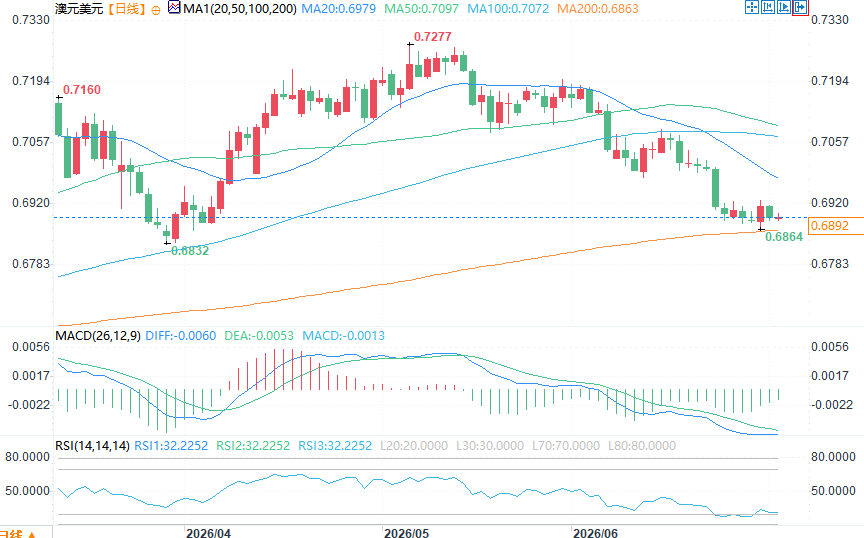
(AUD/USD daily chart, source: FX678)
At 14:02 Beijing time on July 2, the Australian dollar was trading at 0.6894/95 against the US dollar.
According to the latest data, Australia unexpectedly recorded a large trade deficit in May, the largest monthly deficit in more than a decade. A sharp drop in commodity exports coupled with increased imports caused the trade data to plummet from a surplus in April, far below market expectations. The plunge in both gold and iron ore exports highlights the high volatility of Australia's resource-oriented trade flows.
Data Overview: Trade Surplus Turns into Deficit, Unexpectedly Turns Negative
Data released by the Australian Bureau of Statistics shows that the merchandise trade deficit reached A$3.02 billion in May, a stark contrast to the revised A$1.38 billion surplus in April, and far below the market expectation of a A$2.18 billion surplus.
This gap marks Australia's largest monthly trade deficit since the end of 2015.
From a macroeconomic perspective, the Australian economy is highly dependent on resource exports, and fluctuations in the trade balance often serve as an important indicator of its economic resilience. This unexpected turn negative not only reflects short-term supply and demand imbalances but may also signal that the global commodity cycle is entering a period of adjustment.
Market participants believe that if exports fail to recover quickly, the Reserve Bank of Australia may face greater pressure on monetary policy, needing to strike a balance between stimulating domestic demand and preventing inflation risks. Investors should continue to monitor subsequent monthly data revisions and changes in global demand to determine whether this trade deficit is a temporary phenomenon or the beginning of a trend reversal.
Exports Plunge: Gold and Iron Ore Prices Both Plummet
The core driver of the deteriorating trade situation is the sharp contraction in exports. Exports plummeted 6.9% month-on-month in May, a stark contrast to the surge in April.
Among them, non-monetary gold exports plummeted by 35%, and iron ore exports fell by 9%. The simultaneous weakening of these two key commodities directly dragged down the overall export performance.
Analysts point out that if the sharp decline in exports continues, it may force the Australian government to intensify its export diversification strategy, promoting the development of high-end manufacturing and service trade to reduce over-reliance on traditional mineral resources. In the short term, weak export data will also be a significant pressure factor on the Australian dollar exchange rate and the resource sector of the stock market.
Import growth: Automobiles and aviation equipment led the way.
Contrary to the decline in exports, imports rose 2.6% month-on-month, compared with a 0.2% increase in April.
The growth in imports was primarily driven by increased purchases of automobiles, aircraft, and telecommunications equipment, reflecting the resilience of domestic demand in Australia.
The robust growth in automobile imports reflects a recovery in consumer confidence and a release of pent-up demand for equipment upgrades from businesses. Both household and commercial vehicle purchases increased, driven by earlier improvements in the supply chain, a relatively stable Australian dollar exchange rate, and promotional activities for certain models.
The significant increase in imports of aviation equipment is closely related to the recovery of the aviation industry. As passenger traffic on international routes in Australia gradually recovers, airlines are increasing their fleet renewal and expansion efforts, which directly drives the import of related high-end equipment.
In addition, the growth in telecommunications equipment procurement also reflects the continued advancement of digital infrastructure construction, with enterprises and governments maintaining active investment in areas such as 5G and data centers.
In conclusion, the vulnerability of resource dependence has been exposed once again.
May's trade data served as a wake-up call for Australia—its trade balance's heavy reliance on commodity prices and export volumes makes it highly vulnerable to single-month fluctuations. The simultaneous plunge in gold and iron ore prices exposed the inherent structural vulnerabilities of resource-exporting countries' economies.
While import growth suggests that domestic demand remains supported, sharp fluctuations in exports could push the overall trade balance into a deficit. This data could also put short-term pressure on the Australian dollar and trigger a reassessment of Australia's current account and fiscal revenue prospects.
Technical Analysis
According to the daily chart, the Australian dollar against the US dollar is in a medium-term downtrend. After reaching a high of 0.7277, it has been trending downwards, with moving averages forming a bearish resistance pattern: the 20-day moving average (MA20) (0.6979), 50-day moving average (MA50) (0.7097), and 100-day moving average (MA100) (0.7072) are all above the price, with only the long-term 200-day moving average (MA200) providing support below. The price has tested this moving average multiple times, and the recent low of 0.6864 is a key short-term support/resistance level.
In terms of indicators, the MACD lines are running below the zero axis, the DIFF line (-0.0060) is consistently lower than the DEA line (-0.0053), the bearish green bars continue to be released, and although the downward momentum has slightly subsided, no golden cross reversal signal has appeared; the RSI value is 32.23, close to the oversold zone of 30, indicating a short-term technical rebound and correction demand.
(AUD/USD daily chart, source: FX678)
At 14:02 Beijing time on July 2, the Australian dollar was trading at 0.6894/95 against the US dollar.
- Risk Warning and Disclaimer
- The market involves risk, and trading may not be suitable for all investors. This article is for reference only and does not constitute personal investment advice, nor does it take into account certain users’ specific investment objectives, financial situation, or other needs. Any investment decisions made based on this information are at your own risk.