Warsh's "No Fuel" vs. Cooling Euro Inflation: How Far Can the Euro's Rebound Go?
2026-07-02 13:17:39
The euro rose modestly against the dollar in early Asian trading on Thursday (July 2), trading around 1.1380.
Federal Reserve Chairman Warsh's remarks at the European Central Bank forum on Wednesday were interpreted by the market as "less hawkish"—he neither provided forward guidance for the July meeting nor emphasized the need for further observation, which put pressure on the dollar overnight.
Meanwhile, eurozone inflation slowed more than expected, reducing the urgency for the European Central Bank to continue raising interest rates and limiting the euro's upside potential. Ahead of the non-farm payroll report, the euro was caught in a dilemma.
Warsh's speech in Sintra on Wednesday appeared unremarkable, but the market picked up on subtle shifts in the details. He explicitly stated that he would "not provide forward guidance" and that "interest rate decisions will be made in a closed-door meeting"—a statement that differed somewhat from the market's previous expectations of a "hawkish" tone.
Evercore analyst Krishna Guha succinctly commented: "At least, his remarks did not fuel any speculation about a July rate hike. We believe that while the new chairman has retained the flexibility to assess rates at each meeting, there is currently no sufficient reason to raise rates immediately."
This is a very interesting statement. "Assessing at each meeting" means that anything is possible after this meeting—before the meeting, based on economic data, there might be a rate hike, no change, or a rate cut; it's completely flexible. Currently, there is no sufficient reason to raise rates immediately—that is, current data does not support action in July.
Furthermore, Warsh reiterated his preference for reducing the bond portfolio, but emphasized that any such steps would be implemented only after full and public preparation. This conveys a more cautious attitude from the Federal Reserve regarding balance sheet reduction—no rush, no surprises, giving the market ample time to digest the changes.
The CME FedWatch tool shows that the probability of a rate hike in September remains at 67%, but the July meeting is almost unpriced in. The market has begun to reassess the "timing of rate hikes".
The negative factors for the euro itself should not be ignored. Data released by Eurostat on Wednesday showed that the eurozone's harmonized index of consumer prices (HICP) fell to 2.8% year-on-year in June from 3.2% in May, lower than the market expectation of 3.0%. The core HICP (excluding volatile food and energy prices) slowed to 2.4% year-on-year from 2.6%, also lower than the expected 2.6%.
The unexpected slowdown in inflation means the ECB has less "political space" to continue raising interest rates. With inflation falling back towards its target, further rate hikes will face more internal resistance—especially given the already weak economic growth in the Eurozone. This explains why the euro rebounded only slightly after Warsh's speech—the ECB could not provide additional hawkish support.
If inflation in the Eurozone continues its downward trend, the ECB may even begin discussing interest rate cuts before the end of the year, which would fundamentally reverse the upward trend of the euro.
The US June non-farm payrolls report will be released Thursday evening Beijing time. The market expects approximately 110,000 new jobs, compared to 172,000 in the previous month, with the unemployment rate expected to remain at 4.3%. Wednesday's ADP employment data (98,000, lower than the expected 113,000) has already somewhat lowered market expectations for the non-farm payrolls report.
If the non-farm payrolls data falls short of expectations, the US dollar may come under further pressure, pushing the euro to test the 1.1450-1.1480 area; if the non-farm payrolls data is unexpectedly strong, the US dollar will regain buying interest, and the euro may fall back to 1.1300 or even lower. It should be noted that there is not always a strong correlation between ADP and non-farm payrolls data, so the market will not make clear one-sided bets before the data is released.
According to the daily chart, the medium-term downtrend for EUR/USD has been established. After peaking at 1.1848, the price has continued to weaken, with the moving averages arranged in a bearish pattern: MA20 (1.1471), MA50 (1.1592), MA100 (1.1625), and MA200 (1.1653) are all above the price, forming layers of resistance. The bearish dominance is clear, and the recent low of 1.1324 is a key short-term support level.
In terms of indicators, the MACD lines are below the zero axis, the DIFF line is -0.0063 slightly lower than the DEA line is -0.0059, the green bars are narrowing slightly, and the downward momentum has slowed down slightly, but no effective golden cross reversal signal has appeared; the RSI value is 33.85, close to the oversold zone of 30, and there is a short-term technical rebound and correction demand.
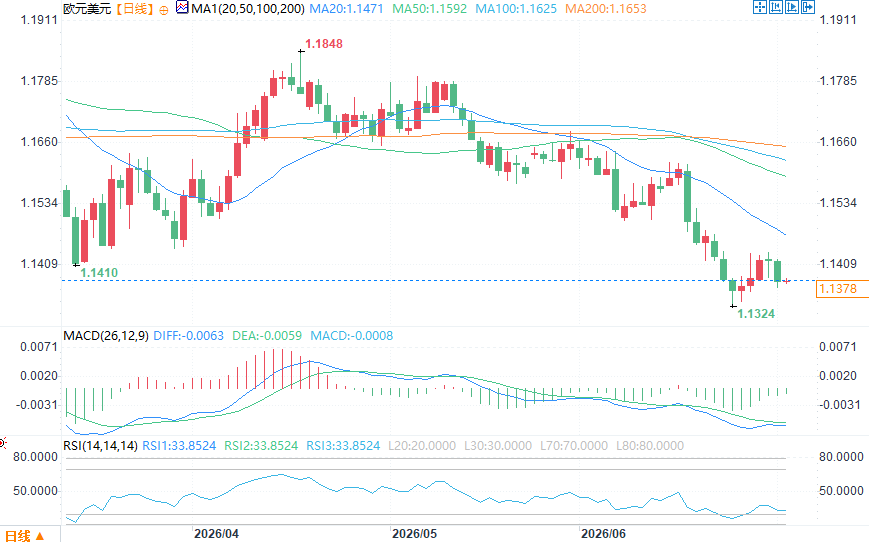
(Euro/USD daily chart, source: FX678)
At 13:17 Beijing time on July 2, the euro was trading at 1.1385/86 against the US dollar.
Federal Reserve Chairman Warsh's remarks at the European Central Bank forum on Wednesday were interpreted by the market as "less hawkish"—he neither provided forward guidance for the July meeting nor emphasized the need for further observation, which put pressure on the dollar overnight.
Meanwhile, eurozone inflation slowed more than expected, reducing the urgency for the European Central Bank to continue raising interest rates and limiting the euro's upside potential. Ahead of the non-farm payroll report, the euro was caught in a dilemma.
Warsh's subtle shift in wording: A signal of no rate hike? The market is beginning to repric.
Warsh's speech in Sintra on Wednesday appeared unremarkable, but the market picked up on subtle shifts in the details. He explicitly stated that he would "not provide forward guidance" and that "interest rate decisions will be made in a closed-door meeting"—a statement that differed somewhat from the market's previous expectations of a "hawkish" tone.
Evercore analyst Krishna Guha succinctly commented: "At least, his remarks did not fuel any speculation about a July rate hike. We believe that while the new chairman has retained the flexibility to assess rates at each meeting, there is currently no sufficient reason to raise rates immediately."
This is a very interesting statement. "Assessing at each meeting" means that anything is possible after this meeting—before the meeting, based on economic data, there might be a rate hike, no change, or a rate cut; it's completely flexible. Currently, there is no sufficient reason to raise rates immediately—that is, current data does not support action in July.
Furthermore, Warsh reiterated his preference for reducing the bond portfolio, but emphasized that any such steps would be implemented only after full and public preparation. This conveys a more cautious attitude from the Federal Reserve regarding balance sheet reduction—no rush, no surprises, giving the market ample time to digest the changes.
The CME FedWatch tool shows that the probability of a rate hike in September remains at 67%, but the July meeting is almost unpriced in. The market has begun to reassess the "timing of rate hikes".
Eurozone inflation slows more than expected: ECB's room for "painless" rate hikes narrows
The negative factors for the euro itself should not be ignored. Data released by Eurostat on Wednesday showed that the eurozone's harmonized index of consumer prices (HICP) fell to 2.8% year-on-year in June from 3.2% in May, lower than the market expectation of 3.0%. The core HICP (excluding volatile food and energy prices) slowed to 2.4% year-on-year from 2.6%, also lower than the expected 2.6%.
The unexpected slowdown in inflation means the ECB has less "political space" to continue raising interest rates. With inflation falling back towards its target, further rate hikes will face more internal resistance—especially given the already weak economic growth in the Eurozone. This explains why the euro rebounded only slightly after Warsh's speech—the ECB could not provide additional hawkish support.
If inflation in the Eurozone continues its downward trend, the ECB may even begin discussing interest rate cuts before the end of the year, which would fundamentally reverse the upward trend of the euro.
Non-farm payrolls report: Thursday's biggest variable
The US June non-farm payrolls report will be released Thursday evening Beijing time. The market expects approximately 110,000 new jobs, compared to 172,000 in the previous month, with the unemployment rate expected to remain at 4.3%. Wednesday's ADP employment data (98,000, lower than the expected 113,000) has already somewhat lowered market expectations for the non-farm payrolls report.
If the non-farm payrolls data falls short of expectations, the US dollar may come under further pressure, pushing the euro to test the 1.1450-1.1480 area; if the non-farm payrolls data is unexpectedly strong, the US dollar will regain buying interest, and the euro may fall back to 1.1300 or even lower. It should be noted that there is not always a strong correlation between ADP and non-farm payrolls data, so the market will not make clear one-sided bets before the data is released.
Technical Analysis
According to the daily chart, the medium-term downtrend for EUR/USD has been established. After peaking at 1.1848, the price has continued to weaken, with the moving averages arranged in a bearish pattern: MA20 (1.1471), MA50 (1.1592), MA100 (1.1625), and MA200 (1.1653) are all above the price, forming layers of resistance. The bearish dominance is clear, and the recent low of 1.1324 is a key short-term support level.
In terms of indicators, the MACD lines are below the zero axis, the DIFF line is -0.0063 slightly lower than the DEA line is -0.0059, the green bars are narrowing slightly, and the downward momentum has slowed down slightly, but no effective golden cross reversal signal has appeared; the RSI value is 33.85, close to the oversold zone of 30, and there is a short-term technical rebound and correction demand.
(Euro/USD daily chart, source: FX678)
At 13:17 Beijing time on July 2, the euro was trading at 1.1385/86 against the US dollar.
- Risk Warning and Disclaimer
- The market involves risk, and trading may not be suitable for all investors. This article is for reference only and does not constitute personal investment advice, nor does it take into account certain users’ specific investment objectives, financial situation, or other needs. Any investment decisions made based on this information are at your own risk.