Non-farm payrolls countdown begins: Market expects 110,000 new jobs, wage growth becomes key clue to inflation.
2026-07-02 16:32:38
On Thursday (July 2), during the European session, the US dollar index fluctuated lower from its highs and is currently trading below 101.10.
The U.S. Bureau of Labor Statistics will release its June non-farm payrolls report on Thursday. The market generally expects 110,000 new jobs, a slowdown from 172,000 in May, and the unemployment rate is expected to remain at 4.3%.
Under the leadership of new Chairman Warsh, the Federal Reserve's policy outlook is hawkish, and the details of this employment data will have a significant impact on the timing of interest rate hikes.
While wage data typically triggers significant market reactions, only extremely weak readings would pose a substantial threat to the dollar in the current context of inflation dominating the policy agenda.

The market expects non-farm payrolls to increase by 110,000 in June, following three consecutive months of unexpectedly strong growth.
The unemployment rate is expected to remain at 4.3%, and the year-on-year growth rate of average hourly wages is expected to rise slightly from 3.4% in May to 3.5%. The moderate recovery in wage growth will be a key reference for measuring inflationary pressures.
Some institutions have a more conservative outlook on the data than the market consensus.
TD Securities analysts expect job growth to slow to 80,000 in June (55,000 in the private sector and 25,000 in the government sector), believing that the strong growth since the beginning of the year will cool down this month.
The agency noted that job growth has spread from the healthcare sector to trade, transportation, and leisure, but may decline across the board this month. Local government employment is supported or remains strong due to the World Cup effect.
TD Securities also expects the unemployment rate to fall slightly to 4.2% due to a decline in the labor force participation rate, and average hourly earnings to grow at a slower pace of 0.2% month-on-month (compared to 3.5% year-on-year).
Jocelyn Paquet, a senior economist at the National Bank of Canada, predicted 90,000 new jobs, believing that the weekly ADP data and previously released soft employment indicators (such as the S&P Global Flash Composite PMI) indicate that job creation remains fairly robust, but is below the levels seen between February and May.
Meanwhile, the rise in initial jobless claims may indicate a slight increase in layoffs, with the two factors combined resulting in an increase of approximately 90,000 in non-farm payrolls.
Wednesday's ADP report showed that the U.S. private sector added 98,000 jobs in June, lower than the market expectation of 113,000 and the figure of 122,000 in May.
This marks the second consecutive month that ADP data has fallen short of expectations, further confirming the trend of a moderate slowdown in the job market.
However, the historical correlation between ADP and non-farm payrolls is not stable, and the market will not rely too much on this leading signal.
This non-farm payroll report offers more than just the job creation figures themselves; three key dimensions deserve close monitoring:
1) Whether the increase in employment falls within the market's expected range;
2) Whether wage growth rebounds to 3.5% as expected will directly affect the assessment of the inflation outlook;
3) The impact of changes in the labor force participation rate on the unemployment rate. With the Federal Reserve shifting towards a "data-driven" decision-making model under Warsh's leadership, the influence of the non-farm payroll report has been further amplified—only extremely weak data can substantially damage the dollar, while readings that meet expectations or are slightly stronger will solidify expectations of interest rate hikes, providing support for the dollar.
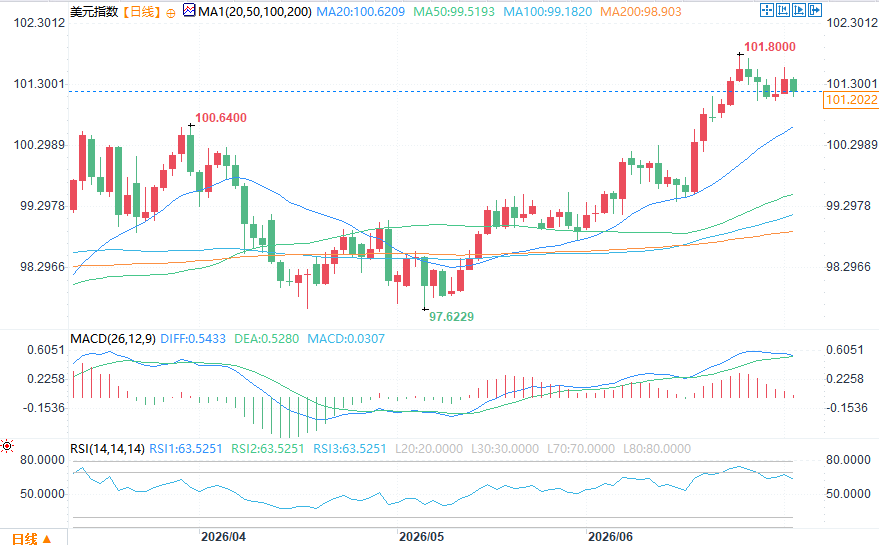
(US Dollar Index Daily Chart, Source: FX678)
At 16:31 Beijing time on July 2, the US dollar index was at 100.99.
The U.S. Bureau of Labor Statistics will release its June non-farm payrolls report on Thursday. The market generally expects 110,000 new jobs, a slowdown from 172,000 in May, and the unemployment rate is expected to remain at 4.3%.
Under the leadership of new Chairman Warsh, the Federal Reserve's policy outlook is hawkish, and the details of this employment data will have a significant impact on the timing of interest rate hikes.
While wage data typically triggers significant market reactions, only extremely weak readings would pose a substantial threat to the dollar in the current context of inflation dominating the policy agenda.
Market Expectations at a Glance: Slowing Down but Steady
The market expects non-farm payrolls to increase by 110,000 in June, following three consecutive months of unexpectedly strong growth.
The unemployment rate is expected to remain at 4.3%, and the year-on-year growth rate of average hourly wages is expected to rise slightly from 3.4% in May to 3.5%. The moderate recovery in wage growth will be a key reference for measuring inflationary pressures.
Investment banks hold differing opinions: expectations are weak, pointing to the 80-90K range.
Some institutions have a more conservative outlook on the data than the market consensus.
TD Securities analysts expect job growth to slow to 80,000 in June (55,000 in the private sector and 25,000 in the government sector), believing that the strong growth since the beginning of the year will cool down this month.
The agency noted that job growth has spread from the healthcare sector to trade, transportation, and leisure, but may decline across the board this month. Local government employment is supported or remains strong due to the World Cup effect.
TD Securities also expects the unemployment rate to fall slightly to 4.2% due to a decline in the labor force participation rate, and average hourly earnings to grow at a slower pace of 0.2% month-on-month (compared to 3.5% year-on-year).
Jocelyn Paquet, a senior economist at the National Bank of Canada, predicted 90,000 new jobs, believing that the weekly ADP data and previously released soft employment indicators (such as the S&P Global Flash Composite PMI) indicate that job creation remains fairly robust, but is below the levels seen between February and May.
Meanwhile, the rise in initial jobless claims may indicate a slight increase in layoffs, with the two factors combined resulting in an increase of approximately 90,000 in non-farm payrolls.
ADP Leading Signals: Lower Than Expected, Suggesting a Moderate Slowdown
Wednesday's ADP report showed that the U.S. private sector added 98,000 jobs in June, lower than the market expectation of 113,000 and the figure of 122,000 in May.
This marks the second consecutive month that ADP data has fallen short of expectations, further confirming the trend of a moderate slowdown in the job market.
However, the historical correlation between ADP and non-farm payrolls is not stable, and the market will not rely too much on this leading signal.
Summary: Data sets the tone; focus on three key dimensions.
This non-farm payroll report offers more than just the job creation figures themselves; three key dimensions deserve close monitoring:
1) Whether the increase in employment falls within the market's expected range;
2) Whether wage growth rebounds to 3.5% as expected will directly affect the assessment of the inflation outlook;
3) The impact of changes in the labor force participation rate on the unemployment rate. With the Federal Reserve shifting towards a "data-driven" decision-making model under Warsh's leadership, the influence of the non-farm payroll report has been further amplified—only extremely weak data can substantially damage the dollar, while readings that meet expectations or are slightly stronger will solidify expectations of interest rate hikes, providing support for the dollar.
(US Dollar Index Daily Chart, Source: FX678)
At 16:31 Beijing time on July 2, the US dollar index was at 100.99.
- Risk Warning and Disclaimer
- The market involves risk, and trading may not be suitable for all investors. This article is for reference only and does not constitute personal investment advice, nor does it take into account certain users’ specific investment objectives, financial situation, or other needs. Any investment decisions made based on this information are at your own risk.