Non-farm payrolls data was unexpectedly weak, with only 57,000 new jobs, triggering a "recession warning." Wall Street is in a frenzy: Can Warsh's hawkish stance still hold water?
2026-07-02 20:53:16
This is undoubtedly the most astonishing non-farm payroll report to hit Wall Street since the beginning of 2026.
On Thursday evening Beijing time, the U.S. Bureau of Labor Statistics (BLS) released its June non-farm payroll data, which completely ignited global financial markets.
This report does not provide a clear black-and-white logic, but presents an extremely bizarre and extremely divisive form: on the one hand, there is a "cliff-like collapse" in the number of monthly recruitments, and on the other hand, there is a "stubborn resistance" in the unemployment rate and wage growth.
The bulls and bears engaged in a near-frenzied battle of positions the moment the data was released, dealing a heavy blow to the hawkish defenses that Federal Reserve Chairman Kevin Warsh had just built at the Sintra Forum.
The actual readings of this non-farm payrolls report have taken the word "torn apart" to its extreme:
Non-farm payrolls (sharp slowdown): Only 57,000 jobs were added, a drop of more than half from the previous figure of 170,000 (Note: the official figure was 172,000), and far below market expectations of 110,000. This indicates that the actual hiring intentions of US companies are on the verge of recession. The "ADP report of only 98,000 new jobs" that was scorned by the market a few days ago was not a false alarm, but a real harbinger of the industry peaking.
Unemployment rate (reverse strengthening): Despite a collapse in hiring, the unemployment rate surprisingly fell to 4.2%, lower than the market consensus of 4.3% and even tighter than the previous value. This suggests that although companies are not hiring, the market remains "labor shortage" due to changes in the labor force participation rate.
Wage growth (inflation stickiness): recorded 3.5% year-on-year, in line with expectations and higher than the previous value of 3.4%. This means that although companies have reduced their staff, they are still raising salaries in order to retain core employees, and the spiral pressure of wage inflation has not been relieved.
Following the release of the data, analysts from major Wall Street investment banks and research institutions immediately exhibited sharply divergent opinions:
"Hard landing recessionists": 57,000 new jobs is a loud wake-up call. In its latest report, Goldman Sachs' macro strategy team pointed out: "It must be acknowledged that a sharp drop in the number of new jobs in a single month is solid evidence of a rapid slowdown in the labor market."
While the low unemployment rate of 4.2% provides some cover, the visible slowdown in corporate hiring momentum indicates that the cumulative damage from past high-interest-rate policies is rapidly penetrating the real economy, and discussions about a September rate cut should be brought back to the table.
The well-known macroeconomic research institution Yardeni Research previously offered a more hawkish and worried perspective: if a significant decline occurs, be careful as it could become the worst-case scenario of "classic stagflation," which is not a hard landing for the economy at all, but a typical signal of stagflation.
Businesses are reducing hiring due to high costs, but labor costs are still rising. This combination is a major headache for central banks, and the Federal Reserve may be forced to maintain high interest rates.
This extremely embarrassing data has put the newly appointed Federal Reserve Chairman Kevin Warsh in a corner.
Just yesterday, Warsh delivered his second major public speech since taking office at the European Central Bank's Sintra Forum.
He coolly declared to the entire market that the Federal Reserve would defend its "political independence" to the death, with "restoring 2% price stability" as its core objective.
He even publicly criticized the government's statistical data for being outdated and problematic (threatening to build a more sensitive real-time data system within a year) to prove that even though half of the officials in the June dot plot supported another rate hike this year and the market was betting heavily on a rate hike in September (previously the probability was 67%), the Federal Reserve had the confidence to maintain a hawkish "defensive high interest rate" stance.
But today's figure of 57,000 is nothing short of a "blow to the head" for hawkish officials.
The real-time price of the CME FedWatch tool plummeted within five minutes of the data release, instantly wiping out most of the probability of a September rate hike.
Wall Street is beginning to realize that if Warsh ignores the collapse of 57,000 jobs in his efforts to combat inflation, the U.S. economy will face a real risk of stalling.
In the foreign exchange market, this disjointed data triggered a sharp, short-term "fan-like" price movement (sweeping orders at both ends).
The US Dollar Index (DXY) fluctuated downwards: Immediately after the data release, the index plummeted due to the unexpectedly low figure of 57,000, directly testing the low of the trading range at 100.58.
However, due to the still strong unemployment rate (4.2%) and wages (3.5%), the US dollar index quickly recovered some of its losses after hitting a low, indicating that the market is repeatedly tug-of-war between "speculating on the Fed's dovish stance" and "concerns about economic stagflation." The middle line of the long-term downward channel from 2022 to 2026 is currently undergoing a fierce battle for survival.
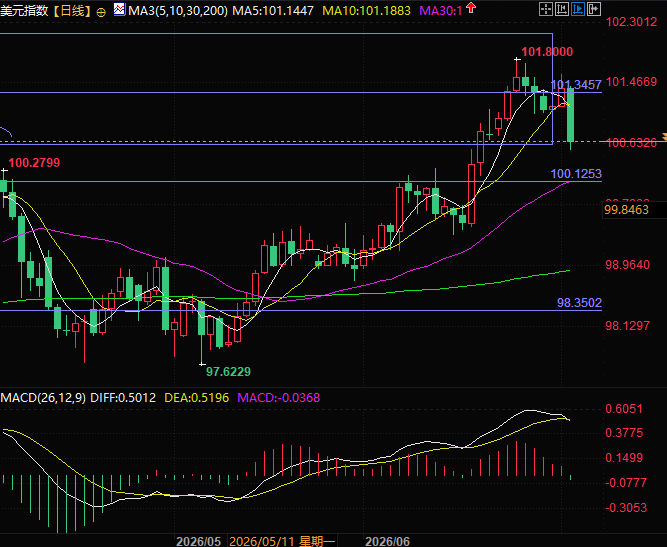
(US Dollar Index Daily Chart, Source: FX678)
The Japanese yen has gained a valuable respite: having previously suffered from the interest rate differential between the US and Japan and fallen to a historic low of 162, the yen has seen a short-covering rally due to the sharp drop in US Treasury yields caused by the unexpectedly weak non-farm payrolls data.
However, this did not completely lull Japan's Ministry of Finance into a false sense of security—as long as the US unemployment rate and wages do not truly collapse, the Federal Reserve is unlikely to cut interest rates significantly, the long-term systemic selling pressure on the yen remains, and the sword of Damocles for central bank intervention still hangs over 162.
Geopolitical undercurrents and the struggle for the petrodollar: It is worth noting that although non-farm payrolls are bearish for the dollar, recent undercurrents in the Middle East (such as the trial settlement of dirhams and yuan in the Strait of Hormuz and the stagnation of indirect negotiations between the US and Iran in Doha) are still providing long-term "safe-haven" support for gold and the dollar.
This explains why the dollar did not experience a panic-driven, one-sided collapse despite weakening data.
The June non-farm payroll report did not provide a clear answer. Instead, it used three contradictory figures—57,000, 4.2%, and 3.5%—to push the foreign exchange market into a more complex quagmire of volatility.
For traders, it's crucial to avoid blindly chasing trends tonight. The collapse in employment figures indicates a significant downward shift in the "ceiling" of the US dollar index, while strong unemployment and wages have solidified its "floor."
In the short term, the market will enter a period of "data correction," and we should pay close attention to the latest interpretation of this mixed data by Federal Reserve officials in the latter half of the night. In a news-driven market with increased leverage, strictly controlling position exposure and readjusting the ratio of position size to account equity to a safe level remains the only rule for survival during tonight's forex market shakeout.
At 20:52 Beijing time, the US dollar index is currently at 100.67.
On Thursday evening Beijing time, the U.S. Bureau of Labor Statistics (BLS) released its June non-farm payroll data, which completely ignited global financial markets.
This report does not provide a clear black-and-white logic, but presents an extremely bizarre and extremely divisive form: on the one hand, there is a "cliff-like collapse" in the number of monthly recruitments, and on the other hand, there is a "stubborn resistance" in the unemployment rate and wage growth.
The bulls and bears engaged in a near-frenzied battle of positions the moment the data was released, dealing a heavy blow to the hawkish defenses that Federal Reserve Chairman Kevin Warsh had just built at the Sintra Forum.
Market Overview: Conflicting Data Triggers Two-Way Market Swing on Wall Street
The actual readings of this non-farm payrolls report have taken the word "torn apart" to its extreme:
Non-farm payrolls (sharp slowdown): Only 57,000 jobs were added, a drop of more than half from the previous figure of 170,000 (Note: the official figure was 172,000), and far below market expectations of 110,000. This indicates that the actual hiring intentions of US companies are on the verge of recession. The "ADP report of only 98,000 new jobs" that was scorned by the market a few days ago was not a false alarm, but a real harbinger of the industry peaking.
Unemployment rate (reverse strengthening): Despite a collapse in hiring, the unemployment rate surprisingly fell to 4.2%, lower than the market consensus of 4.3% and even tighter than the previous value. This suggests that although companies are not hiring, the market remains "labor shortage" due to changes in the labor force participation rate.
Wage growth (inflation stickiness): recorded 3.5% year-on-year, in line with expectations and higher than the previous value of 3.4%. This means that although companies have reduced their staff, they are still raising salaries in order to retain core employees, and the spiral pressure of wage inflation has not been relieved.
Latest views from Wall Street institutions: A fierce clash between recessionists and stagflationists.
Following the release of the data, analysts from major Wall Street investment banks and research institutions immediately exhibited sharply divergent opinions:
"Hard landing recessionists": 57,000 new jobs is a loud wake-up call. In its latest report, Goldman Sachs' macro strategy team pointed out: "It must be acknowledged that a sharp drop in the number of new jobs in a single month is solid evidence of a rapid slowdown in the labor market."
While the low unemployment rate of 4.2% provides some cover, the visible slowdown in corporate hiring momentum indicates that the cumulative damage from past high-interest-rate policies is rapidly penetrating the real economy, and discussions about a September rate cut should be brought back to the table.
The well-known macroeconomic research institution Yardeni Research previously offered a more hawkish and worried perspective: if a significant decline occurs, be careful as it could become the worst-case scenario of "classic stagflation," which is not a hard landing for the economy at all, but a typical signal of stagflation.
Businesses are reducing hiring due to high costs, but labor costs are still rising. This combination is a major headache for central banks, and the Federal Reserve may be forced to maintain high interest rates.
Reconstructing the Fed's Strategy: Warsh's "Sintra Defense" Encounters Data Betrayal
This extremely embarrassing data has put the newly appointed Federal Reserve Chairman Kevin Warsh in a corner.
Just yesterday, Warsh delivered his second major public speech since taking office at the European Central Bank's Sintra Forum.
He coolly declared to the entire market that the Federal Reserve would defend its "political independence" to the death, with "restoring 2% price stability" as its core objective.
He even publicly criticized the government's statistical data for being outdated and problematic (threatening to build a more sensitive real-time data system within a year) to prove that even though half of the officials in the June dot plot supported another rate hike this year and the market was betting heavily on a rate hike in September (previously the probability was 67%), the Federal Reserve had the confidence to maintain a hawkish "defensive high interest rate" stance.
But today's figure of 57,000 is nothing short of a "blow to the head" for hawkish officials.
The real-time price of the CME FedWatch tool plummeted within five minutes of the data release, instantly wiping out most of the probability of a September rate hike.
Wall Street is beginning to realize that if Warsh ignores the collapse of 57,000 jobs in his efforts to combat inflation, the U.S. economy will face a real risk of stalling.
Technical Breakthrough, Yen Respite, and Undercurrents of Geopolitical Safe-Haven Demand
In the foreign exchange market, this disjointed data triggered a sharp, short-term "fan-like" price movement (sweeping orders at both ends).
The US Dollar Index (DXY) fluctuated downwards: Immediately after the data release, the index plummeted due to the unexpectedly low figure of 57,000, directly testing the low of the trading range at 100.58.
However, due to the still strong unemployment rate (4.2%) and wages (3.5%), the US dollar index quickly recovered some of its losses after hitting a low, indicating that the market is repeatedly tug-of-war between "speculating on the Fed's dovish stance" and "concerns about economic stagflation." The middle line of the long-term downward channel from 2022 to 2026 is currently undergoing a fierce battle for survival.
(US Dollar Index Daily Chart, Source: FX678)
The Japanese yen has gained a valuable respite: having previously suffered from the interest rate differential between the US and Japan and fallen to a historic low of 162, the yen has seen a short-covering rally due to the sharp drop in US Treasury yields caused by the unexpectedly weak non-farm payrolls data.
However, this did not completely lull Japan's Ministry of Finance into a false sense of security—as long as the US unemployment rate and wages do not truly collapse, the Federal Reserve is unlikely to cut interest rates significantly, the long-term systemic selling pressure on the yen remains, and the sword of Damocles for central bank intervention still hangs over 162.
Geopolitical undercurrents and the struggle for the petrodollar: It is worth noting that although non-farm payrolls are bearish for the dollar, recent undercurrents in the Middle East (such as the trial settlement of dirhams and yuan in the Strait of Hormuz and the stagnation of indirect negotiations between the US and Iran in Doha) are still providing long-term "safe-haven" support for gold and the dollar.
This explains why the dollar did not experience a panic-driven, one-sided collapse despite weakening data.
Summary: How should traders deal with conflicting data?
The June non-farm payroll report did not provide a clear answer. Instead, it used three contradictory figures—57,000, 4.2%, and 3.5%—to push the foreign exchange market into a more complex quagmire of volatility.
For traders, it's crucial to avoid blindly chasing trends tonight. The collapse in employment figures indicates a significant downward shift in the "ceiling" of the US dollar index, while strong unemployment and wages have solidified its "floor."
In the short term, the market will enter a period of "data correction," and we should pay close attention to the latest interpretation of this mixed data by Federal Reserve officials in the latter half of the night. In a news-driven market with increased leverage, strictly controlling position exposure and readjusting the ratio of position size to account equity to a safe level remains the only rule for survival during tonight's forex market shakeout.
At 20:52 Beijing time, the US dollar index is currently at 100.67.
- Risk Warning and Disclaimer
- The market involves risk, and trading may not be suitable for all investors. This article is for reference only and does not constitute personal investment advice, nor does it take into account certain users’ specific investment objectives, financial situation, or other needs. Any investment decisions made based on this information are at your own risk.