Weaker-than-expected non-farm payroll data weakened expectations of a Federal Reserve rate hike, causing gold and silver prices to rise sharply.
2026-07-02 22:12:00
Following the release of US June employment data on Thursday, which fell short of market expectations, the market's previously tight trading sentiment was completely reversed, leading to a significant surge in international spot gold and silver prices. The weak non-farm payroll data dragged down the US dollar index and significantly cooled market bets on a near-term Federal Reserve rate hike, providing strong momentum for precious metal prices. Spot gold was quoted at approximately $4,123.80 per ounce during the session, a daily increase of 2.28%; spot silver was quoted at approximately $61.052 per ounce, a daily increase of 3.27%, with silver significantly outperforming gold and demonstrating stronger rebound resilience.

The June US non-farm payrolls report completely altered market expectations regarding the Federal Reserve's monetary policy, prompting investors to adjust their asset allocation strategies. The overall market focus shifted towards expectations of a slower pace of tightening by the Fed. Data showed that US non-farm payrolls increased by only 57,000 in June, far below the market's median expectation of 115,000. Simultaneously, the US unemployment rate slightly declined to 4.2%, and the combined downward revision of April and May's non-farm payrolls data by 74,000 indicated a significant contraction in the overall expansion of the job market, highlighting a gradual cooling trend in the US labor market.
The overall weak employment data put downward pressure on the dollar, and the yield on the 10-year US Treasury note fell to 4.465% during the session. However, the mixed data did not force the Federal Reserve to immediately shift to an easing monetary policy. The low unemployment rate indicates that corporate layoffs are still relatively limited, and the labor market has not yet shown signs of a full-blown recession. As a result, market expectations for the timing of a Fed rate hike have been further delayed, the probability curve for rate hikes has continued to shift downward, and traders have postponed their expectations for a new round of Fed rate hikes from October to December, significantly cooling market expectations for short-term monetary policy tightening.
The shipping situation in the Strait of Hormuz has not completely calmed down. Market tensions have eased somewhat but have not completely subsided. Currently, shipping in the strait is operating under a new normal of low volatility and low volume, rather than having completely eliminated the bottleneck of shipping risks. Over the past seven days, the number of ships passing through the strait daily has remained stable between 30 and 60, with an average of about 40 ships passing through daily this week, indicating a gradual restoration of shipping order. However, the control over navigation in the strait remains highly controversial, and market uncertainty has not been completely eliminated. Iran continues to assert its dominance over the management of shipping in the Strait of Hormuz, while the US military has clearly stated that no country has the right to block or control this important international waterway. This stalemate between the two sides means that shipping in the strait faces potential geopolitical risks in the long term, continuously providing safe-haven support for precious metals.
Currently, market traders are closely watching the closing movements of the US spot financial markets ahead of the Independence Day holiday. Pre-holiday trading is expected to be cautious, with increased adjustments to market positions; therefore, closing volatility warrants close attention. Meanwhile, the US inflation data to be released on July 14th will be a key reference point for subsequent adjustments to the Federal Reserve's monetary policy. Due to the approaching Independence Day holiday, market liquidity is tightening significantly. This thinning liquidity will amplify the price volatility of the US dollar, US Treasury yields, and precious metals, significantly increasing short-term market uncertainty.
In the global commodities market, New York WTI crude oil prices fell slightly, with an intraday price of around $67.19 per barrel; London Brent crude oil also declined, with prices remaining around $70.26 per barrel. The US dollar index was under overall downward pressure and continued to weaken, while the benchmark 10-year US Treasury yield hovered around the 4.478% mark. The weakening dollar combined with the decline in US Treasury yields created a double boost, supporting higher precious metal prices.
Gold Technical Analysis
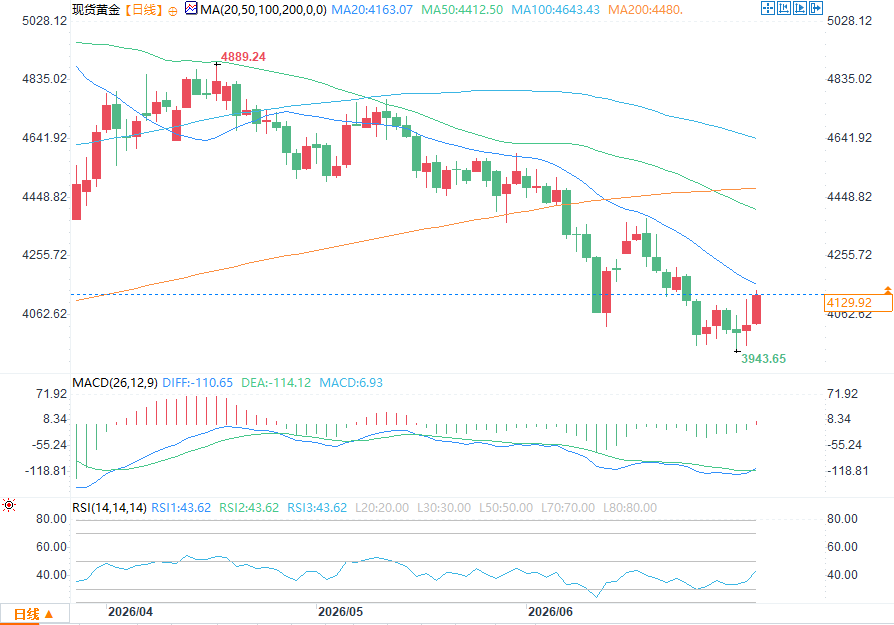
(Spot gold daily chart source: FX678)
From a technical perspective, the next key upside target for spot gold bulls is to push the price above the resistance zone of $4162.36/oz to $4214.34/oz. If the price breaks through this zone and holds, further upside potential will open up, potentially reaching $4382.62/oz, with the ultimate bullish target at $4411.94/oz.
The short-term downside target for bears is a break below the key support level of $3959/oz. A decisive break below this level would trigger a deeper correction in gold prices, with secondary support at $3942.10/oz and a further downside target of $3886.46/oz. The first short-term resistance level for gold is $4162.36/oz, and the second resistance level is $4214.34/oz; the first support level is $3959.00/oz, and the second support level is $3942.10/oz.
Technical Analysis of Silver
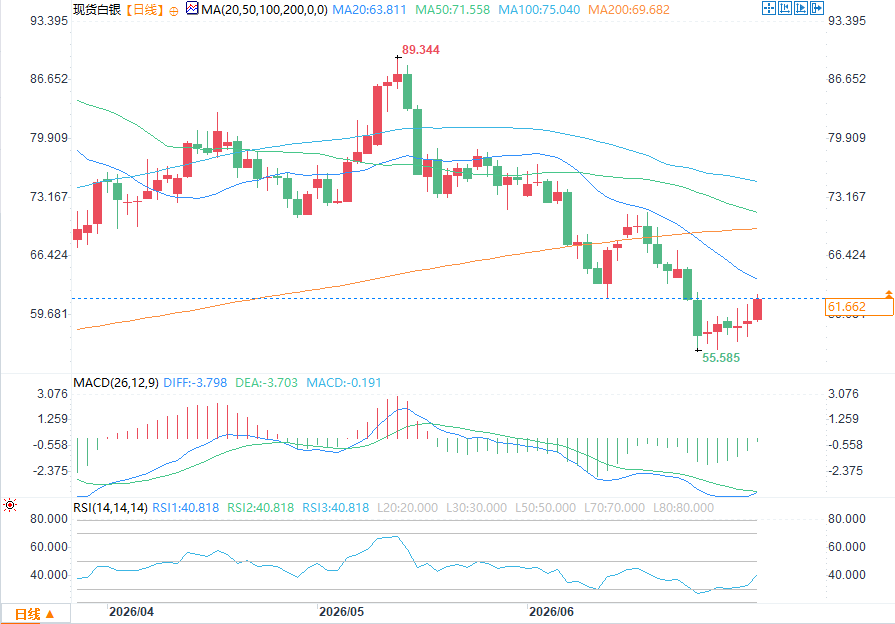
(Spot silver daily chart source: EasyTrade)
The main focus for spot silver bulls is to push the price above the core resistance zone of $60.05/oz to $63.32/oz. If the price successfully breaks through and stabilizes, it will continue its rebound, with upward targets at $65.03/oz and $69.85/oz respectively.
The key short-term support level for silver is $58.83/oz. A break below this level would trigger a new round of correction, with further downside targets at $58.00/oz and $55.58/oz. The first short-term resistance level is $60.05/oz, and the second is $63.32/oz. The core support level is $58.83/oz, and the secondary support level is $58.00/oz.
The June US non-farm payrolls report completely altered market expectations regarding the Federal Reserve's monetary policy, prompting investors to adjust their asset allocation strategies. The overall market focus shifted towards expectations of a slower pace of tightening by the Fed. Data showed that US non-farm payrolls increased by only 57,000 in June, far below the market's median expectation of 115,000. Simultaneously, the US unemployment rate slightly declined to 4.2%, and the combined downward revision of April and May's non-farm payrolls data by 74,000 indicated a significant contraction in the overall expansion of the job market, highlighting a gradual cooling trend in the US labor market.
The overall weak employment data put downward pressure on the dollar, and the yield on the 10-year US Treasury note fell to 4.465% during the session. However, the mixed data did not force the Federal Reserve to immediately shift to an easing monetary policy. The low unemployment rate indicates that corporate layoffs are still relatively limited, and the labor market has not yet shown signs of a full-blown recession. As a result, market expectations for the timing of a Fed rate hike have been further delayed, the probability curve for rate hikes has continued to shift downward, and traders have postponed their expectations for a new round of Fed rate hikes from October to December, significantly cooling market expectations for short-term monetary policy tightening.
The shipping situation in the Strait of Hormuz has not completely calmed down. Market tensions have eased somewhat but have not completely subsided. Currently, shipping in the strait is operating under a new normal of low volatility and low volume, rather than having completely eliminated the bottleneck of shipping risks. Over the past seven days, the number of ships passing through the strait daily has remained stable between 30 and 60, with an average of about 40 ships passing through daily this week, indicating a gradual restoration of shipping order. However, the control over navigation in the strait remains highly controversial, and market uncertainty has not been completely eliminated. Iran continues to assert its dominance over the management of shipping in the Strait of Hormuz, while the US military has clearly stated that no country has the right to block or control this important international waterway. This stalemate between the two sides means that shipping in the strait faces potential geopolitical risks in the long term, continuously providing safe-haven support for precious metals.
Currently, market traders are closely watching the closing movements of the US spot financial markets ahead of the Independence Day holiday. Pre-holiday trading is expected to be cautious, with increased adjustments to market positions; therefore, closing volatility warrants close attention. Meanwhile, the US inflation data to be released on July 14th will be a key reference point for subsequent adjustments to the Federal Reserve's monetary policy. Due to the approaching Independence Day holiday, market liquidity is tightening significantly. This thinning liquidity will amplify the price volatility of the US dollar, US Treasury yields, and precious metals, significantly increasing short-term market uncertainty.
In the global commodities market, New York WTI crude oil prices fell slightly, with an intraday price of around $67.19 per barrel; London Brent crude oil also declined, with prices remaining around $70.26 per barrel. The US dollar index was under overall downward pressure and continued to weaken, while the benchmark 10-year US Treasury yield hovered around the 4.478% mark. The weakening dollar combined with the decline in US Treasury yields created a double boost, supporting higher precious metal prices.
Gold Technical Analysis
(Spot gold daily chart source: FX678)
From a technical perspective, the next key upside target for spot gold bulls is to push the price above the resistance zone of $4162.36/oz to $4214.34/oz. If the price breaks through this zone and holds, further upside potential will open up, potentially reaching $4382.62/oz, with the ultimate bullish target at $4411.94/oz.
The short-term downside target for bears is a break below the key support level of $3959/oz. A decisive break below this level would trigger a deeper correction in gold prices, with secondary support at $3942.10/oz and a further downside target of $3886.46/oz. The first short-term resistance level for gold is $4162.36/oz, and the second resistance level is $4214.34/oz; the first support level is $3959.00/oz, and the second support level is $3942.10/oz.
Technical Analysis of Silver
(Spot silver daily chart source: EasyTrade)
The main focus for spot silver bulls is to push the price above the core resistance zone of $60.05/oz to $63.32/oz. If the price successfully breaks through and stabilizes, it will continue its rebound, with upward targets at $65.03/oz and $69.85/oz respectively.
The key short-term support level for silver is $58.83/oz. A break below this level would trigger a new round of correction, with further downside targets at $58.00/oz and $55.58/oz. The first short-term resistance level is $60.05/oz, and the second is $63.32/oz. The core support level is $58.83/oz, and the secondary support level is $58.00/oz.
- Risk Warning and Disclaimer
- The market involves risk, and trading may not be suitable for all investors. This article is for reference only and does not constitute personal investment advice, nor does it take into account certain users’ specific investment objectives, financial situation, or other needs. Any investment decisions made based on this information are at your own risk.