The significantly weaker-than-expected US non-farm payrolls data pressured the dollar, causing it to rise and then fall back. Gold is expected to return to range-bound trading.
2026-07-03 09:59:50
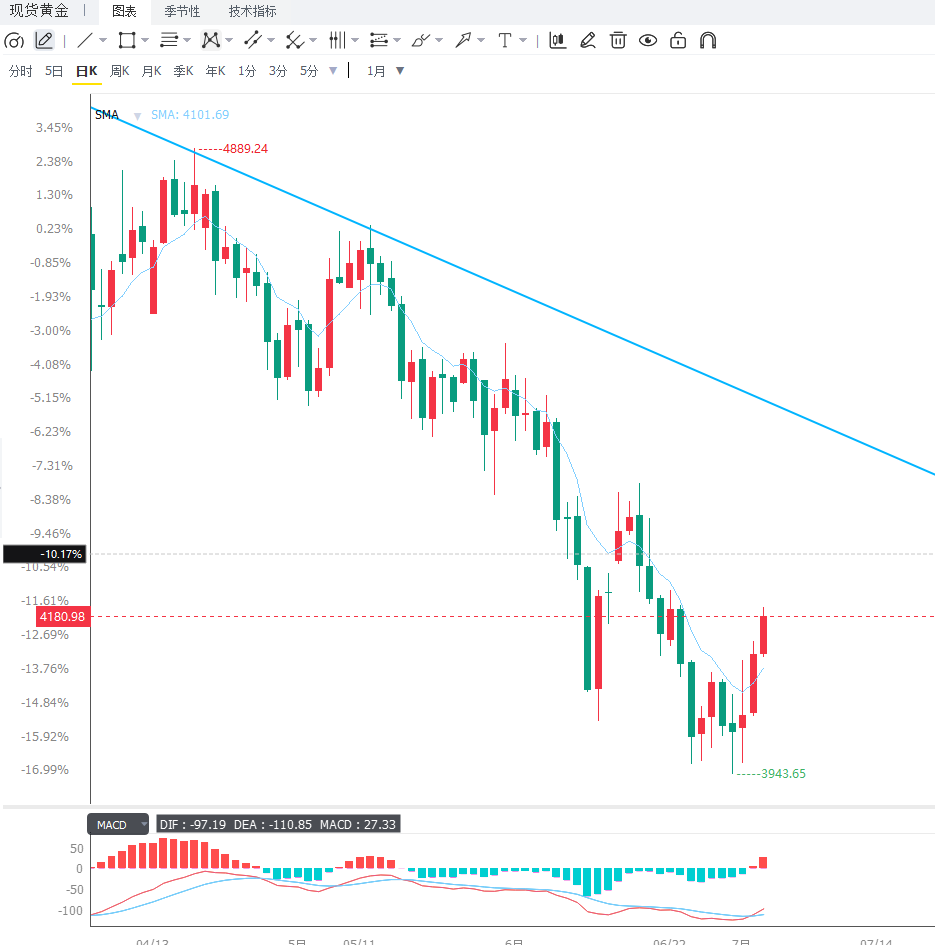
Spot gold (XAU/USD) continued its upward trend in early Asian trading, climbing to around $4180 , a new recent high. The core driver of this rally was the significant cooling of the latest US employment data and the rapid adjustment in market expectations regarding the path of monetary policy.

Data from the U.S. Bureau of Labor Statistics showed that nonfarm payrolls increased by only about 57,000 in June, significantly lower than the market consensus of 110,000, indicating a marked slowdown in the expansion momentum of the U.S. labor market. Although the unemployment rate fell slightly to 4.2% during the same period, a slight improvement from the previous value of 4.3%, the divergence in structural data failed to change the market's overall assessment of a cooling employment trend. In addition, the ADP private employment data released the previous day also fell short of expectations, further reinforcing the signal of an economic slowdown.
Following the data release, the market quickly adjusted its expectations for the Federal Reserve's policy path. Several traders pointed out that the weak jobs data significantly reduced the likelihood of further rate hikes this year and even increased the scope for future discussions on a shift towards easing. As market participants noted, "weaker jobs data means a lower probability of rate hikes, and gold typically performs better in a low-interest-rate environment," a logic that propelled gold prices to a rapid rise in a short period.
From a macroeconomic perspective, gold benefits from the dual support of declining real interest rate expectations and safe-haven demand. On the one hand, lower interest rate expectations reduce the opportunity cost of holding gold; on the other hand, global geopolitical uncertainties persist. The latest round of indirect US-Iran talks concluded in Doha, but no breakthroughs were achieved on key issues, and market concerns about a prolonged Middle East conflict continue.
At the same time, a complex interplay exists between geopolitical risks and macroeconomic policies. Some market participants believe that continued tensions in the Middle East could reignite energy prices, leading to a rise in inflation expectations and creating new disruptions to the Federal Reserve's policy path. This environment of "inflation and safe-haven demand coexisting" further highlights the dual nature of gold.
However, from a trading structure perspective, the market is gradually entering a phase of high-level consolidation. Gold prices have become significantly more volatile after the rapid breakout, with increased divergence between bulls and bears intensifying in the short term, and some profit-taking already showing signs of taking profits.
From a technical perspective, the daily chart shows that gold is still maintaining a strong upward trend overall, but after accelerating above $4100, the price has entered a high-level extension phase, and signs of momentum slowing down are beginning to emerge. The key support level to watch is the $4050 area, which is a previous breakout platform and a dense area of short-term moving averages; a break below this level could trigger a pullback. On the upside, resistance is gradually moving up to the $4180-$4200 range, which combines psychological resistance with previous highs.
From the 4-hour chart, gold prices show a clear stepped upward structure, but the short-term RSI has entered a high range, and momentum indicators show some signs of bearish divergence, indicating that the upward momentum has slowed. If the price fails to break through above $4120 with sustained volume, it may enter a period of consolidation at higher levels; conversely, a breakout above the $4200 level with significant volume could initiate a new round of trend extension. Overall, the short-term trend remains bullish, but increased volatility means a corresponding increase in trading risk.
Editor's Summary:
This round of gold price increases was driven by a combination of significantly weak US employment data and rising expectations of interest rate cuts, while geopolitical uncertainty provided additional safe-haven support. The market has now shifted from a single macroeconomic logic to a dual-driven model of "interest rate expectations + geopolitical risks." In the short term, while gold prices remain strong, increased volatility at high levels suggests a need for technical consolidation. In the medium term, if US economic data continues to weaken and expectations of a policy shift persist, gold is likely to maintain a relatively strong upward trend, but the risk of a phased correction due to recurring inflation or easing geopolitical tensions should be closely monitored.
Data from the U.S. Bureau of Labor Statistics showed that nonfarm payrolls increased by only about 57,000 in June, significantly lower than the market consensus of 110,000, indicating a marked slowdown in the expansion momentum of the U.S. labor market. Although the unemployment rate fell slightly to 4.2% during the same period, a slight improvement from the previous value of 4.3%, the divergence in structural data failed to change the market's overall assessment of a cooling employment trend. In addition, the ADP private employment data released the previous day also fell short of expectations, further reinforcing the signal of an economic slowdown.
Following the data release, the market quickly adjusted its expectations for the Federal Reserve's policy path. Several traders pointed out that the weak jobs data significantly reduced the likelihood of further rate hikes this year and even increased the scope for future discussions on a shift towards easing. As market participants noted, "weaker jobs data means a lower probability of rate hikes, and gold typically performs better in a low-interest-rate environment," a logic that propelled gold prices to a rapid rise in a short period.
From a macroeconomic perspective, gold benefits from the dual support of declining real interest rate expectations and safe-haven demand. On the one hand, lower interest rate expectations reduce the opportunity cost of holding gold; on the other hand, global geopolitical uncertainties persist. The latest round of indirect US-Iran talks concluded in Doha, but no breakthroughs were achieved on key issues, and market concerns about a prolonged Middle East conflict continue.
At the same time, a complex interplay exists between geopolitical risks and macroeconomic policies. Some market participants believe that continued tensions in the Middle East could reignite energy prices, leading to a rise in inflation expectations and creating new disruptions to the Federal Reserve's policy path. This environment of "inflation and safe-haven demand coexisting" further highlights the dual nature of gold.
However, from a trading structure perspective, the market is gradually entering a phase of high-level consolidation. Gold prices have become significantly more volatile after the rapid breakout, with increased divergence between bulls and bears intensifying in the short term, and some profit-taking already showing signs of taking profits.
From a technical perspective, the daily chart shows that gold is still maintaining a strong upward trend overall, but after accelerating above $4100, the price has entered a high-level extension phase, and signs of momentum slowing down are beginning to emerge. The key support level to watch is the $4050 area, which is a previous breakout platform and a dense area of short-term moving averages; a break below this level could trigger a pullback. On the upside, resistance is gradually moving up to the $4180-$4200 range, which combines psychological resistance with previous highs.
From the 4-hour chart, gold prices show a clear stepped upward structure, but the short-term RSI has entered a high range, and momentum indicators show some signs of bearish divergence, indicating that the upward momentum has slowed. If the price fails to break through above $4120 with sustained volume, it may enter a period of consolidation at higher levels; conversely, a breakout above the $4200 level with significant volume could initiate a new round of trend extension. Overall, the short-term trend remains bullish, but increased volatility means a corresponding increase in trading risk.
Editor's Summary:
This round of gold price increases was driven by a combination of significantly weak US employment data and rising expectations of interest rate cuts, while geopolitical uncertainty provided additional safe-haven support. The market has now shifted from a single macroeconomic logic to a dual-driven model of "interest rate expectations + geopolitical risks." In the short term, while gold prices remain strong, increased volatility at high levels suggests a need for technical consolidation. In the medium term, if US economic data continues to weaken and expectations of a policy shift persist, gold is likely to maintain a relatively strong upward trend, but the risk of a phased correction due to recurring inflation or easing geopolitical tensions should be closely monitored.
- Risk Warning and Disclaimer
- The market involves risk, and trading may not be suitable for all investors. This article is for reference only and does not constitute personal investment advice, nor does it take into account certain users’ specific investment objectives, financial situation, or other needs. Any investment decisions made based on this information are at your own risk.