Wells Fargo's key analysis: Inflation is a supply-side issue, not overheated demand; Fed rate hikes are "out of the question."
2026-07-03 16:06:51
On Friday (July 3) during the European session, the US dollar index continued its downward trend from the previous trading day and is currently trading around 100.70.
On July 2, local time, the latest non-farm payroll report showed that the United States added only 57,000 jobs in June, significantly lower than the expected 115,000.
Meanwhile, the number of new nonfarm jobs in April was revised down from 179,000 to 148,000, a decrease of 31,000; and in May, it was revised down from 172,000 to 129,000, a decrease of 43,000. The combined downward revisions for the two months totaled 74,000.
The US job market has seen a significant slowdown in growth, with new job creation falling far short of expectations and previous data being revised downwards considerably. Expectations for a Federal Reserve rate hike have also cooled rapidly.
Wells Fargo's economic research team (led by Tom Porcelli) expects the release of the minutes from the Fed's June FOMC meeting next week to provide clues about how the internal divisions within the committee have evolved, but the bank maintains its view that the Fed will keep the federal funds rate unchanged.
Wells Fargo points out that recent U.S. inflation has been primarily driven by supply-side factors (including tariffs and energy prices), while the labor market has not shown signs of overheating. Therefore, inflationary pressures should subside over time and are unlikely to trigger further interest rate hikes.
Wells Fargo said the market will be closely watching the FOMC meeting minutes to be released next week for any signs that the committee’s internal divisions may have shifted from “holding rates steady” to “raising rates.”
The dot plot from the June meeting clearly shows that policymakers are significantly divided on whether further interest rate hikes are needed.
However, with forward guidance being downplayed during Chairman Warsh's tenure, uncertainty remains regarding the Fed's response mechanism—it is unclear what conditions will garner broader support to push for a tighter policy.
Wells Fargo will focus on two key areas:
The assessment of the sustainability of inflation – whether most participants believe that the recent rebound in inflation is sufficiently sustainable to support further tightening, or whether they view it as primarily a temporary supply-side shock;
The role of the labor market – to what extent do committee members view the labor market/demand side as the source of inflation?
Despite the potentially hawkish tone of the meeting minutes, Wells Fargo reiterated its core view that the recent surge in inflation is primarily driven by supply-side factors, including tariffs and energy prices, and that the impact of these factors should gradually subside over time.
Oil prices have fallen further since the June meeting, which should help alleviate market concerns about a potential further spread of energy-related inflation. Meanwhile, the June jobs report showed no signs of an overheated labor market or any contribution to overall inflationary pressures.
Based on these two points, Wells Fargo continues to expect the FOMC to maintain the federal funds rate unchanged for the foreseeable future.
According to the 4-hour chart of the US Dollar Index, the short-term bullish trend has ended, and the index has entered a downward correction phase. The previous two attempts to break through 101.80 and 101.59 formed a double top, leading to a significant price pullback. Short-term moving averages have now become resistance: the 20-day moving average (MA20) (101.15) and the 50-day moving average (MA50) are above the price, the 100-day moving average (MA100) is near the current price and forms short-term resistance, the 200-day moving average (MA200) is the medium-term support, and the recent low of 100.55 is a key short-term support level.
In terms of indicators, the MACD lines have fallen below the zero axis, the DIFF line at -0.1360 is lower than the DEA line at -0.0695, and the bearish green bars continue to expand, indicating strong short-term downward momentum. The RSI value is 33.09, close to the oversold zone of 30, indicating a need for a slight technical rebound in the short term, but there is no sign of a golden cross or stabilization yet.
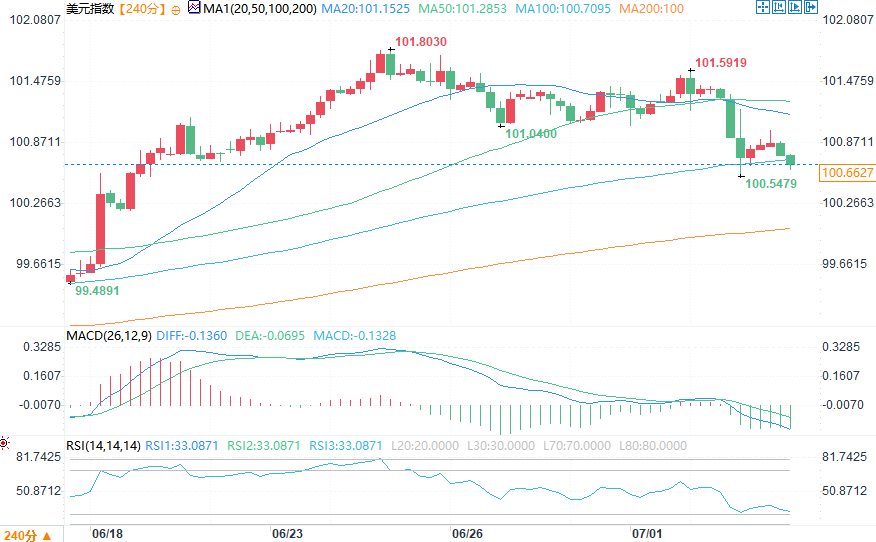
(US Dollar Index 4-hour chart, source: FX678)
At 16:02 Beijing time on July 3, the US dollar index was at 100.70.
On July 2, local time, the latest non-farm payroll report showed that the United States added only 57,000 jobs in June, significantly lower than the expected 115,000.
Meanwhile, the number of new nonfarm jobs in April was revised down from 179,000 to 148,000, a decrease of 31,000; and in May, it was revised down from 172,000 to 129,000, a decrease of 43,000. The combined downward revisions for the two months totaled 74,000.
The US job market has seen a significant slowdown in growth, with new job creation falling far short of expectations and previous data being revised downwards considerably. Expectations for a Federal Reserve rate hike have also cooled rapidly.
Wells Fargo's economic research team (led by Tom Porcelli) expects the release of the minutes from the Fed's June FOMC meeting next week to provide clues about how the internal divisions within the committee have evolved, but the bank maintains its view that the Fed will keep the federal funds rate unchanged.
Wells Fargo points out that recent U.S. inflation has been primarily driven by supply-side factors (including tariffs and energy prices), while the labor market has not shown signs of overheating. Therefore, inflationary pressures should subside over time and are unlikely to trigger further interest rate hikes.
The FOMC minutes are attracting much attention: disagreements and clues to policy path.
Wells Fargo said the market will be closely watching the FOMC meeting minutes to be released next week for any signs that the committee’s internal divisions may have shifted from “holding rates steady” to “raising rates.”
The dot plot from the June meeting clearly shows that policymakers are significantly divided on whether further interest rate hikes are needed.
However, with forward guidance being downplayed during Chairman Warsh's tenure, uncertainty remains regarding the Fed's response mechanism—it is unclear what conditions will garner broader support to push for a tighter policy.
Key focus areas: Inflationary characteristics and the labor market
Wells Fargo will focus on two key areas:
The assessment of the sustainability of inflation – whether most participants believe that the recent rebound in inflation is sufficiently sustainable to support further tightening, or whether they view it as primarily a temporary supply-side shock;
The role of the labor market – to what extent do committee members view the labor market/demand side as the source of inflation?
Wells Fargo's assessment: Supply-driven growth is the primary driver, and interest rate hikes are unnecessary.
Despite the potentially hawkish tone of the meeting minutes, Wells Fargo reiterated its core view that the recent surge in inflation is primarily driven by supply-side factors, including tariffs and energy prices, and that the impact of these factors should gradually subside over time.
Oil prices have fallen further since the June meeting, which should help alleviate market concerns about a potential further spread of energy-related inflation. Meanwhile, the June jobs report showed no signs of an overheated labor market or any contribution to overall inflationary pressures.
Based on these two points, Wells Fargo continues to expect the FOMC to maintain the federal funds rate unchanged for the foreseeable future.
Technical Analysis
According to the 4-hour chart of the US Dollar Index, the short-term bullish trend has ended, and the index has entered a downward correction phase. The previous two attempts to break through 101.80 and 101.59 formed a double top, leading to a significant price pullback. Short-term moving averages have now become resistance: the 20-day moving average (MA20) (101.15) and the 50-day moving average (MA50) are above the price, the 100-day moving average (MA100) is near the current price and forms short-term resistance, the 200-day moving average (MA200) is the medium-term support, and the recent low of 100.55 is a key short-term support level.
In terms of indicators, the MACD lines have fallen below the zero axis, the DIFF line at -0.1360 is lower than the DEA line at -0.0695, and the bearish green bars continue to expand, indicating strong short-term downward momentum. The RSI value is 33.09, close to the oversold zone of 30, indicating a need for a slight technical rebound in the short term, but there is no sign of a golden cross or stabilization yet.
(US Dollar Index 4-hour chart, source: FX678)
At 16:02 Beijing time on July 3, the US dollar index was at 100.70.
- Risk Warning and Disclaimer
- The market involves risk, and trading may not be suitable for all investors. This article is for reference only and does not constitute personal investment advice, nor does it take into account certain users’ specific investment objectives, financial situation, or other needs. Any investment decisions made based on this information are at your own risk.