USD/JPY Analysis: Currency Market Intervention Fails to Break the Structural Weakness of the Yen
2026-07-03 19:01:03
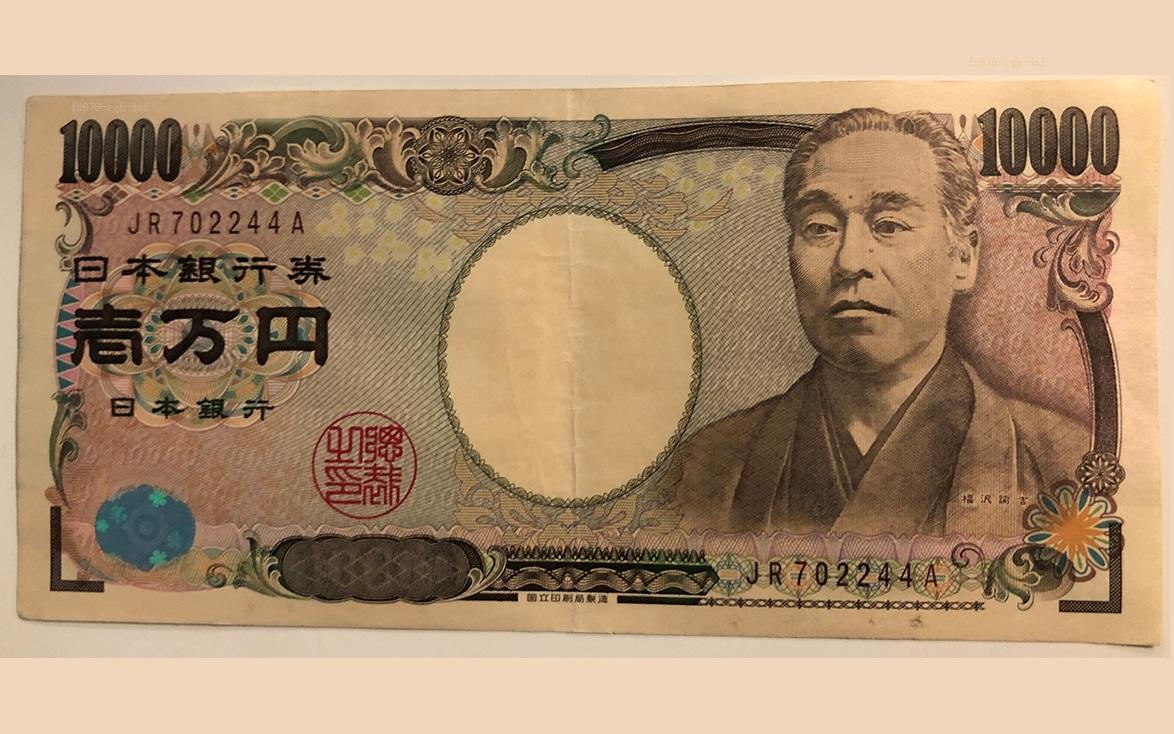
On Friday (July 3), the continued divergence in monetary policies between the US and Japan further solidified the yen's weakness. The USD/JPY exchange rate touched 162.38 during the Asian session on June 30, a 40-year low since 1986. Entering the latest trading day on July 2, the exchange rate continued its wide-range fluctuation, opening at 162.60, reaching a low of 160.62, and trading at 161.09, showing a significant short-term pullback from its historical high.
The market generally believes that this round of correction may be affected by both potential foreign exchange intervention by Japan and weak US employment data. However, from a fundamental perspective, short-term intervention can only create short-term fluctuations and cannot reverse the long-term structural depreciation trend of the yen. Crowded carry trade positions also continue to increase the risk of a sharp reversal in the exchange rate.
The core reason for the yen's weakness: the severe divergence in monetary policies between the US and Japan.
The core reason for the continued weakening of the yen lies in the significant divergence between the monetary policies and interest rate expectations of the US and Japan. At the beginning of 2026, the market initially bet on two Federal Reserve rate cuts within the year, but current market expectations have completely reversed. The probability of a Fed rate hike in December has risen to 80%, corresponding to a sharp increase in the implied yield of US Treasury futures from 3.05% to 3.95%. Conversely, the Bank of Japan's policy stance has remained consistently conservative. Even with domestic inflation consistently exceeding the policy target, the implied yield of interest rate futures at the end of the year actually fell from 1.29% at the beginning of the year to 1.20%, indicating no substantial shift in the easing stance. The continuously widening US-Japan interest rate differential has spurred large-scale yen carry trades, with investors borrowing yen at extremely low costs and increasing their holdings of high-yield dollar assets, continuously suppressing the yen's exchange rate valuation.
External negative factors combined further dragged down the yen's exchange rate.
Besides the divergence in monetary policy, two external factors continue to weigh on the yen's performance. As an economy heavily reliant on Middle Eastern energy imports, Japan's geopolitical conflicts have led to a risk premium that has driven up oil prices, further deteriorating its terms of trade and making the yen more vulnerable to depreciation compared to other major currencies. Meanwhile, foreign capital has flowed heavily into the Japanese stock market this year, with net purchases of Japanese stocks by overseas investors reaching 10.2 trillion yen in the first 24 weeks. However, this has not provided effective support for the yen. The core reason is that most foreign institutions simultaneously hedge against exchange rate risks. Large-scale hedging operations in a weak yen environment have continuously created yen selling pressure in the foreign exchange market, completely offsetting the positive effects of capital inflows.
Institutional Interpretation: Low Liquidity During Holidays Increases Intervention Risk
ING Group provides its latest interpretation of the recent yen's pullback. The bank points out that the USD/JPY pair generally trended downwards on July 2nd. Even though weak US employment data briefly pushed the exchange rate below the 161.0 level, the decline continued. This round of decline cannot be ruled out as a result of covert foreign exchange intervention by the Bank of Japan. The market is currently affected by the US Independence Day holiday, and liquidity will tighten significantly in the coming days and on Monday, increasing the probability of phased intervention by Japanese authorities. Japanese regulators have historically favored using low-liquidity windows during holidays to conduct foreign exchange market regulation, with operations often taking place over several days. Intervention when the dollar is weak has been a typical operating style since 2024. Currently, the one-week risk reversal indicator for USD/JPY has fallen sharply, further confirming a significant increase in the probability of short-term intervention.
Intervention only addresses the symptoms, not the root cause; policy mismatch is the core issue.
The institution also emphasized the limitations of intervention measures. Looking back at market performance over the past two years, official Japanese intervention has consistently only provided short-term support for the yen, addressing the symptoms but not the root cause. In April and May of this year, the Japanese Ministry of Finance intervened in the market with a record 11.7 trillion yen (US$73.6 billion), briefly suppressing the USD/JPY exchange rate to the 155-156 range. However, the exchange rate fully recovered its losses in less than two months. Similar interventions in 2024 exhibited the same ineffective characteristics. Even though Japan currently has ample foreign exchange reserves, reaching US$1.094 trillion as of the end of May, enough to support more than ten large-scale interventions, 70% of these reserves are in US Treasury bonds. Large-scale selling of US Treasury bonds to intervene in the foreign exchange market would push up US Treasury yields, triggering a chain reaction of global financial fluctuations, thus limiting Japan's capacity for continued intervention.
ING Group has explicitly warned that if the Bank of Japan does not implement a tough interest rate hike and tightening policy and change its easing stance, the situation of "intervention to temporarily support the currency and then a rapid rebound" that occurred in April and May this year will be repeated, and the weak yen trend cannot be fundamentally reversed.
Short positions are extremely crowded, increasing the risk of a currency reversal.
From the perspective of market positioning, the current short positions in the Japanese yen are extremely crowded. As of June 22, CFTC data shows that net short positions in the yen reached $11.3 billion, approaching a two-year peak and comparable to the high level in July 2024. Historical experience shows that dense short positions combined with sudden intervention can easily trigger a concentrated unwinding of carry trades. In July 2024, intervention combined with central bank interest rate hikes propelled the yen to its strongest rebound in recent years. The current market also harbors the risk of a significant reversal.
Technical Analysis of Key Levels
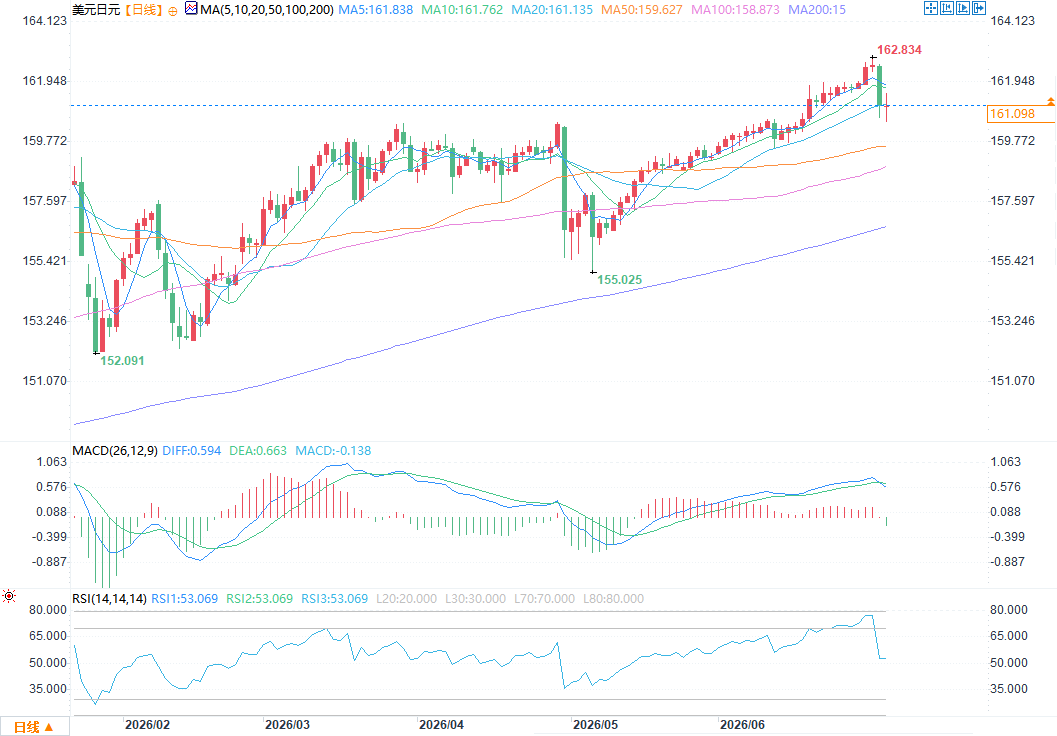
(USD/JPY daily chart source: EasyForex)
From a technical perspective, excluding unforeseen intervention factors, the core upside target for USD/JPY remains at 163.64, corresponding to the 100% Fibonacci extension of the gains from January to April this year. The key short-term support lies at 160.9, coinciding with the 20-day moving average. If this level is breached, the exchange rate will further decline to the 157.6-158.0 range, opening up further room for fluctuations.
The market generally believes that this round of correction may be affected by both potential foreign exchange intervention by Japan and weak US employment data. However, from a fundamental perspective, short-term intervention can only create short-term fluctuations and cannot reverse the long-term structural depreciation trend of the yen. Crowded carry trade positions also continue to increase the risk of a sharp reversal in the exchange rate.
The core reason for the yen's weakness: the severe divergence in monetary policies between the US and Japan.
The core reason for the continued weakening of the yen lies in the significant divergence between the monetary policies and interest rate expectations of the US and Japan. At the beginning of 2026, the market initially bet on two Federal Reserve rate cuts within the year, but current market expectations have completely reversed. The probability of a Fed rate hike in December has risen to 80%, corresponding to a sharp increase in the implied yield of US Treasury futures from 3.05% to 3.95%. Conversely, the Bank of Japan's policy stance has remained consistently conservative. Even with domestic inflation consistently exceeding the policy target, the implied yield of interest rate futures at the end of the year actually fell from 1.29% at the beginning of the year to 1.20%, indicating no substantial shift in the easing stance. The continuously widening US-Japan interest rate differential has spurred large-scale yen carry trades, with investors borrowing yen at extremely low costs and increasing their holdings of high-yield dollar assets, continuously suppressing the yen's exchange rate valuation.
External negative factors combined further dragged down the yen's exchange rate.
Besides the divergence in monetary policy, two external factors continue to weigh on the yen's performance. As an economy heavily reliant on Middle Eastern energy imports, Japan's geopolitical conflicts have led to a risk premium that has driven up oil prices, further deteriorating its terms of trade and making the yen more vulnerable to depreciation compared to other major currencies. Meanwhile, foreign capital has flowed heavily into the Japanese stock market this year, with net purchases of Japanese stocks by overseas investors reaching 10.2 trillion yen in the first 24 weeks. However, this has not provided effective support for the yen. The core reason is that most foreign institutions simultaneously hedge against exchange rate risks. Large-scale hedging operations in a weak yen environment have continuously created yen selling pressure in the foreign exchange market, completely offsetting the positive effects of capital inflows.
Institutional Interpretation: Low Liquidity During Holidays Increases Intervention Risk
ING Group provides its latest interpretation of the recent yen's pullback. The bank points out that the USD/JPY pair generally trended downwards on July 2nd. Even though weak US employment data briefly pushed the exchange rate below the 161.0 level, the decline continued. This round of decline cannot be ruled out as a result of covert foreign exchange intervention by the Bank of Japan. The market is currently affected by the US Independence Day holiday, and liquidity will tighten significantly in the coming days and on Monday, increasing the probability of phased intervention by Japanese authorities. Japanese regulators have historically favored using low-liquidity windows during holidays to conduct foreign exchange market regulation, with operations often taking place over several days. Intervention when the dollar is weak has been a typical operating style since 2024. Currently, the one-week risk reversal indicator for USD/JPY has fallen sharply, further confirming a significant increase in the probability of short-term intervention.
Intervention only addresses the symptoms, not the root cause; policy mismatch is the core issue.
The institution also emphasized the limitations of intervention measures. Looking back at market performance over the past two years, official Japanese intervention has consistently only provided short-term support for the yen, addressing the symptoms but not the root cause. In April and May of this year, the Japanese Ministry of Finance intervened in the market with a record 11.7 trillion yen (US$73.6 billion), briefly suppressing the USD/JPY exchange rate to the 155-156 range. However, the exchange rate fully recovered its losses in less than two months. Similar interventions in 2024 exhibited the same ineffective characteristics. Even though Japan currently has ample foreign exchange reserves, reaching US$1.094 trillion as of the end of May, enough to support more than ten large-scale interventions, 70% of these reserves are in US Treasury bonds. Large-scale selling of US Treasury bonds to intervene in the foreign exchange market would push up US Treasury yields, triggering a chain reaction of global financial fluctuations, thus limiting Japan's capacity for continued intervention.
ING Group has explicitly warned that if the Bank of Japan does not implement a tough interest rate hike and tightening policy and change its easing stance, the situation of "intervention to temporarily support the currency and then a rapid rebound" that occurred in April and May this year will be repeated, and the weak yen trend cannot be fundamentally reversed.
Short positions are extremely crowded, increasing the risk of a currency reversal.
From the perspective of market positioning, the current short positions in the Japanese yen are extremely crowded. As of June 22, CFTC data shows that net short positions in the yen reached $11.3 billion, approaching a two-year peak and comparable to the high level in July 2024. Historical experience shows that dense short positions combined with sudden intervention can easily trigger a concentrated unwinding of carry trades. In July 2024, intervention combined with central bank interest rate hikes propelled the yen to its strongest rebound in recent years. The current market also harbors the risk of a significant reversal.
Technical Analysis of Key Levels
(USD/JPY daily chart source: EasyForex)
From a technical perspective, excluding unforeseen intervention factors, the core upside target for USD/JPY remains at 163.64, corresponding to the 100% Fibonacci extension of the gains from January to April this year. The key short-term support lies at 160.9, coinciding with the 20-day moving average. If this level is breached, the exchange rate will further decline to the 157.6-158.0 range, opening up further room for fluctuations.
- Risk Warning and Disclaimer
- The market involves risk, and trading may not be suitable for all investors. This article is for reference only and does not constitute personal investment advice, nor does it take into account certain users’ specific investment objectives, financial situation, or other needs. Any investment decisions made based on this information are at your own risk.