Futures premiums are sounding alarm bells; is the crude oil market trading a new round of surplus?
2026-07-03 20:52:31
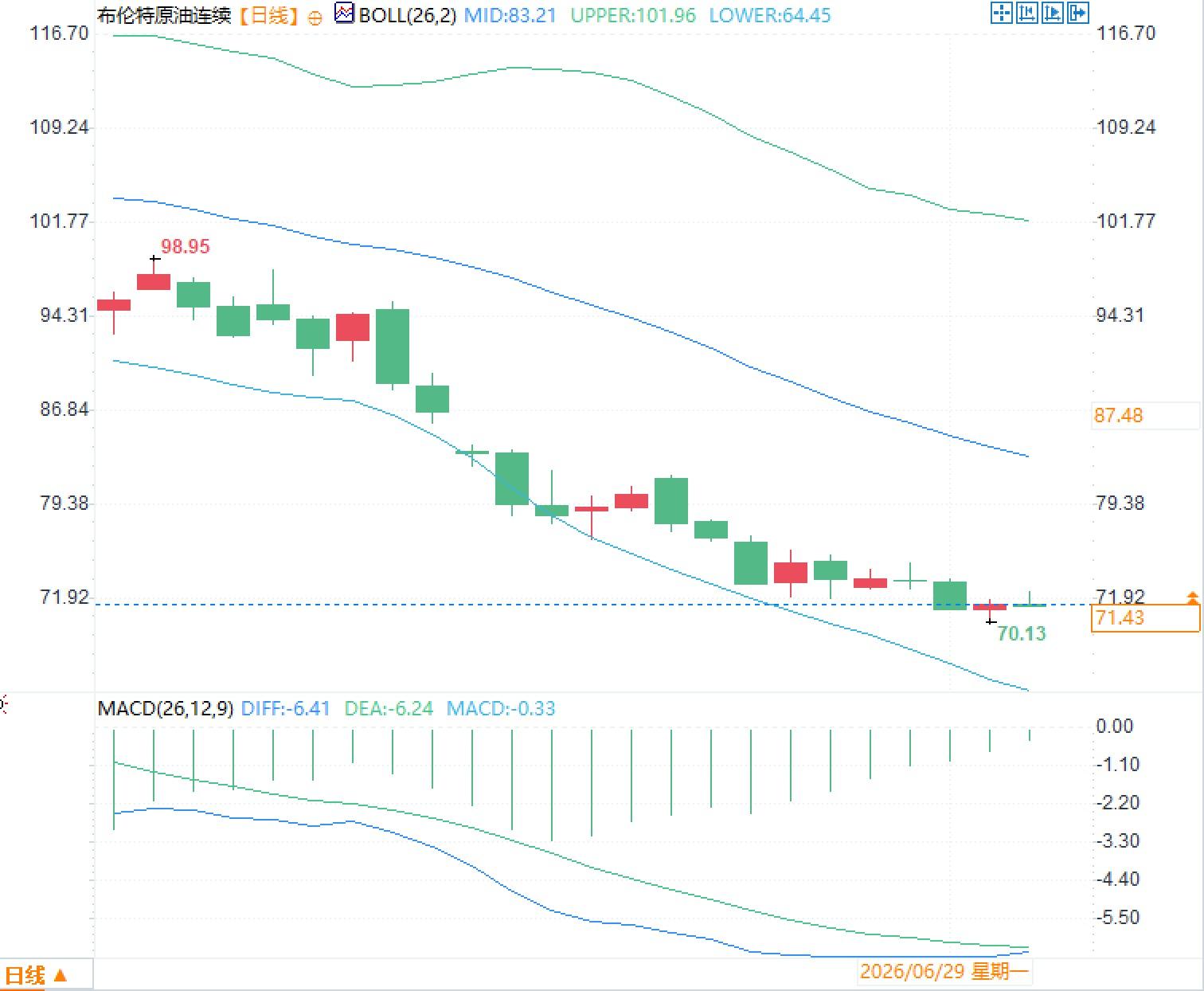
On Friday, July 3, Brent crude continued to fluctuate below $72 per barrel in a low-liquidity market, while WTI crude hovered below $69 per barrel, with prices having largely erased the premium from the previous US-Iran conflict. More importantly, the Brent near-term spread briefly shifted to a futures premium structure, reflecting that the market is retracing its trading based on supply recovery, weak demand, and the inventory cycle, rather than simply trading on the risk of the Strait of Hormuz.

The core issue behind this round of oil price declines is not a single-day reversal of sentiment, but rather a shift in market pricing anchor from risk premiums back to fundamentals. Saudi crude oil exports have recovered to approximately 90% of pre-conflict levels, the UAE is also seeing a similar rebound, Iraqi exports are showing signs of recovery, and Iran's floating storage capacity is increasing. This means that the discount on Gulf supply, which was previously highly valued by traders, is being repriced.
Brent crude fell by about 30% in the second quarter, which illustrates one thing: risk buying driven by conflict disturbances did not create a long-term inventory gap; instead, it exposed short-term supply pressures after the channel reopened. The current low-level fluctuations are not a simple "rebound after a sharp drop," but rather a correction in the spot price spread and futures curve as short-term supplies re-enter the market.
More important than the $72 per barrel level is the curve pattern. The weakness of the Brent near-month contract relative to the far-month contract indicates that the market is no longer willing to pay a premium for immediate delivery of crude oil. Typically, when supply is tight, near-month prices are stronger, and the curve shows a cash premium; while when near-end supply is ample and demand is insufficient, the futures premium structure suppresses the willingness to hold and forces the spot market to rebalance through discounts.
On the daily chart, the MACD remains below the zero line, with both DIFF and DEA showing negative values, indicating that the trend correction is not yet complete. However, after the Relative Strength Index (RSI) fell below 30 on the 14th, short-term oversold signals are accumulating, and the market may experience technical fluctuations. But this does not change the overall trend of the fundamentals shifting from tight to loose.
The latest official weekly report shows that for the week ending June 26, U.S. refinery inputs were 17.2 million barrels per day, with a refinery utilization rate of 96.6%, and gasoline production rose to around 10 million barrels per day. Commercial crude oil inventories decreased by 3.8 million barrels to 408.4 million barrels, still about 7% below the five-year average. On the surface, the inventory decline seems to indicate tight supply, but demand for refined products is not strong. Gasoline supply over the past four weeks was 9 million barrels per day, down 2.6% year-on-year, while distillate fuel oil supply was 3.7 million barrels per day, down 1.9% year-on-year.
This data suggests that high refinery operating rates have not translated into strong end-user demand. If Gulf exports continue to recover, and fuel demand remains inelastic during the summer, the spot market will feel supply pressure more quickly. Low crude oil inventories do not necessarily equate to strong oil prices, as refined product crack spreads, gasoline consumption, and floating storage changes collectively determine refinery restocking intentions. The current contradiction is that while short-term crude oil supply is improving, refined product demand lacks a sufficient upward slope.
Regarding the oil-producing alliance, Saudi Arabia, Russia, Iraq, Kuwait, Kazakhstan, Algeria, and Oman decided on June 7 to implement a production adjustment of 188,000 barrels per day in July, emphasizing that the arrangement could be suspended, increased, or reversed based on market conditions. The next meeting is scheduled for July 5. This arrangement provides flexibility on the supply side, but also means that the market will continue to assess the pace of production increases and price tolerance.
Negotiation clues should not be overlooked. Trump recently stated that Iran "has agreed to almost everything we need." However, disagreements surrounding the administration of the Strait of Hormuz, passage fees, the nuclear issue, and the resolution of regional conflicts remain. Some institutions believe that if the temporary ceasefire framework continues and the passage is normalized, Brent crude could fall to the $60-$65 per barrel range by the end of the year; others argue that the fragility of the negotiations will retain tail risks. The current market is not completely denying risk, but rather reducing the probability weight of its occurrence.
The conflict premium recedes, and oil prices return to the balance sheet of supply and demand.
The core issue behind this round of oil price declines is not a single-day reversal of sentiment, but rather a shift in market pricing anchor from risk premiums back to fundamentals. Saudi crude oil exports have recovered to approximately 90% of pre-conflict levels, the UAE is also seeing a similar rebound, Iraqi exports are showing signs of recovery, and Iran's floating storage capacity is increasing. This means that the discount on Gulf supply, which was previously highly valued by traders, is being repriced.
Brent crude fell by about 30% in the second quarter, which illustrates one thing: risk buying driven by conflict disturbances did not create a long-term inventory gap; instead, it exposed short-term supply pressures after the channel reopened. The current low-level fluctuations are not a simple "rebound after a sharp drop," but rather a correction in the spot price spread and futures curve as short-term supplies re-enter the market.
The signals released by futures premiums are more important than absolute prices.
More important than the $72 per barrel level is the curve pattern. The weakness of the Brent near-month contract relative to the far-month contract indicates that the market is no longer willing to pay a premium for immediate delivery of crude oil. Typically, when supply is tight, near-month prices are stronger, and the curve shows a cash premium; while when near-end supply is ample and demand is insufficient, the futures premium structure suppresses the willingness to hold and forces the spot market to rebalance through discounts.
On the daily chart, the MACD remains below the zero line, with both DIFF and DEA showing negative values, indicating that the trend correction is not yet complete. However, after the Relative Strength Index (RSI) fell below 30 on the 14th, short-term oversold signals are accumulating, and the market may experience technical fluctuations. But this does not change the overall trend of the fundamentals shifting from tight to loose.
Demand failed to absorb the increased supply, and inventory data revealed structural contradictions.
The latest official weekly report shows that for the week ending June 26, U.S. refinery inputs were 17.2 million barrels per day, with a refinery utilization rate of 96.6%, and gasoline production rose to around 10 million barrels per day. Commercial crude oil inventories decreased by 3.8 million barrels to 408.4 million barrels, still about 7% below the five-year average. On the surface, the inventory decline seems to indicate tight supply, but demand for refined products is not strong. Gasoline supply over the past four weeks was 9 million barrels per day, down 2.6% year-on-year, while distillate fuel oil supply was 3.7 million barrels per day, down 1.9% year-on-year.
This data suggests that high refinery operating rates have not translated into strong end-user demand. If Gulf exports continue to recover, and fuel demand remains inelastic during the summer, the spot market will feel supply pressure more quickly. Low crude oil inventories do not necessarily equate to strong oil prices, as refined product crack spreads, gasoline consumption, and floating storage changes collectively determine refinery restocking intentions. The current contradiction is that while short-term crude oil supply is improving, refined product demand lacks a sufficient upward slope.
The policy flexibility of oil-producing countries and the US-Iran negotiations will determine the risk boundaries in the second half of the year.
Regarding the oil-producing alliance, Saudi Arabia, Russia, Iraq, Kuwait, Kazakhstan, Algeria, and Oman decided on June 7 to implement a production adjustment of 188,000 barrels per day in July, emphasizing that the arrangement could be suspended, increased, or reversed based on market conditions. The next meeting is scheduled for July 5. This arrangement provides flexibility on the supply side, but also means that the market will continue to assess the pace of production increases and price tolerance.
Negotiation clues should not be overlooked. Trump recently stated that Iran "has agreed to almost everything we need." However, disagreements surrounding the administration of the Strait of Hormuz, passage fees, the nuclear issue, and the resolution of regional conflicts remain. Some institutions believe that if the temporary ceasefire framework continues and the passage is normalized, Brent crude could fall to the $60-$65 per barrel range by the end of the year; others argue that the fragility of the negotiations will retain tail risks. The current market is not completely denying risk, but rather reducing the probability weight of its occurrence.
- Risk Warning and Disclaimer
- The market involves risk, and trading may not be suitable for all investors. This article is for reference only and does not constitute personal investment advice, nor does it take into account certain users’ specific investment objectives, financial situation, or other needs. Any investment decisions made based on this information are at your own risk.