With the co-management plan finalized and supply increasing, major investment banks are collectively bearish on the future of crude oil.
2026-07-03 21:31:55
TEHRAN, July 3 (Xinhua) -- According to Iran's Tasnim News Agency, Iranian Parliament Speaker Qassem Ghalibaf stated on July 3 that the Strait of Hormuz will be jointly managed by Iran and Oman.
This statement came from a meeting between Qalibaf and Iraqi Parliament Speaker Haibat al-Khalabsi. He explicitly mentioned that the memorandum of understanding previously signed by the US and Iran has been incorporated into this management plan, and that Iran is widely soliciting opinions from Iraq and other Persian Gulf littoral states on the joint management mechanism of the Straits.
This memorandum outlining the rules for governing the Strait of Hormuz is a key factor in the rapid return of shipping to normalcy in the Strait of Hormuz and the continued decline of geopolitical risk premiums. It has also become the core geopolitical basis for major Wall Street investment banks to lower their oil price expectations.
A recent energy research report from Citibank expressed an extremely bearish view on oil prices, predicting that Brent crude oil prices could fall to $60 per barrel by the end of the year, as oil transport through the Strait of Hormuz gradually returns to normal and geopolitical tensions between the US and Iran continue to ease.
A Citigroup analyst report provides clear trading guidance, advising investors to short the summer oil price rebound on rallies, and predicting that Brent crude oil will trade between $60 and $65 per barrel by the end of the year.
Meanwhile, Citigroup believes that the current US-Iran memorandum of understanding has a stable foundation for implementation, and the two sides are likely to finalize a formal agreement in the coming months. For the US, Iran, and most countries in the Middle East, the economic and security benefits of easing geopolitical conflicts far outweigh the costs of continued confrontation.
As a well-known investment bank holding a bearish view in the market, Citigroup's bearish outlook on oil prices is based on a confluence of multiple negative factors: the full opening of the Strait of Hormuz, the implementation of the Iran-Afghanistan co-management mechanism, and the continued clearing of geopolitical premiums; persistently weak domestic crude oil procurement demand; a concentrated release of crude oil in the Middle East in the short term, putting significant pressure on spot oil prices; and a slower-than-expected reduction in global crude oil inventories, with inventory support continuing to weaken.
There is also a mainstream bullish view on crude oil in the market. Many industry analysts have pointed out that four months have passed since the outbreak of the current Middle East geopolitical conflict, and crude oil inventories in the United States and many other countries around the world have fallen to multi-decade lows.
Based on past cyclical patterns, the subsequent demand from various countries to replenish their strategic reserves is expected to provide temporary support for international oil prices, creating short-term bullish support.
Goldman Sachs released an analysis this week that significantly weakened the bullish value of low inventory replenishment. The bank stated that even if the global crude oil replenishment cycle starts simultaneously, it will not be able to offset the pressure of large-scale oversupply in the market next year. The normalization of shipping in the Strait of Hormuz will further amplify the scale of surplus crude oil supply.
Samantha Dart, co-head of global commodities research at Goldman Sachs, said that calculations show the global crude oil oversupply will reach 3 million barrels per day next year.
Even if countries around the world make every effort to replenish their strategic oil reserves, they can only absorb about 1 million barrels of excess supply per day, leaving a supply surplus of nearly 2 million barrels per day in the market.
Since the US and Iran signed a memorandum of understanding and finalized a joint management plan for the Strait of Hormuz, several Wall Street investment banks have simultaneously turned to the short side, unanimously predicting that the oil market will fall into a state of oversupply next year.
Morgan Stanley has significantly lowered its oil price forecast for the next 18 months, with the core logic consistent with Citigroup and Goldman Sachs: the full resumption of shipping in the Strait of Hormuz, coupled with the continued release of incremental supply from the Middle East, will accelerate the arrival of a new round of crude oil oversupply cycle, and the upside potential of oil prices in the medium to long term will be continuously suppressed.
Considering the current market fundamentals and changes in geopolitical policies, the divergence between bulls and bears in the crude oil market is very clear.
Short-term low inventory levels and the resulting restocking demand can only provide temporary price support. The implementation of the Strait of Hormuz co-management mechanism, the full recovery of oil transportation, and the long-term oversupply expectations brought about by the easing of US-Iran geopolitical tensions have become the core basis for major investment banks' collective bearish outlook on oil prices. In terms of trading strategy, the summer rebound in crude oil prices is more suitable for shorting on rallies.
From a technical perspective, the overall adjustment in oil prices has been too large, and there is no significant rebound in the short term. It remains in a state where a rebound is imminent, presenting an opportunity to buy at opportune points.
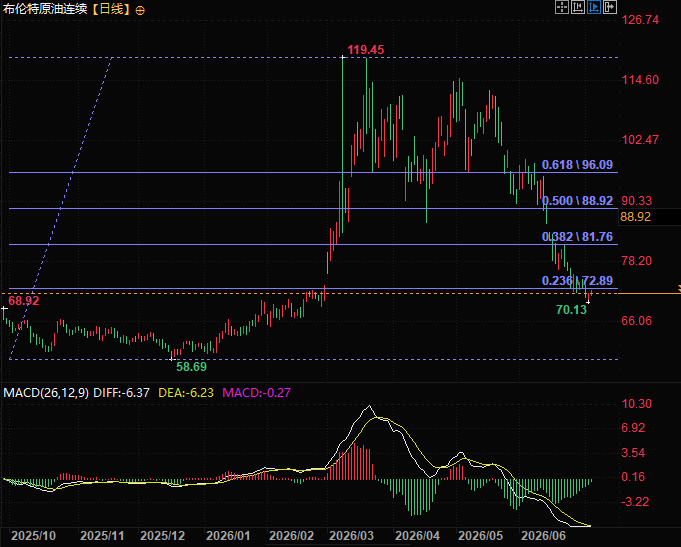
(Brent futures continuous daily chart, source: EasyForex)
At 21:29 Beijing time, Brent crude oil futures were trading at $71.93 per barrel.
This statement came from a meeting between Qalibaf and Iraqi Parliament Speaker Haibat al-Khalabsi. He explicitly mentioned that the memorandum of understanding previously signed by the US and Iran has been incorporated into this management plan, and that Iran is widely soliciting opinions from Iraq and other Persian Gulf littoral states on the joint management mechanism of the Straits.
This memorandum outlining the rules for governing the Strait of Hormuz is a key factor in the rapid return of shipping to normalcy in the Strait of Hormuz and the continued decline of geopolitical risk premiums. It has also become the core geopolitical basis for major Wall Street investment banks to lower their oil price expectations.
Citigroup issues pessimistic forecast: Brent crude oil may fall to $60/barrel by the end of the year.
A recent energy research report from Citibank expressed an extremely bearish view on oil prices, predicting that Brent crude oil prices could fall to $60 per barrel by the end of the year, as oil transport through the Strait of Hormuz gradually returns to normal and geopolitical tensions between the US and Iran continue to ease.
A Citigroup analyst report provides clear trading guidance, advising investors to short the summer oil price rebound on rallies, and predicting that Brent crude oil will trade between $60 and $65 per barrel by the end of the year.
Meanwhile, Citigroup believes that the current US-Iran memorandum of understanding has a stable foundation for implementation, and the two sides are likely to finalize a formal agreement in the coming months. For the US, Iran, and most countries in the Middle East, the economic and security benefits of easing geopolitical conflicts far outweigh the costs of continued confrontation.
As a well-known investment bank holding a bearish view in the market, Citigroup's bearish outlook on oil prices is based on a confluence of multiple negative factors: the full opening of the Strait of Hormuz, the implementation of the Iran-Afghanistan co-management mechanism, and the continued clearing of geopolitical premiums; persistently weak domestic crude oil procurement demand; a concentrated release of crude oil in the Middle East in the short term, putting significant pressure on spot oil prices; and a slower-than-expected reduction in global crude oil inventories, with inventory support continuing to weaken.
The market has bullish logic: low inventory levels may trigger a period of restocking support.
There is also a mainstream bullish view on crude oil in the market. Many industry analysts have pointed out that four months have passed since the outbreak of the current Middle East geopolitical conflict, and crude oil inventories in the United States and many other countries around the world have fallen to multi-decade lows.
Based on past cyclical patterns, the subsequent demand from various countries to replenish their strategic reserves is expected to provide temporary support for international oil prices, creating short-term bullish support.
Goldman Sachs refutes claims of restocking benefits: Global crude oil surplus to reach 3 million barrels per day next year.
Goldman Sachs released an analysis this week that significantly weakened the bullish value of low inventory replenishment. The bank stated that even if the global crude oil replenishment cycle starts simultaneously, it will not be able to offset the pressure of large-scale oversupply in the market next year. The normalization of shipping in the Strait of Hormuz will further amplify the scale of surplus crude oil supply.
Samantha Dart, co-head of global commodities research at Goldman Sachs, said that calculations show the global crude oil oversupply will reach 3 million barrels per day next year.
Even if countries around the world make every effort to replenish their strategic oil reserves, they can only absorb about 1 million barrels of excess supply per day, leaving a supply surplus of nearly 2 million barrels per day in the market.
Multiple investment banks have simultaneously turned bearish, limiting the upside potential for oil prices in the medium to long term.
Since the US and Iran signed a memorandum of understanding and finalized a joint management plan for the Strait of Hormuz, several Wall Street investment banks have simultaneously turned to the short side, unanimously predicting that the oil market will fall into a state of oversupply next year.
Morgan Stanley has significantly lowered its oil price forecast for the next 18 months, with the core logic consistent with Citigroup and Goldman Sachs: the full resumption of shipping in the Strait of Hormuz, coupled with the continued release of incremental supply from the Middle East, will accelerate the arrival of a new round of crude oil oversupply cycle, and the upside potential of oil prices in the medium to long term will be continuously suppressed.
Trading Summary: Prioritize shorting on rallies during the summer rebound.
Considering the current market fundamentals and changes in geopolitical policies, the divergence between bulls and bears in the crude oil market is very clear.
Short-term low inventory levels and the resulting restocking demand can only provide temporary price support. The implementation of the Strait of Hormuz co-management mechanism, the full recovery of oil transportation, and the long-term oversupply expectations brought about by the easing of US-Iran geopolitical tensions have become the core basis for major investment banks' collective bearish outlook on oil prices. In terms of trading strategy, the summer rebound in crude oil prices is more suitable for shorting on rallies.
From a technical perspective, the overall adjustment in oil prices has been too large, and there is no significant rebound in the short term. It remains in a state where a rebound is imminent, presenting an opportunity to buy at opportune points.
(Brent futures continuous daily chart, source: EasyForex)
At 21:29 Beijing time, Brent crude oil futures were trading at $71.93 per barrel.
- Risk Warning and Disclaimer
- The market involves risk, and trading may not be suitable for all investors. This article is for reference only and does not constitute personal investment advice, nor does it take into account certain users’ specific investment objectives, financial situation, or other needs. Any investment decisions made based on this information are at your own risk.