Nuclear facility construction continues to disrupt US-Iran negotiations, and the Hormuz premium once again weighs on the oil market.
2026-07-06 08:38:23
On Monday (July 6) in early Asian trading, Brent crude oil futures hovered at low levels, currently trading around $71.65 per barrel.
According to a report by Al Jazeera on Saturday (July 4), negotiations between the United States and Iran on a permanent ceasefire are expected to resume in Pakistan on July 11.
The agenda for these negotiations not only covers the ceasefire itself, but will also touch upon three more thorny issues: Iran's nuclear program, economic sanctions against Iran, and the freezing of the Islamic Revolutionary Guard Corps' assets. Each of these three issues involves the core interests of both sides. The nuclear program is the strategic threat that the United States is most concerned about, sanctions are the biggest bargaining chip the United States holds, and the asset freeze is Iran's urgent demand to unfreeze its assets.
The negotiations are taking place against a complex and delicate backdrop. On the one hand, both sides have a real need to ease tensions; on the other hand, Iran's actual actions on the ground and in its nuclear activities are constantly undermining the foundation of mutual trust in the negotiations.
Just as negotiations were about to resume, the Washington-based Institute for Science and International Security released a set of worrying satellite images to Fox News, showing that Iran was continuing secret construction at an underground facility codenamed Gorshka deep in the Zagros Mountains.
The key fact is that IAEA inspectors have not yet been allowed access to the site.
Spencer Faragaso, a senior researcher at the institute, wrote on the X platform that the ongoing construction at Hkayama is deeply concerning. This work has been progressing steadily since at least 2020. In his view, this is Iran's backup plan should negotiations fail, at which point they will have a nuclear facility already in the late stages of construction. They assess that Hkayama is large enough to accommodate a nuclear enrichment plant. If Iran is serious about negotiations, it should halt construction at Hkayama as a gesture of goodwill. But what can be expected in the face of such a brutal and cunning regime as Iran?
The institute’s analysis report provided a detailed satellite comparison of several key nuclear facilities, with the timeline ending at the end of June 2026. The imagery was provided by Vantortech.
The scene at the Natanz nuclear complex is shocking. Entrances to the underground enrichment halls remain unrepaired, personnel entrances are still damaged, and vehicle entrances are also severely damaged. Around the pilot fuel enrichment plant destroyed in June 2025, only one vehicle can be seen on the roads. HVAC coolers are scattered throughout the plant, and both the main and backup power systems remain disabled. In other words, recovery efforts at Natanz have virtually stalled since the attack in June 2025.
Regarding the Gaoshan Tunnel Group, satellite images show traces of vehicle activity on the road leading to the western tunnel entrance, indicating that construction is underway inside the tunnel, and reinforcement and hardening work at the tunnel entrance is also progressing simultaneously.
The institute specifically pointed out that the memorandum of understanding signed between the US and Iran requires Iran to maintain the status quo, namely prohibiting construction on any nuclear-related facilities, and Gaoshan clearly falls within this scope. However, Iran has not complied. Furthermore, the eastern tunnel entrance has been partially backfilled with soil, preventing ground vehicles from entering; analysts believe this was likely intentional to prevent rapid access.
Regarding the Fordow nuclear facility, the institute observed between May 10th and 18th that Iran had added earth and rock piles and other obstacles as a passive defense measure on the road leading to the Fordow tunnel entrance. These obstacles were placed with extreme precision, forming a series of sharp turns and deceleration bends, their purpose not merely to block the road, but to prevent any vehicles from rapidly entering or leaving the tunnel. Imagery as of June 21st showed that these obstacles remained unchanged, and the tunnel entrance was still blocked with earth.
Regarding the Isfahan nuclear facility, no activity was observed as of June 29, and the tunnel entrance was also backfilled with soil.
Back in May, the research institute had issued a warning about the situation at Gaoshan. Newly acquired satellite imagery at the time showed that, as of April 22, the entrances to two eastern tunnels of the Gaoshan underground complex had been partially blocked by gray soil material, preventing vehicles from entering. Just on April 1, these entrances were completely unobstructed.
Unlike the situations in Foldo and Isfahan, the sealing material at Gaoshan did not completely cover the tunnel entrances, but it was sufficient to severely impede the rapid entry and exit of vehicles. Any vehicle attempting to enter had to use heavy earthmoving equipment to clear the passage. Notably, the two tunnel entrances on the west side have not yet been sealed. The institute points out that this is a deeply buried tunnel complex, perfectly suited for protecting valuable equipment or materials.
More notably, earlier this year they observed that the entrances to the old tunnels left over from 2007 in Gaoshan had been sealed and reinforced with concrete, suggesting that something may have been moved into those tunnels.
The International Atomic Energy Agency (IAEA) stated that despite the disruptions to inspections caused by the US and Israeli strikes on Iranian nuclear facilities in 2025-2026, there has been no significant new progress in Iran's nuclear program. An escalation of the Iranian nuclear issue or a failure of negotiations could trigger a new round of sanctions or conflict, further increasing oil price volatility. Conversely, a peaceful resolution to the nuclear issue or a return to the agreement framework would unlock Iran's oil export potential, alleviate global supply shortages, and push oil prices down.
The International Energy Agency (IEA) stated that while short-term inventory depletion supports prices, a rapid rebound in supply could lead to an oil surplus by 2027 if nuclear negotiations progress and the Strait of Hormuz reopens. The IEA warned that continued uncertainty surrounding Iran's nuclear facilities is weighing on market confidence and called for stronger supply diversification and coordination of strategic reserves. The prospect of a nuclear resolution directly impacts oil price paths: lasting peace will accelerate the return of Iranian crude to the market, stabilizing prices; conversely, nuclear escalation could maintain high volatility, hindering global economic recovery. The IEA emphasized the need to accelerate energy transition to reduce dependence on Middle Eastern oil.
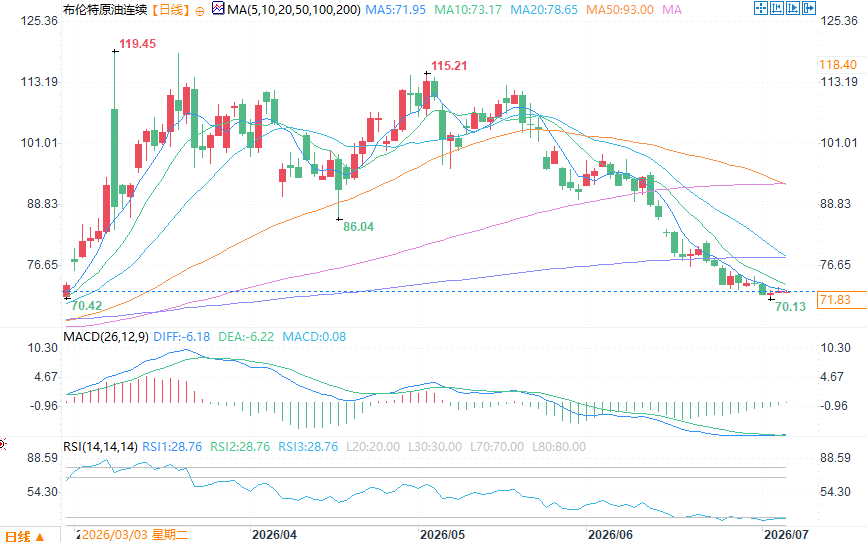
(Brent crude oil futures daily chart, source: FX678)
At 8:38 a.m. Beijing time on July 6, Brent crude oil futures were trading at $71.65 per barrel.
According to a report by Al Jazeera on Saturday (July 4), negotiations between the United States and Iran on a permanent ceasefire are expected to resume in Pakistan on July 11.
The agenda for these negotiations not only covers the ceasefire itself, but will also touch upon three more thorny issues: Iran's nuclear program, economic sanctions against Iran, and the freezing of the Islamic Revolutionary Guard Corps' assets. Each of these three issues involves the core interests of both sides. The nuclear program is the strategic threat that the United States is most concerned about, sanctions are the biggest bargaining chip the United States holds, and the asset freeze is Iran's urgent demand to unfreeze its assets.
The negotiations are taking place against a complex and delicate backdrop. On the one hand, both sides have a real need to ease tensions; on the other hand, Iran's actual actions on the ground and in its nuclear activities are constantly undermining the foundation of mutual trust in the negotiations.
Satellite images reveal that construction on a secret facility in Gaoshan has never stopped.
Just as negotiations were about to resume, the Washington-based Institute for Science and International Security released a set of worrying satellite images to Fox News, showing that Iran was continuing secret construction at an underground facility codenamed Gorshka deep in the Zagros Mountains.
The key fact is that IAEA inspectors have not yet been allowed access to the site.
Spencer Faragaso, a senior researcher at the institute, wrote on the X platform that the ongoing construction at Hkayama is deeply concerning. This work has been progressing steadily since at least 2020. In his view, this is Iran's backup plan should negotiations fail, at which point they will have a nuclear facility already in the late stages of construction. They assess that Hkayama is large enough to accommodate a nuclear enrichment plant. If Iran is serious about negotiations, it should halt construction at Hkayama as a gesture of goodwill. But what can be expected in the face of such a brutal and cunning regime as Iran?
Natanz's wounds have not yet healed; the effects of the attack a year ago still linger.
The institute’s analysis report provided a detailed satellite comparison of several key nuclear facilities, with the timeline ending at the end of June 2026. The imagery was provided by Vantortech.
The scene at the Natanz nuclear complex is shocking. Entrances to the underground enrichment halls remain unrepaired, personnel entrances are still damaged, and vehicle entrances are also severely damaged. Around the pilot fuel enrichment plant destroyed in June 2025, only one vehicle can be seen on the roads. HVAC coolers are scattered throughout the plant, and both the main and backup power systems remain disabled. In other words, recovery efforts at Natanz have virtually stalled since the attack in June 2025.
Frequent activity at multiple nuclear facilities in Foldo Isfahan, Hkayama
Regarding the Gaoshan Tunnel Group, satellite images show traces of vehicle activity on the road leading to the western tunnel entrance, indicating that construction is underway inside the tunnel, and reinforcement and hardening work at the tunnel entrance is also progressing simultaneously.
The institute specifically pointed out that the memorandum of understanding signed between the US and Iran requires Iran to maintain the status quo, namely prohibiting construction on any nuclear-related facilities, and Gaoshan clearly falls within this scope. However, Iran has not complied. Furthermore, the eastern tunnel entrance has been partially backfilled with soil, preventing ground vehicles from entering; analysts believe this was likely intentional to prevent rapid access.
Regarding the Fordow nuclear facility, the institute observed between May 10th and 18th that Iran had added earth and rock piles and other obstacles as a passive defense measure on the road leading to the Fordow tunnel entrance. These obstacles were placed with extreme precision, forming a series of sharp turns and deceleration bends, their purpose not merely to block the road, but to prevent any vehicles from rapidly entering or leaving the tunnel. Imagery as of June 21st showed that these obstacles remained unchanged, and the tunnel entrance was still blocked with earth.
Regarding the Isfahan nuclear facility, no activity was observed as of June 29, and the tunnel entrance was also backfilled with soil.
The mystery surrounding Gaoshan remains unresolved; hidden projects hint at nuclear ambitions.
Back in May, the research institute had issued a warning about the situation at Gaoshan. Newly acquired satellite imagery at the time showed that, as of April 22, the entrances to two eastern tunnels of the Gaoshan underground complex had been partially blocked by gray soil material, preventing vehicles from entering. Just on April 1, these entrances were completely unobstructed.
Unlike the situations in Foldo and Isfahan, the sealing material at Gaoshan did not completely cover the tunnel entrances, but it was sufficient to severely impede the rapid entry and exit of vehicles. Any vehicle attempting to enter had to use heavy earthmoving equipment to clear the passage. Notably, the two tunnel entrances on the west side have not yet been sealed. The institute points out that this is a deeply buried tunnel complex, perfectly suited for protecting valuable equipment or materials.
More notably, earlier this year they observed that the entrances to the old tunnels left over from 2007 in Gaoshan had been sealed and reinforced with concrete, suggesting that something may have been moved into those tunnels.
Institutional Views
The International Atomic Energy Agency (IAEA) stated that despite the disruptions to inspections caused by the US and Israeli strikes on Iranian nuclear facilities in 2025-2026, there has been no significant new progress in Iran's nuclear program. An escalation of the Iranian nuclear issue or a failure of negotiations could trigger a new round of sanctions or conflict, further increasing oil price volatility. Conversely, a peaceful resolution to the nuclear issue or a return to the agreement framework would unlock Iran's oil export potential, alleviate global supply shortages, and push oil prices down.
The International Energy Agency (IEA) stated that while short-term inventory depletion supports prices, a rapid rebound in supply could lead to an oil surplus by 2027 if nuclear negotiations progress and the Strait of Hormuz reopens. The IEA warned that continued uncertainty surrounding Iran's nuclear facilities is weighing on market confidence and called for stronger supply diversification and coordination of strategic reserves. The prospect of a nuclear resolution directly impacts oil price paths: lasting peace will accelerate the return of Iranian crude to the market, stabilizing prices; conversely, nuclear escalation could maintain high volatility, hindering global economic recovery. The IEA emphasized the need to accelerate energy transition to reduce dependence on Middle Eastern oil.
(Brent crude oil futures daily chart, source: FX678)
At 8:38 a.m. Beijing time on July 6, Brent crude oil futures were trading at $71.65 per barrel.
- Risk Warning and Disclaimer
- The market involves risk, and trading may not be suitable for all investors. This article is for reference only and does not constitute personal investment advice, nor does it take into account certain users’ specific investment objectives, financial situation, or other needs. Any investment decisions made based on this information are at your own risk.