Crude oil trading alert: Continued production increases by OPEC+ and the resumption of shipping in the Strait of Hormuz are causing a supply surge that is suppressing market sentiment, leading to continued fluctuations in crude oil prices.
2026-07-06 09:43:00
The latest OPEC+ meeting decided to further increase crude oil production by approximately 188,000 barrels per day in August, continuing the production increase trend of the previous months. Against the backdrop of weak global demand growth momentum, this move further reinforces expectations of ample supply. At the same time, shipping activity in the Strait of Hormuz is gradually recovering, and export efficiency from major Persian Gulf oil-producing countries has rebounded significantly, with the geopolitical risk premium previously priced into the market continuing to subside.

Brent crude has fallen back to around $72 per barrel , while WTI crude is approaching $68 per barrel , essentially erasing all the gains made earlier due to supply disruptions. This round of decline is not only due to the continued supply releases by OPEC+, but also related to the export growth of non-OPEC oil-producing countries and the pace of strategic reserve releases. The release of strategic reserves coordinated by the International Energy Agency has, to some extent, exacerbated the supply pressure in the spot market, causing the global crude oil market to enter a phase of "supply peak."
In the physical market, crude oil pricing has clearly shifted to a futures premium, meaning that forward prices are higher than near-month prices. This is generally seen as a signal of oversupply or weak demand. Market participants generally believe that the current recovery in crude oil production is significantly outpacing the pace of global demand expansion, especially against the backdrop of weak manufacturing activity and slowing energy consumption in some major economies, further amplifying this contradiction.
Geopolitically, shipping in the Strait of Hormuz is recovering at a faster pace as the interim peace agreement between Washington and Tehran remains in effect. Exports from major oil-producing countries such as Saudi Arabia are nearing pre-conflict levels, and previously restricted supplies from countries like the UAE have re-entered the international market. While some risks remain, such as sporadic shipping security incidents in the Red Sea, overall transport insurance costs and supply chain uncertainty have significantly decreased.
It's worth noting that Brent crude oil prices fell by nearly 30% in the second quarter of this year, indicating that the oil market has shifted from a "risk premium-driven" model to a "supply and demand repricing phase." During this process, institutional expectations for the market outlook have clearly become more cautious. Several Wall Street investment banks believe that oil prices still have room to decline further in the second half of the year, with some even warning of a potential scenario where prices could fall back to the $60 range by the end of the year.
From a market sentiment perspective, the trading logic has shifted from geopolitical to fundamentals-driven, with investors paying closer attention to inventory changes, OPEC+ policy flexibility, and global demand resilience. While OPEC+ emphasizes that it will "continue to monitor the market and maintain policy flexibility," short-term supply pressures remain dominant given the current production recovery path.
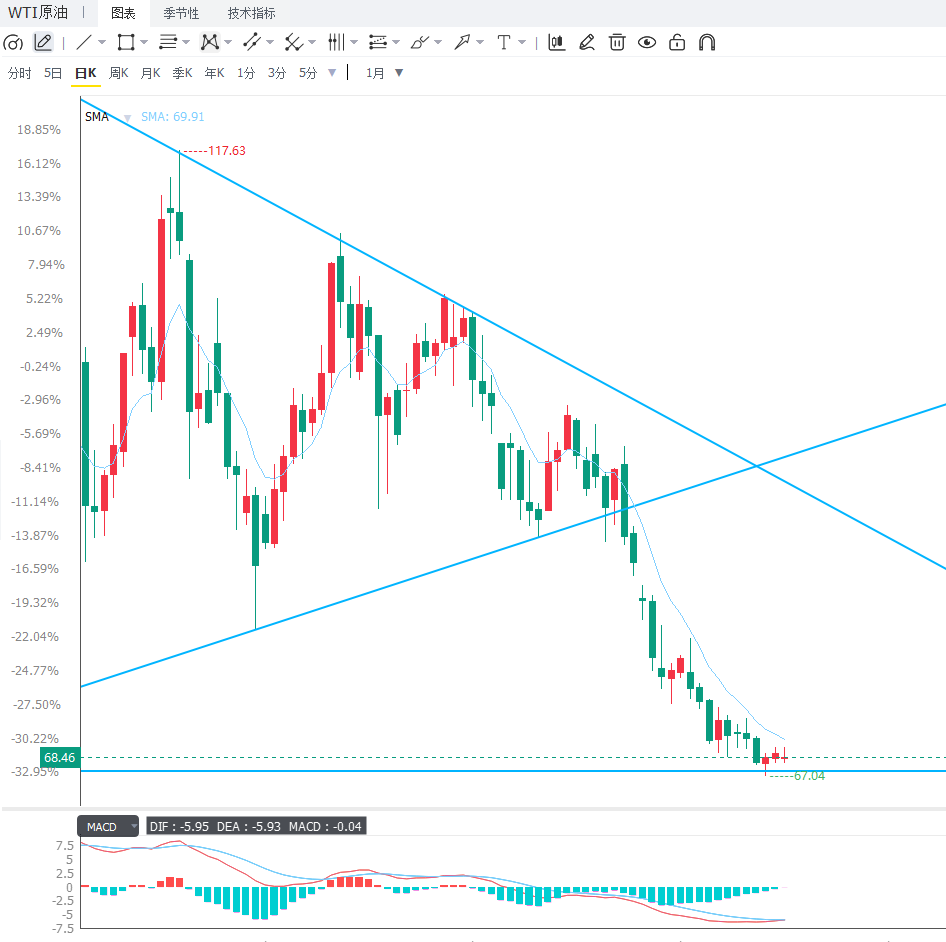
From a daily chart perspective, after a continuous decline, crude oil prices have entered a previously densely traded range, and the overall trend has shifted from a pullback from previous highs to a medium-term weak and volatile structure. US crude oil is repeatedly fluctuating around $68 . The moving average system shows signs of a bearish alignment, with short-term moving averages continuing to suppress price rebounds, and overall momentum remains weak. However, the support area below is gradually thickening, indicating that some selling pressure has eased.
From a 4-hour chart perspective, the short-term price structure has entered a low-level consolidation phase. The market is experiencing a technical correction after a rapid decline, but the rebound has been limited, indicating insufficient buying interest. The RSI indicator has repeatedly corrected in the low range but failed to enter a strong zone. While the MACD histogram shows signs of convergence, a clear golden cross signal has not yet formed, suggesting that short-term consolidation will continue. If the price fails to hold above $68, there is still a possibility of retesting the previous low support; conversely, if it stabilizes and breaks through the upper resistance with increased volume, it may enter a phase of technical rebound and correction.
Overall, the market is in a phase of "supply suppression + sentiment recovery" coexisting. The trend has not yet completely reversed, but the window for directional selection after the decline in volatility is approaching.
Editor's Summary : The core driver of this round of oil price adjustments stems from the combined effect of rapid supply-side release and the fading geopolitical risk premium. Continued production increases by OPEC+, coupled with the resumption of shipping in the Strait of Hormuz, have significantly improved the efficiency of the global crude oil supply chain, shifting the market from a tight balance to a period of relative easing. In the short term, oil prices will likely continue to fluctuate around the current support range, with market focus shifting to demand verification and inventory trends. If global demand does not show a significant recovery while supply continues to increase, oil prices will face downward pressure in the medium term, potentially even approaching the $60 range. Risks include potential resurgences in geopolitical tensions and whether major oil-producing countries adjust their production strategies after the rapid price decline. Overall, the crude oil market has entered a new rebalancing phase, and price fluctuations may shift from a "one-sided trend" to a "range-boundary game."
Brent crude has fallen back to around $72 per barrel , while WTI crude is approaching $68 per barrel , essentially erasing all the gains made earlier due to supply disruptions. This round of decline is not only due to the continued supply releases by OPEC+, but also related to the export growth of non-OPEC oil-producing countries and the pace of strategic reserve releases. The release of strategic reserves coordinated by the International Energy Agency has, to some extent, exacerbated the supply pressure in the spot market, causing the global crude oil market to enter a phase of "supply peak."
In the physical market, crude oil pricing has clearly shifted to a futures premium, meaning that forward prices are higher than near-month prices. This is generally seen as a signal of oversupply or weak demand. Market participants generally believe that the current recovery in crude oil production is significantly outpacing the pace of global demand expansion, especially against the backdrop of weak manufacturing activity and slowing energy consumption in some major economies, further amplifying this contradiction.
Geopolitically, shipping in the Strait of Hormuz is recovering at a faster pace as the interim peace agreement between Washington and Tehran remains in effect. Exports from major oil-producing countries such as Saudi Arabia are nearing pre-conflict levels, and previously restricted supplies from countries like the UAE have re-entered the international market. While some risks remain, such as sporadic shipping security incidents in the Red Sea, overall transport insurance costs and supply chain uncertainty have significantly decreased.
It's worth noting that Brent crude oil prices fell by nearly 30% in the second quarter of this year, indicating that the oil market has shifted from a "risk premium-driven" model to a "supply and demand repricing phase." During this process, institutional expectations for the market outlook have clearly become more cautious. Several Wall Street investment banks believe that oil prices still have room to decline further in the second half of the year, with some even warning of a potential scenario where prices could fall back to the $60 range by the end of the year.
From a market sentiment perspective, the trading logic has shifted from geopolitical to fundamentals-driven, with investors paying closer attention to inventory changes, OPEC+ policy flexibility, and global demand resilience. While OPEC+ emphasizes that it will "continue to monitor the market and maintain policy flexibility," short-term supply pressures remain dominant given the current production recovery path.
From a daily chart perspective, after a continuous decline, crude oil prices have entered a previously densely traded range, and the overall trend has shifted from a pullback from previous highs to a medium-term weak and volatile structure. US crude oil is repeatedly fluctuating around $68 . The moving average system shows signs of a bearish alignment, with short-term moving averages continuing to suppress price rebounds, and overall momentum remains weak. However, the support area below is gradually thickening, indicating that some selling pressure has eased.
From a 4-hour chart perspective, the short-term price structure has entered a low-level consolidation phase. The market is experiencing a technical correction after a rapid decline, but the rebound has been limited, indicating insufficient buying interest. The RSI indicator has repeatedly corrected in the low range but failed to enter a strong zone. While the MACD histogram shows signs of convergence, a clear golden cross signal has not yet formed, suggesting that short-term consolidation will continue. If the price fails to hold above $68, there is still a possibility of retesting the previous low support; conversely, if it stabilizes and breaks through the upper resistance with increased volume, it may enter a phase of technical rebound and correction.
Overall, the market is in a phase of "supply suppression + sentiment recovery" coexisting. The trend has not yet completely reversed, but the window for directional selection after the decline in volatility is approaching.
Editor's Summary : The core driver of this round of oil price adjustments stems from the combined effect of rapid supply-side release and the fading geopolitical risk premium. Continued production increases by OPEC+, coupled with the resumption of shipping in the Strait of Hormuz, have significantly improved the efficiency of the global crude oil supply chain, shifting the market from a tight balance to a period of relative easing. In the short term, oil prices will likely continue to fluctuate around the current support range, with market focus shifting to demand verification and inventory trends. If global demand does not show a significant recovery while supply continues to increase, oil prices will face downward pressure in the medium term, potentially even approaching the $60 range. Risks include potential resurgences in geopolitical tensions and whether major oil-producing countries adjust their production strategies after the rapid price decline. Overall, the crude oil market has entered a new rebalancing phase, and price fluctuations may shift from a "one-sided trend" to a "range-boundary game."
- Risk Warning and Disclaimer
- The market involves risk, and trading may not be suitable for all investors. This article is for reference only and does not constitute personal investment advice, nor does it take into account certain users’ specific investment objectives, financial situation, or other needs. Any investment decisions made based on this information are at your own risk.