Non-farm payrolls reversal policy logic creates a window of opportunity for bonds and gold.
2026-07-06 18:12:02
As we enter the second half of 2026, with new Federal Reserve Chairman Warsh taking the helm, the first policy meeting saw a unanimous vote to maintain interest rates. However, half the votes projected a dot plot indicating a rate hike by the end of the year, supported by ample data. Yet, within just a few days, the data underwent a dramatic shift.
Prior to the release of the June non-farm payroll data, the Federal Reserve maintained a generally hawkish policy stance, remaining highly vigilant about the resilience of the job market and the stickiness of inflation. This assessment became the core basis for the market's prediction that the Fed might raise interest rates.
At that time, the Federal Reserve's policy balance was generally biased towards preventing a rebound in inflation and consolidating the results of its anti-inflation efforts. It did not release any signals of interest rate cuts and maintained a policy narrative of high interest rates or even moderate interest rate hikes, which firmly occupied the mainstream of the market.

The core reason supporting the Fed's hawkish stance stems from the consistently strong US employment data in the preceding period.
Prior to the release of this non-farm payroll data, the US labor market had consistently demonstrated strong resilience, with core indicators such as job growth and job openings remaining generally stable and showing no obvious signs of weakening.
Based on this fundamental logic of strong employment and sticky inflation, the market had even priced in the possibility of two Fed rate hikes this year, with several investment banks predicting a cumulative rate hike of 75 basis points by the end of the year. Tightening expectations continued to suppress the prices of global bonds, gold, and other assets.
At the time, the market generally expected that the minutes of Thursday's meeting would further confirm the Fed's hawkish policy approach of relying on stable employment and being wary of a rebound in inflation , and continue to strengthen the policy orientation of maintaining high interest rates and retaining room for interest rate hikes, becoming an important fundamental support for short-term suppression of risk assets and benefit to the US dollar.
This provides a basis for the market's high expectations for US employment data.
However, the latest June non-farm payroll data has completely disrupted the original policy logic and significantly shaken the core data foundation of the Fed's hawkish stance.
Data shows that the U.S. added only 57,000 non-farm jobs in June, significantly lower than market expectations. At the same time, the combined employment data for April and May were revised down sharply, completely ending the previous narrative of the resilience of the job market.
This unexpected data suggests that the US labor market has shifted from a steady plateau to a significant cooling, with endogenous employment demand in the economy continuing to weaken. The core employment arguments that previously supported the Fed's hawkish policy and expectations of interest rate hikes will be directly shaken.
The sharp reversal in employment data has also led to a weakening of the core logic of the upcoming Federal Reserve meeting minutes.
The policy confidence in the previous meeting minutes was entirely based on a strong job market and the economy's ability to withstand high interest rates or even further tightening. However, the current substantial weakening of the employment fundamentals has directly undermined the data support of the original policy framework.
Even though the minutes text continues the hawkish tone, the underlying reality no longer exists. The rationale for the Federal Reserve to maintain a tough tightening stance and implement interest rate hikes has decreased significantly, and the probability of a rate hike this year has further declined. The policy focus has officially shifted from "preventing a rebound in inflation and preparing for interest rate hikes" to "waiting for data and balancing the economy and inflation."
The fundamental shift in the core policy argument has created clear investment opportunities in the current market, with bonds and gold assets entering their optimal allocation window.
For the bond market, the interest rate hike expectations that had been suppressing bond prices have quickly subsided. The market is repricing the new logic of the Federal Reserve maintaining interest rates unchanged for a long period and the end of the tightening cycle. US Treasury yields have continued to fall, and the prices of short- to medium-term bonds with maturities of 2 to 5 years have ample room for rebound. Both short-term trading opportunities and medium-term allocation value are very prominent. At the same time, European bonds will also usher in a valuation repair market based on the expectation of global interest rate easing.
For gold assets, the cooling of expectations for Fed rate hikes, the decline in real interest rates, and the weakening of the dollar have created a multi-faceted positive effect, completely removing the core suppression of gold prices by high interest rates. Coupled with the rise in risk aversion caused by market policy uncertainty, the upside potential of gold prices has been fully opened up, making it the asset class with the clearest fundamentals and the highest cost-effectiveness at present.
Overall, the reversal in employment data has reshaped the Fed's policy path, and market uncertainty has transformed into certain trading opportunities in bonds and gold. Thursday's meeting minutes may reinforce this logic, making it a worthwhile time to realize profits . However, risks must be considered. A significant driver of recent Treasury yield increases is the surge in AI demand. The expectation of high capital expenditures in AI directly impacts the US interest rate center. Therefore, if AI-related equity assets continue to surge, it will further pull down US interest rates and lead to capital outflows from gold and bonds.
From a technical perspective, Friday's low-volume positive candlestick indicates that there is not much divergence among investors and that turnover is insufficient. This suggests that the market may experience rapid rises and falls in the future, while consolidation periods present good entry opportunities.
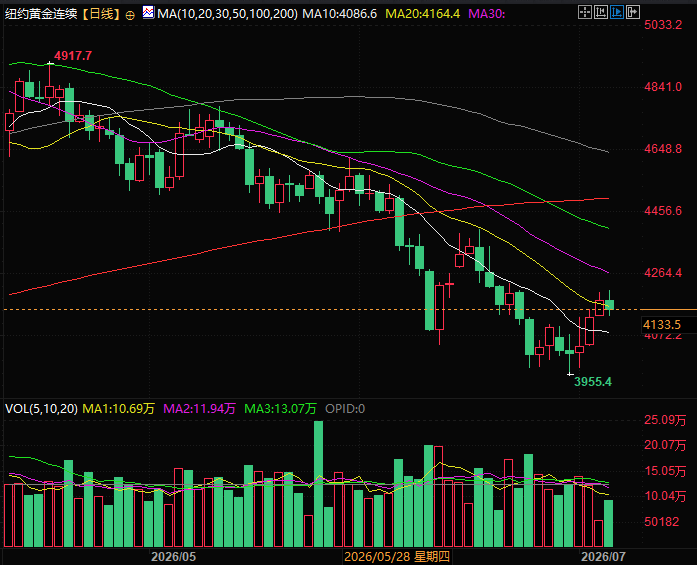
(New York gold futures futures, source: FX678)
At 18:08 Beijing time, the New York gold futures contract was trading at $4156.2 per ounce.
Prior to the release of the June non-farm payroll data, the Federal Reserve maintained a generally hawkish policy stance, remaining highly vigilant about the resilience of the job market and the stickiness of inflation. This assessment became the core basis for the market's prediction that the Fed might raise interest rates.
At that time, the Federal Reserve's policy balance was generally biased towards preventing a rebound in inflation and consolidating the results of its anti-inflation efforts. It did not release any signals of interest rate cuts and maintained a policy narrative of high interest rates or even moderate interest rate hikes, which firmly occupied the mainstream of the market.
The core logic of the old policy: strong employment supports expectations of tightening.
The core reason supporting the Fed's hawkish stance stems from the consistently strong US employment data in the preceding period.
Prior to the release of this non-farm payroll data, the US labor market had consistently demonstrated strong resilience, with core indicators such as job growth and job openings remaining generally stable and showing no obvious signs of weakening.
Based on this fundamental logic of strong employment and sticky inflation, the market had even priced in the possibility of two Fed rate hikes this year, with several investment banks predicting a cumulative rate hike of 75 basis points by the end of the year. Tightening expectations continued to suppress the prices of global bonds, gold, and other assets.
At the time, the market generally expected that the minutes of Thursday's meeting would further confirm the Fed's hawkish policy approach of relying on stable employment and being wary of a rebound in inflation , and continue to strengthen the policy orientation of maintaining high interest rates and retaining room for interest rate hikes, becoming an important fundamental support for short-term suppression of risk assets and benefit to the US dollar.
This provides a basis for the market's high expectations for US employment data.
Expectations diverge: Unexpected non-farm payrolls data breaks through deflationary foundations.
However, the latest June non-farm payroll data has completely disrupted the original policy logic and significantly shaken the core data foundation of the Fed's hawkish stance.
Data shows that the U.S. added only 57,000 non-farm jobs in June, significantly lower than market expectations. At the same time, the combined employment data for April and May were revised down sharply, completely ending the previous narrative of the resilience of the job market.
This unexpected data suggests that the US labor market has shifted from a steady plateau to a significant cooling, with endogenous employment demand in the economy continuing to weaken. The core employment arguments that previously supported the Fed's hawkish policy and expectations of interest rate hikes will be directly shaken.
The sharp reversal in employment data has also led to a weakening of the core logic of the upcoming Federal Reserve meeting minutes.
The policy confidence in the previous meeting minutes was entirely based on a strong job market and the economy's ability to withstand high interest rates or even further tightening. However, the current substantial weakening of the employment fundamentals has directly undermined the data support of the original policy framework.
Even though the minutes text continues the hawkish tone, the underlying reality no longer exists. The rationale for the Federal Reserve to maintain a tough tightening stance and implement interest rate hikes has decreased significantly, and the probability of a rate hike this year has further declined. The policy focus has officially shifted from "preventing a rebound in inflation and preparing for interest rate hikes" to "waiting for data and balancing the economy and inflation."
Asset allocation opportunities: Bonds and gold are entering a window of certainty.
The fundamental shift in the core policy argument has created clear investment opportunities in the current market, with bonds and gold assets entering their optimal allocation window.
For the bond market, the interest rate hike expectations that had been suppressing bond prices have quickly subsided. The market is repricing the new logic of the Federal Reserve maintaining interest rates unchanged for a long period and the end of the tightening cycle. US Treasury yields have continued to fall, and the prices of short- to medium-term bonds with maturities of 2 to 5 years have ample room for rebound. Both short-term trading opportunities and medium-term allocation value are very prominent. At the same time, European bonds will also usher in a valuation repair market based on the expectation of global interest rate easing.
For gold assets, the cooling of expectations for Fed rate hikes, the decline in real interest rates, and the weakening of the dollar have created a multi-faceted positive effect, completely removing the core suppression of gold prices by high interest rates. Coupled with the rise in risk aversion caused by market policy uncertainty, the upside potential of gold prices has been fully opened up, making it the asset class with the clearest fundamentals and the highest cost-effectiveness at present.
Overall, the reversal in employment data has reshaped the Fed's policy path, and market uncertainty has transformed into certain trading opportunities in bonds and gold. Thursday's meeting minutes may reinforce this logic, making it a worthwhile time to realize profits . However, risks must be considered. A significant driver of recent Treasury yield increases is the surge in AI demand. The expectation of high capital expenditures in AI directly impacts the US interest rate center. Therefore, if AI-related equity assets continue to surge, it will further pull down US interest rates and lead to capital outflows from gold and bonds.
From a technical perspective, Friday's low-volume positive candlestick indicates that there is not much divergence among investors and that turnover is insufficient. This suggests that the market may experience rapid rises and falls in the future, while consolidation periods present good entry opportunities.
(New York gold futures futures, source: FX678)
At 18:08 Beijing time, the New York gold futures contract was trading at $4156.2 per ounce.
- Risk Warning and Disclaimer
- The market involves risk, and trading may not be suitable for all investors. This article is for reference only and does not constitute personal investment advice, nor does it take into account certain users’ specific investment objectives, financial situation, or other needs. Any investment decisions made based on this information are at your own risk.