EUR/USD approaches a key turning point; three pricing discrepancies are hidden behind 1.14.
2026-07-06 19:58:45
On Monday, July 6th, the euro traded back around 1.14 against the US dollar. The current price remains below the Bollinger Middle Band at 1.1492, but has not yet fallen back below the Lower Band at 1.1311. In other words, the current market action is not a continuation of a one-sided trend, but rather a narrow pricing range squeezed out by factors such as cooling employment, sticky inflation, expectations of a pause in the European Central Bank's trading, and falling energy prices.

Last week's US non-farm payroll data released a complex picture. June saw an increase of 57,000 non-farm jobs, with the unemployment rate at 4.2% and the labor force participation rate falling to 61.5%. April and May's employment figures were revised downwards by a combined 74,000. Wages remained resilient, with average hourly earnings rising 0.3% month-over-month and 3.5% year-over-year. The core message of this data is that employment momentum is cooling marginally, but has not yet reached a recessionary level. Therefore, the pressure on the dollar stems primarily from the repricing of interest rate expectations, rather than a complete reassessment of fundamentals.
Inflation remains the true determinant of the dollar's pricing structure. In May, the overall US CPI rose 4.2% year-on-year, higher than April's 3.8%; core CPI rose 2.9% year-on-year, energy prices rose 23.5% year-on-year, and gasoline prices rose 40.5% year-on-year. This means that a slowdown in non-farm payrolls may reduce the urgency of an immediate rate hike in July, but it cannot automatically open up expectations of further easing. For forex traders, the key to the dollar is not the employment data alone, but whether inflation is spreading from the energy sector to the service and wage chains.
On June 17, the Federal Reserve maintained the target range for the federal funds rate at 3.50%-3.75%, stating that inflation remained above the 2% target and emphasizing its commitment to price stability. New Fed Chairman Warsh took office on May 22, also serving as Chairman of the Fed's policy meetings, meaning the market is still in a relearning phase regarding its policy response function.
Within this communication framework, the marginal value of a single official's speech decreases, while the value of meeting minutes increases. The reason is straightforward: if the Federal Reserve reduces forward guidance, the market can only glean the true weighting of voting members' opinions on inflation, employment, energy shocks, and financial conditions from the minutes. If the minutes show that a majority of voting members still consider the May CPI as an unresolved source of pressure, the downside potential for the dollar will be limited; if the minutes emphasize a cooling employment trend and a decline in energy prices, then the euro/dollar exchange rate will have the opportunity to recover towards the Bollinger Middle Band.
The European Central Bank raised all three of its key interest rates by 25 basis points in June. Effective June 17, the deposit facility rate, main refinancing rate, and marginal lending rate are now 2.25%, 2.40%, and 2.65%, respectively. This rate hike previously provided policy support for the euro, but the latest inflation data is changing market pricing in further rate increases.
The Eurozone's harmonized CPI preliminary reading for June was 2.8%, down from 3.2% in May; the year-on-year increase in energy prices fell to 8.7% from 10.8% in May, and services inflation also declined to 3.2% from 3.5%. Meanwhile, Brent crude oil fell to $71.50 per barrel on July 6, a 24.14% drop over the past month. This data suggests that the urgency for the European Central Bank to continue tightening in the short term has decreased, and the euro's interest rate drivers have shifted from active support to passive defense.
However, the euro has not lost all its support. Current European inflation remains above the 2% target, and core and service prices have not fully fallen back to safe levels. More importantly, the dollar is also under pressure from slowing employment, resulting in a range-bound trading pattern for the euro against the dollar after both sides' expectations cooled, rather than a one-sided euro strengthening.
From the daily chart, the euro rebounded after forming a low near 1.1324 against the US dollar, but a significant upper shadow appeared near 1.1472, indicating that buying at higher levels has not been consistently confirmed. The Bollinger Band middle line is at 1.1492, and the current price is still below it, meaning the medium-term moving average has not yet been recovered; the lower band is around 1.1311, forming a lower market memory zone with the previous low of 1.1324.
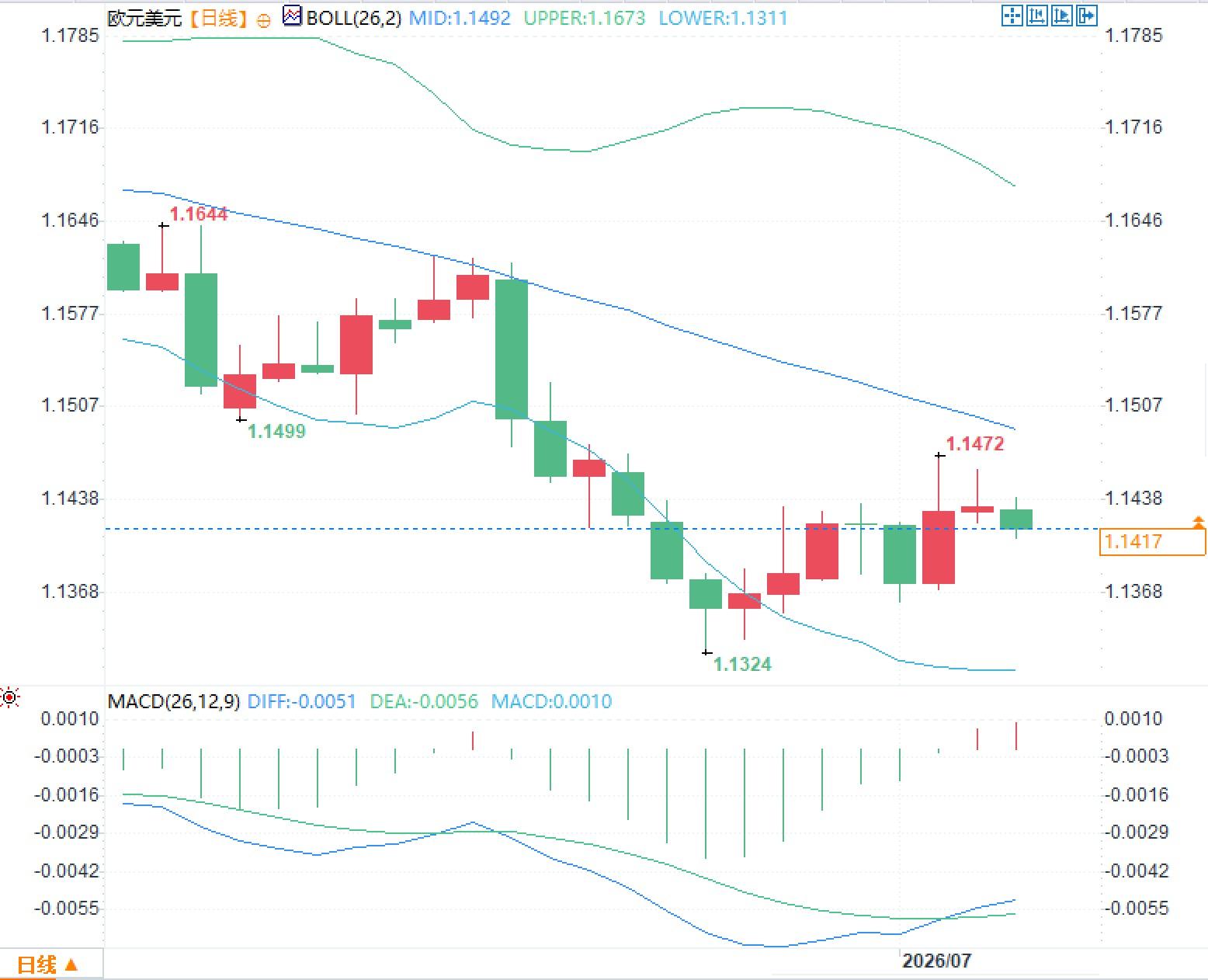
On the MACD front, the DIFF is -0.0051 and the DEA is -0.0056. Although the histogram has turned positive, both lines are still in negative territory. This structure typically corresponds to a correction after a decline, rather than a trend reversal. Short-term upside potential comes from short covering and a weakening dollar, while its sustainability depends on whether the price can maintain its position above the 1.1470 to 1.1490 range for an extended period. If it fails to break through the moving average resistance, the area around 1.14 may continue to be a battleground between bulls and bears.
Macroeconomic theme: The recent pullback in the US dollar is not a trend reversal, but rather a result of the renewed compression of interest rate hike expectations.
Last week's US non-farm payroll data released a complex picture. June saw an increase of 57,000 non-farm jobs, with the unemployment rate at 4.2% and the labor force participation rate falling to 61.5%. April and May's employment figures were revised downwards by a combined 74,000. Wages remained resilient, with average hourly earnings rising 0.3% month-over-month and 3.5% year-over-year. The core message of this data is that employment momentum is cooling marginally, but has not yet reached a recessionary level. Therefore, the pressure on the dollar stems primarily from the repricing of interest rate expectations, rather than a complete reassessment of fundamentals.
Inflation remains the true determinant of the dollar's pricing structure. In May, the overall US CPI rose 4.2% year-on-year, higher than April's 3.8%; core CPI rose 2.9% year-on-year, energy prices rose 23.5% year-on-year, and gasoline prices rose 40.5% year-on-year. This means that a slowdown in non-farm payrolls may reduce the urgency of an immediate rate hike in July, but it cannot automatically open up expectations of further easing. For forex traders, the key to the dollar is not the employment data alone, but whether inflation is spreading from the energy sector to the service and wage chains.
Federal Reserve variables: Minutes are more important than verbal guidance
On June 17, the Federal Reserve maintained the target range for the federal funds rate at 3.50%-3.75%, stating that inflation remained above the 2% target and emphasizing its commitment to price stability. New Fed Chairman Warsh took office on May 22, also serving as Chairman of the Fed's policy meetings, meaning the market is still in a relearning phase regarding its policy response function.
Within this communication framework, the marginal value of a single official's speech decreases, while the value of meeting minutes increases. The reason is straightforward: if the Federal Reserve reduces forward guidance, the market can only glean the true weighting of voting members' opinions on inflation, employment, energy shocks, and financial conditions from the minutes. If the minutes show that a majority of voting members still consider the May CPI as an unresolved source of pressure, the downside potential for the dollar will be limited; if the minutes emphasize a cooling employment trend and a decline in energy prices, then the euro/dollar exchange rate will have the opportunity to recover towards the Bollinger Middle Band.
European Situation: Cooling Inflation Weakens Imagination of Euro Interest Rate Advantage
The European Central Bank raised all three of its key interest rates by 25 basis points in June. Effective June 17, the deposit facility rate, main refinancing rate, and marginal lending rate are now 2.25%, 2.40%, and 2.65%, respectively. This rate hike previously provided policy support for the euro, but the latest inflation data is changing market pricing in further rate increases.
The Eurozone's harmonized CPI preliminary reading for June was 2.8%, down from 3.2% in May; the year-on-year increase in energy prices fell to 8.7% from 10.8% in May, and services inflation also declined to 3.2% from 3.5%. Meanwhile, Brent crude oil fell to $71.50 per barrel on July 6, a 24.14% drop over the past month. This data suggests that the urgency for the European Central Bank to continue tightening in the short term has decreased, and the euro's interest rate drivers have shifted from active support to passive defense.
However, the euro has not lost all its support. Current European inflation remains above the 2% target, and core and service prices have not fully fallen back to safe levels. More importantly, the dollar is also under pressure from slowing employment, resulting in a range-bound trading pattern for the euro against the dollar after both sides' expectations cooled, rather than a one-sided euro strengthening.
Technical structure: The area around 1.14 is a mean reversion zone, not a directional confirmation zone.
From the daily chart, the euro rebounded after forming a low near 1.1324 against the US dollar, but a significant upper shadow appeared near 1.1472, indicating that buying at higher levels has not been consistently confirmed. The Bollinger Band middle line is at 1.1492, and the current price is still below it, meaning the medium-term moving average has not yet been recovered; the lower band is around 1.1311, forming a lower market memory zone with the previous low of 1.1324.
On the MACD front, the DIFF is -0.0051 and the DEA is -0.0056. Although the histogram has turned positive, both lines are still in negative territory. This structure typically corresponds to a correction after a decline, rather than a trend reversal. Short-term upside potential comes from short covering and a weakening dollar, while its sustainability depends on whether the price can maintain its position above the 1.1470 to 1.1490 range for an extended period. If it fails to break through the moving average resistance, the area around 1.14 may continue to be a battleground between bulls and bears.
- Risk Warning and Disclaimer
- The market involves risk, and trading may not be suitable for all investors. This article is for reference only and does not constitute personal investment advice, nor does it take into account certain users’ specific investment objectives, financial situation, or other needs. Any investment decisions made based on this information are at your own risk.