The yen is near a 40-year low, and the inverse relationship between the stock market and currency has led to a continued upward trend in Japanese stocks.
2026-07-06 20:40:40
On Monday (July 6), during the Asian and European sessions, the US dollar continued to rise sharply against the Japanese yen. After a sharp rebound from the bottom last Friday, the US dollar continued to rise sharply against the Japanese yen. It is currently trading around 162.33, up 0.59%, and is once again approaching the 40-year extreme value of 162.83. The yen continues to be under deep pressure, and the risk of Japanese official intervention in the foreign exchange market continues to rise.
The core reasons for the recent weakening of the yen are multiple macroeconomic factors, including a strong US dollar, the US-Japan interest rate differential, and the lagging nature of Japanese monetary policy. At the same time, a factor that the market often overlooks is also at play: Japanese stocks and the yen are exhibiting a typical inverse relationship. Based on the analysis of mainstream institutions, the weak yen trend is likely to continue in the medium to long term, which also means that funds continue to be optimistic about Japanese technology stocks.
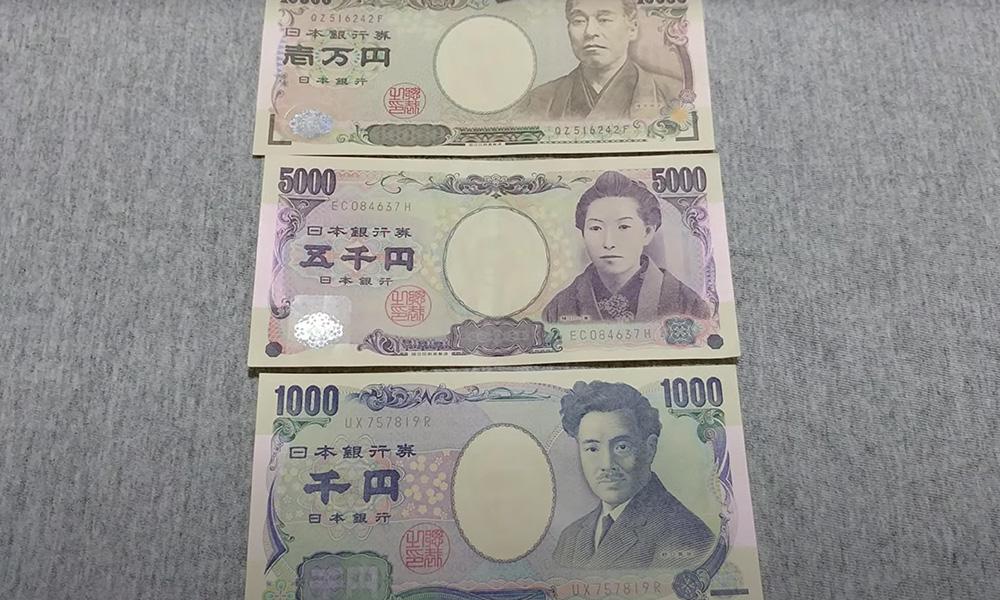
The current depreciation of the yen has been relatively sustained. After a brief rebound last week, the USD/JPY pair rose again on Monday, with a daily increase of nearly 0.6%, reaching a high of 162.40.
Despite weak US non-farm payroll data, the market has already fully priced in the Fed's expected rate hike this year, supporting the dollar's strength and becoming the core factor putting pressure on the yen.
Coupled with geopolitical tensions in the Strait of Hormuz, market risk aversion intensified, further exacerbating the yen's weakness and volatility.
At the same time, the Japanese market has shown a clear inverse relationship between stocks and currency. The rise in Japanese stocks is often accompanied by the depreciation of the yen. There are two core logics behind this: First, foreign investors are hedging. The incremental funds in Japanese stocks mainly come from overseas. Foreign investors' holdings are denominated in yen. In order to avoid exchange rate fluctuations and lock in dollar gains, foreign investors will sell yen at the same time when they buy Japanese stocks. The greater the rise in the stock index and the more foreign capital flows in, the heavier the selling pressure on the yen will be.
Secondly, the fundamentals drive the market in a closed loop. The Nikkei weighted stocks are mostly export leaders with a high proportion of overseas revenue. The depreciation of the yen can increase the exchange rate profits of these companies, drive better-than-expected financial reports, and attract funds to go long on Japanese stocks. This eventually forms a fixed market pattern of "yen depreciation and Japanese stock strength" . The phenomenon of "the more the yen falls, the more the Japanese stock rises, and the more the Japanese stock rises, the more the yen falls" also indicates that the rally in technology stocks is not over yet, and funds are still rushing into the market.
Currently, Japanese officials are maintaining unusual silence, and the market anticipates that they may adjust their intervention strategy, abandoning advance warnings and instead adopting surprise, unannounced interventions to precisely target speculative funds and improve the effectiveness of interventions.
At the institutional level, Mitsubishi UFJ pointed out that the market underestimated the hawkish stance of the Bank of Japan, the steepening of the Japanese bond yield curve, and the opportunity for marginal improvement in fundamentals. The yen has the potential for a phased recovery, but Japan's fiscal risks and policy lags will continue to constrain the currency rebound in the long term.
HSBC's medium- to long-term outlook is more conservative, believing that the USD/JPY exchange rate has entered a new oscillation range at a 40-year high.
Given the Bank of Japan's difficulty in raising interest rates significantly, the continued widening of the US-Japan interest rate differential, and the continued efforts of Japanese fiscal policy, the US dollar/Japanese yen exchange rate is expected to maintain a generally strong trend until mid-2027.
However, the threshold for intervention in the foreign exchange market has been raised, and the decline in oil prices has eased imported inflationary pressures. Coupled with the historical pattern of gradually increasing intervention levels, the probability of strong intervention in the short term is low, but the risk of a sudden attack at high levels always exists.
Furthermore, the continued depreciation of the yen could trigger a "triple whammy" of falling stocks, bonds, and currency, and the authorities will not allow the exchange rate to decline in a disorderly manner.
Overall, the strength of the US dollar and the disadvantage of the US-Japan interest rate differential will continue to dominate the yen's trend in the short term. The current main theme of the market is the high-level fluctuation of the exchange rate and the potential for intervention. The inverse correlation between stocks and currencies will continue to dominate the Japanese market, indicating that the Japanese stock market may be able to reach new highs in the short term.
In the medium to long term, as long as the US-Japan interest rate differential remains high and Japan's monetary policy remains loose, the yen is unlikely to experience a sustained upward trend.
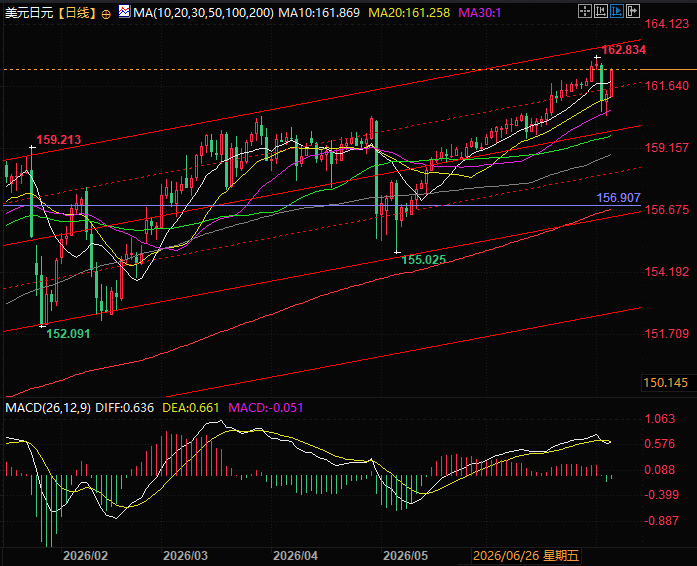
(USD/JPY daily chart, source: FX678)
At 20:35 Beijing time, the USD/JPY exchange rate is currently at 162.37.
The core reasons for the recent weakening of the yen are multiple macroeconomic factors, including a strong US dollar, the US-Japan interest rate differential, and the lagging nature of Japanese monetary policy. At the same time, a factor that the market often overlooks is also at play: Japanese stocks and the yen are exhibiting a typical inverse relationship. Based on the analysis of mainstream institutions, the weak yen trend is likely to continue in the medium to long term, which also means that funds continue to be optimistic about Japanese technology stocks.
A strong US dollar coupled with geopolitical disturbances caused the yen and Japanese stocks to fluctuate wildly.
The current depreciation of the yen has been relatively sustained. After a brief rebound last week, the USD/JPY pair rose again on Monday, with a daily increase of nearly 0.6%, reaching a high of 162.40.
Despite weak US non-farm payroll data, the market has already fully priced in the Fed's expected rate hike this year, supporting the dollar's strength and becoming the core factor putting pressure on the yen.
Coupled with geopolitical tensions in the Strait of Hormuz, market risk aversion intensified, further exacerbating the yen's weakness and volatility.
At the same time, the Japanese market has shown a clear inverse relationship between stocks and currency. The rise in Japanese stocks is often accompanied by the depreciation of the yen. There are two core logics behind this: First, foreign investors are hedging. The incremental funds in Japanese stocks mainly come from overseas. Foreign investors' holdings are denominated in yen. In order to avoid exchange rate fluctuations and lock in dollar gains, foreign investors will sell yen at the same time when they buy Japanese stocks. The greater the rise in the stock index and the more foreign capital flows in, the heavier the selling pressure on the yen will be.
Secondly, the fundamentals drive the market in a closed loop. The Nikkei weighted stocks are mostly export leaders with a high proportion of overseas revenue. The depreciation of the yen can increase the exchange rate profits of these companies, drive better-than-expected financial reports, and attract funds to go long on Japanese stocks. This eventually forms a fixed market pattern of "yen depreciation and Japanese stock strength" . The phenomenon of "the more the yen falls, the more the Japanese stock rises, and the more the Japanese stock rises, the more the yen falls" also indicates that the rally in technology stocks is not over yet, and funds are still rushing into the market.
Intervention Expectations and Short-Term Fundamentals: Japan Remains Silent, Yen Has an Opportunity to Recover
Currently, Japanese officials are maintaining unusual silence, and the market anticipates that they may adjust their intervention strategy, abandoning advance warnings and instead adopting surprise, unannounced interventions to precisely target speculative funds and improve the effectiveness of interventions.
At the institutional level, Mitsubishi UFJ pointed out that the market underestimated the hawkish stance of the Bank of Japan, the steepening of the Japanese bond yield curve, and the opportunity for marginal improvement in fundamentals. The yen has the potential for a phased recovery, but Japan's fiscal risks and policy lags will continue to constrain the currency rebound in the long term.
Medium- to long-term institutional outlook: The US-Japan interest rate differential will dominate, and the yen will continue its high-level consolidation pattern.
HSBC's medium- to long-term outlook is more conservative, believing that the USD/JPY exchange rate has entered a new oscillation range at a 40-year high.
Given the Bank of Japan's difficulty in raising interest rates significantly, the continued widening of the US-Japan interest rate differential, and the continued efforts of Japanese fiscal policy, the US dollar/Japanese yen exchange rate is expected to maintain a generally strong trend until mid-2027.
However, the threshold for intervention in the foreign exchange market has been raised, and the decline in oil prices has eased imported inflationary pressures. Coupled with the historical pattern of gradually increasing intervention levels, the probability of strong intervention in the short term is low, but the risk of a sudden attack at high levels always exists.
Furthermore, the continued depreciation of the yen could trigger a "triple whammy" of falling stocks, bonds, and currency, and the authorities will not allow the exchange rate to decline in a disorderly manner.
Overall Summary: The weak market trend remains unchanged, and the correlation between stocks and the currency continues.
Overall, the strength of the US dollar and the disadvantage of the US-Japan interest rate differential will continue to dominate the yen's trend in the short term. The current main theme of the market is the high-level fluctuation of the exchange rate and the potential for intervention. The inverse correlation between stocks and currencies will continue to dominate the Japanese market, indicating that the Japanese stock market may be able to reach new highs in the short term.
In the medium to long term, as long as the US-Japan interest rate differential remains high and Japan's monetary policy remains loose, the yen is unlikely to experience a sustained upward trend.
(USD/JPY daily chart, source: FX678)
At 20:35 Beijing time, the USD/JPY exchange rate is currently at 162.37.
- Risk Warning and Disclaimer
- The market involves risk, and trading may not be suitable for all investors. This article is for reference only and does not constitute personal investment advice, nor does it take into account certain users’ specific investment objectives, financial situation, or other needs. Any investment decisions made based on this information are at your own risk.