The British pound broke through the 217 level against the Japanese yen, reaching an 18-year high. After the strong rise, the market is focusing on the potential for further breakthroughs.
2026-07-07 10:19:52
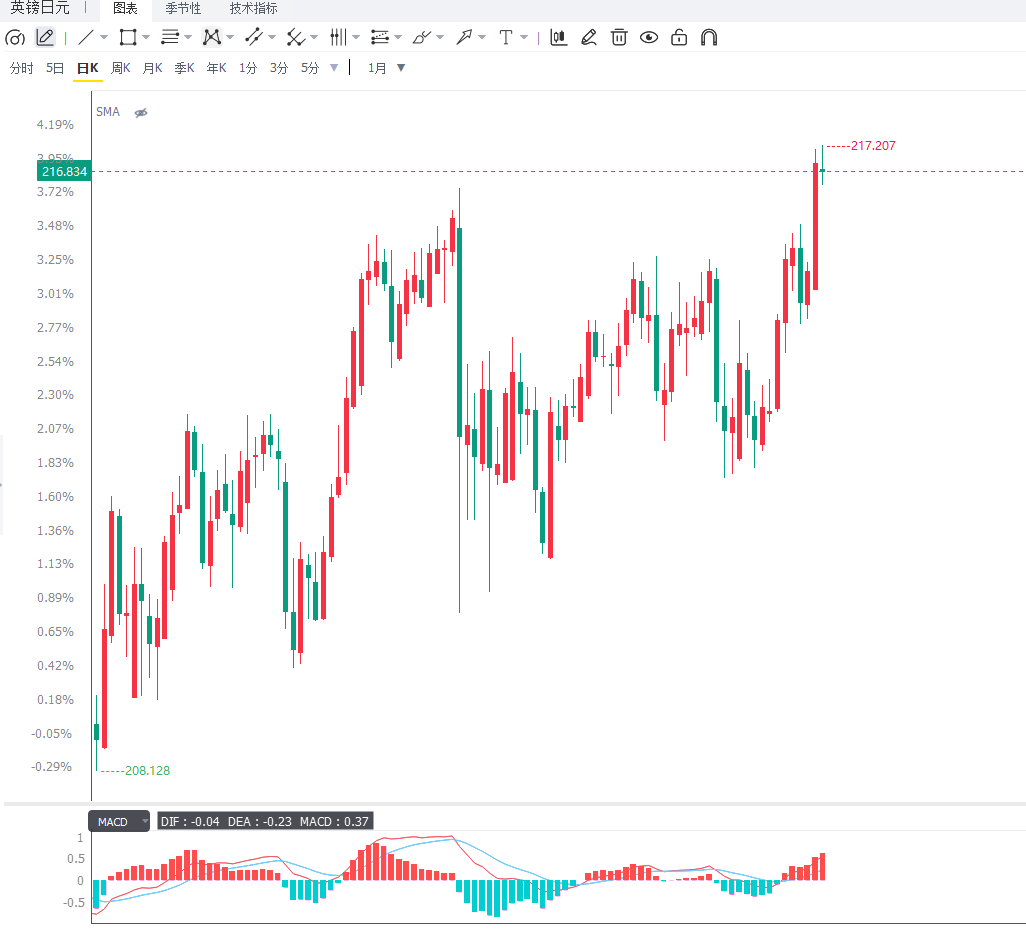
The British pound continued its strong upward trend against the Japanese yen on Tuesday, briefly breaking through the 217.00 level to reach its highest level in nearly 18 years. Data shows that the pair rose by more than 0.77% on the day, surpassing its year-to-date high of 216.60 and becoming a focus of market attention. As of the latest trading session, GBP/JPY is trading around 217.11, with bullish sentiment clearly strengthening in the market.
This rise was primarily driven by the overall strengthening of the pound, while continued pressure on the yen also provided additional support for the pound/yen exchange rate. Recently, the market has remained cautious about the pace of the Bank of Japan's policy adjustments, and improved global risk appetite has weakened demand for the yen as a safe haven, allowing the pound/yen to maintain its upward trend.
From a fundamental perspective, the rise in the pound against the yen reflects increased market demand for UK assets, while the weakness of the yen has also amplified the exchange rate's appreciation. Investors are currently focused on UK economic data, the Bank of England's future policy path, and whether the Bank of Japan will release clearer signals of policy adjustments.
If the pound continues its strength and the Bank of Japan's policy normalization process is slower than market expectations, the pound/yen exchange rate could gain further upward momentum. However, after a period of continuous gains, the market also needs to be wary of the risk of a technical correction, especially if buying interest weakens at higher levels.
From a daily chart perspective, the GBP/JPY pair maintains a clear upward trend, with prices continuously hitting new highs. The moving average system is in a bullish alignment, indicating that the market trend remains biased towards further gains. Having broken through the key psychological level of 217.00 , the short-term target for further gains is the resistance area around 217.50 . If the price effectively breaks through this area, it may continue to challenge the 218.00 level, further targeting the psychological level of 220.00. Meanwhile, the RSI indicator continues to rise and is approaching 70, indicating strong market momentum, but also suggesting the possibility of short-term high-level consolidation.
From a 4-hour chart perspective, GBP/JPY maintains a short-term upward structure, with the price moving along short-term moving averages, and the bullish trend has not yet clearly changed. However, as technical indicators have entered overbought territory after a rapid rise, a short-term correction is possible. If the exchange rate falls back and breaks below the psychological support level of 215.00 , the upward structure may be challenged, with the next support area around the July 3 low of 214.72. Further weakness could see the market test support around the 50-period simple moving average at 214.09 and the 100-period simple moving average at 213.17. Overall, as long as key support levels hold, GBP/JPY will likely continue to find buying opportunities after pullbacks.
Editor's Summary : The GBP/JPY pair broke through 217.00, hitting a multi-year high, indicating that current market expectations regarding the interest rate differential between the pound and yen, as well as capital flows, remain favorable for the pound. However, after the rapid rise, technical indicators are gradually entering overbought territory, and the short-term trend may shift from a one-sided upward movement to a period of consolidation. Future movements will depend on expectations of Bank of England policy, the pace of Bank of Japan policy adjustments, and changes in global risk sentiment. If the bulls can hold above 215.00, GBP/JPY may continue to advance towards 218.00 or even 220.00; however, if market risk appetite declines or the yen regains safe-haven buying, the exchange rate may face pressure for a phase of correction. The market is currently focusing on whether the 217.50 level can be broken, as this level may become an important reference for the continuation of the next trend.
This rise was primarily driven by the overall strengthening of the pound, while continued pressure on the yen also provided additional support for the pound/yen exchange rate. Recently, the market has remained cautious about the pace of the Bank of Japan's policy adjustments, and improved global risk appetite has weakened demand for the yen as a safe haven, allowing the pound/yen to maintain its upward trend.
From a fundamental perspective, the rise in the pound against the yen reflects increased market demand for UK assets, while the weakness of the yen has also amplified the exchange rate's appreciation. Investors are currently focused on UK economic data, the Bank of England's future policy path, and whether the Bank of Japan will release clearer signals of policy adjustments.
If the pound continues its strength and the Bank of Japan's policy normalization process is slower than market expectations, the pound/yen exchange rate could gain further upward momentum. However, after a period of continuous gains, the market also needs to be wary of the risk of a technical correction, especially if buying interest weakens at higher levels.
From a daily chart perspective, the GBP/JPY pair maintains a clear upward trend, with prices continuously hitting new highs. The moving average system is in a bullish alignment, indicating that the market trend remains biased towards further gains. Having broken through the key psychological level of 217.00 , the short-term target for further gains is the resistance area around 217.50 . If the price effectively breaks through this area, it may continue to challenge the 218.00 level, further targeting the psychological level of 220.00. Meanwhile, the RSI indicator continues to rise and is approaching 70, indicating strong market momentum, but also suggesting the possibility of short-term high-level consolidation.
From a 4-hour chart perspective, GBP/JPY maintains a short-term upward structure, with the price moving along short-term moving averages, and the bullish trend has not yet clearly changed. However, as technical indicators have entered overbought territory after a rapid rise, a short-term correction is possible. If the exchange rate falls back and breaks below the psychological support level of 215.00 , the upward structure may be challenged, with the next support area around the July 3 low of 214.72. Further weakness could see the market test support around the 50-period simple moving average at 214.09 and the 100-period simple moving average at 213.17. Overall, as long as key support levels hold, GBP/JPY will likely continue to find buying opportunities after pullbacks.
Editor's Summary : The GBP/JPY pair broke through 217.00, hitting a multi-year high, indicating that current market expectations regarding the interest rate differential between the pound and yen, as well as capital flows, remain favorable for the pound. However, after the rapid rise, technical indicators are gradually entering overbought territory, and the short-term trend may shift from a one-sided upward movement to a period of consolidation. Future movements will depend on expectations of Bank of England policy, the pace of Bank of Japan policy adjustments, and changes in global risk sentiment. If the bulls can hold above 215.00, GBP/JPY may continue to advance towards 218.00 or even 220.00; however, if market risk appetite declines or the yen regains safe-haven buying, the exchange rate may face pressure for a phase of correction. The market is currently focusing on whether the 217.50 level can be broken, as this level may become an important reference for the continuation of the next trend.
- Risk Warning and Disclaimer
- The market involves risk, and trading may not be suitable for all investors. This article is for reference only and does not constitute personal investment advice, nor does it take into account certain users’ specific investment objectives, financial situation, or other needs. Any investment decisions made based on this information are at your own risk.