From "verbal intervention" to "silent strangulation": Japan's foreign exchange strategy completes its biggest shift in two decades.
2026-07-07 11:24:41
The dollar edged lower against the yen on Tuesday (July 7), currently trading around 161.80. This followed two consecutive days of gains.

Last week, as the USD/JPY exchange rate hit a cyclical high, the market briefly revisited the massive foreign exchange market intervention by Japan's Ministry of Finance in April and May of this year, which cost approximately 12 trillion yen (about US$73 billion). At that time, the yen rebounded significantly, forcing speculative funds to liquidate their positions.
However, the market quickly realized that Tokyo's intervention strategy had quietly changed: it no longer issued public warnings or set any clear exchange rate red lines.
The Ministry of Finance appears to have fully shifted to an "ambush tactic," the triggering condition of which no longer depends on a fixed price level, but is based on the accumulation of speculative short yen positions and market imbalance signals.
The 162.00 level is more of a psychological defense line built by traders themselves than an officially endorsed intervention threshold. Once Tokyo explicitly recognizes a specific price level as a red line, speculators can position themselves in advance and confidently short sell. This "sand line" strategy is flexible and covert, like shifting sand dunes, making it difficult for opponents to grasp the true bottom line, thereby increasing the surprise and deterrent effect of intervention.
Analysts point out that this shift reflects the Japanese authorities' greater emphasis on intervention efficiency and resource conservation in the current environment of high inflation and diverging global interest rates. The previous combination of verbal and practical measures has given way to data-driven precision strikes, which avoid excessive depletion of foreign exchange reserves while maintaining a deterrent effect on the market.
In the short term, if the US dollar continues to strengthen and short positions in the Japanese yen accumulate excessively, the Ministry of Finance may still intervene suddenly, but the timing and scale will be even more difficult to predict. For forex traders, this means they must pay close attention to indirect signals such as CFTC positioning reports and implied volatility of options, rather than simply focusing on a specific round number level.
Against the backdrop of widening divergence in global monetary policies, Japan's "sand line" approach to intervention may become a new paradigm for major Asian economies to cope with exchange rate pressures, testing market self-discipline and highlighting the refined evolution of central bank strategies.
On June 16, the Bank of Japan announced an increase in its policy rate to 1.00%, marking the first time in 30 years that it had broken through this key level. Although there was one dissenting vote, the overall tone of the meeting leaned hawkish, with several members mentioning a clear path towards the 2% neutral interest rate range.
This decision initially boosted market confidence, and the yen strengthened significantly against the dollar that afternoon as some speculative short positions were covered.
However, this boost was extremely short-lived, with the yen maintaining its strength for only about one trading day before returning to its weak range.
The reason for this is that the Bank of Japan itself still characterizes its current policy as "easing," and real interest rates remain in negative territory. Coupled with the gradual withdrawal of subsidies and the transmission of energy costs, the inflation rate is expected to steadily rise to above 2%, but the next interest rate hike is likely to be postponed until the fourth quarter.
With the Federal Reserve maintaining the federal funds rate around 3.75% and internal debates still raging over its next move, the Bank of Japan's 25-basis-point "phased rate hikes" are unlikely to substantially alter the yield advantage of global carry trades. Dollar assets remain highly attractive to international capital, and while yen funding costs have risen slightly, arbitrage opportunities have not fundamentally narrowed.
Looking ahead, the Bank of Japan will need to find a more nuanced balance between its dual objectives of controlling inflation expectations and maintaining financial stability, while the market's patience for "gradual normalization" is being tested.
This brief boost also serves as a reminder to investors that isolated monetary policy adjustments, in a global interest rate divergence environment, often have an impact limited to short-term sentiment.
According to the daily chart, the USD/JPY pair maintains a strong bullish trend in the medium to long term, with the price consistently holding above all moving averages. The 20-day moving average (MA20) (161.322), 50-day moving average (MA50), 100-day moving average (MA100), and 200-day moving average (MA200) are arranged in a bullish formation from bottom to top, providing clear medium- to long-term support and maintaining a healthy long-term uptrend structure. The previous high of 162.83 forms strong short-term resistance, while short-term support lies at the 20-day moving average (161.32), and medium-term support is at the 50-day moving average (MA50) (159.732).
The MACD indicator DIFF (0.592) is slightly lower than DEA (0.644), and the red bars have narrowed slightly, forming a slight short-term death cross, indicating that the short-term bullish momentum has weakened. However, the two lines are still far above the zero axis, and the medium-to-long-term bullish trend has not reversed.
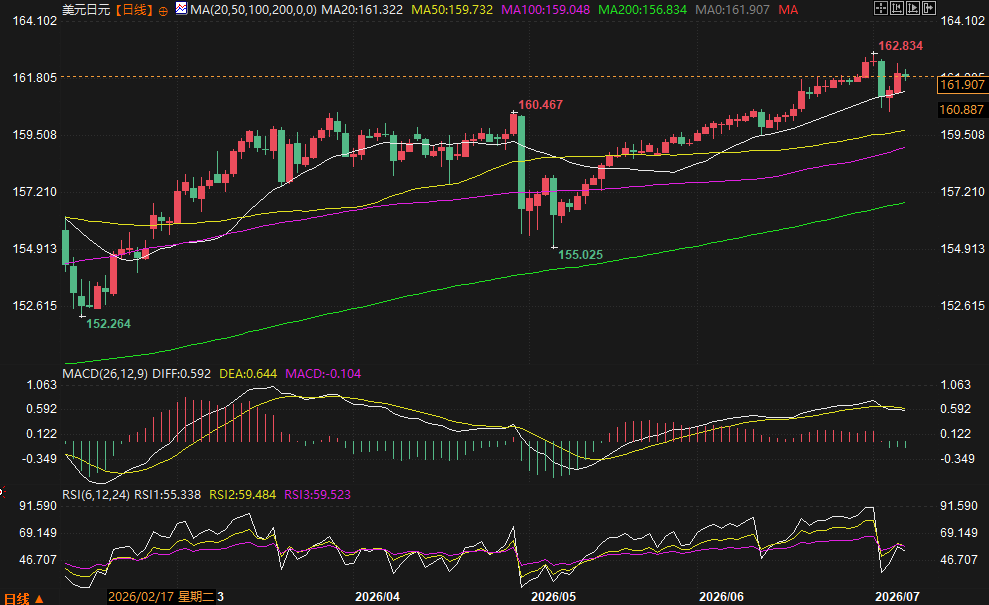
(USD/JPY daily chart, source: FX678)
At 11:24 Beijing time on July 7, the USD/JPY exchange rate was 161.81/82.
Intervention in Retirement: Tokyo's "Sand Defense Line"
Last week, as the USD/JPY exchange rate hit a cyclical high, the market briefly revisited the massive foreign exchange market intervention by Japan's Ministry of Finance in April and May of this year, which cost approximately 12 trillion yen (about US$73 billion). At that time, the yen rebounded significantly, forcing speculative funds to liquidate their positions.
However, the market quickly realized that Tokyo's intervention strategy had quietly changed: it no longer issued public warnings or set any clear exchange rate red lines.
The Ministry of Finance appears to have fully shifted to an "ambush tactic," the triggering condition of which no longer depends on a fixed price level, but is based on the accumulation of speculative short yen positions and market imbalance signals.
The 162.00 level is more of a psychological defense line built by traders themselves than an officially endorsed intervention threshold. Once Tokyo explicitly recognizes a specific price level as a red line, speculators can position themselves in advance and confidently short sell. This "sand line" strategy is flexible and covert, like shifting sand dunes, making it difficult for opponents to grasp the true bottom line, thereby increasing the surprise and deterrent effect of intervention.
Analysts point out that this shift reflects the Japanese authorities' greater emphasis on intervention efficiency and resource conservation in the current environment of high inflation and diverging global interest rates. The previous combination of verbal and practical measures has given way to data-driven precision strikes, which avoid excessive depletion of foreign exchange reserves while maintaining a deterrent effect on the market.
In the short term, if the US dollar continues to strengthen and short positions in the Japanese yen accumulate excessively, the Ministry of Finance may still intervene suddenly, but the timing and scale will be even more difficult to predict. For forex traders, this means they must pay close attention to indirect signals such as CFTC positioning reports and implied volatility of options, rather than simply focusing on a specific round number level.
Against the backdrop of widening divergence in global monetary policies, Japan's "sand line" approach to intervention may become a new paradigm for major Asian economies to cope with exchange rate pressures, testing market self-discipline and highlighting the refined evolution of central bank strategies.
After the rate hike: an afternoon of boost
On June 16, the Bank of Japan announced an increase in its policy rate to 1.00%, marking the first time in 30 years that it had broken through this key level. Although there was one dissenting vote, the overall tone of the meeting leaned hawkish, with several members mentioning a clear path towards the 2% neutral interest rate range.
This decision initially boosted market confidence, and the yen strengthened significantly against the dollar that afternoon as some speculative short positions were covered.
However, this boost was extremely short-lived, with the yen maintaining its strength for only about one trading day before returning to its weak range.
The reason for this is that the Bank of Japan itself still characterizes its current policy as "easing," and real interest rates remain in negative territory. Coupled with the gradual withdrawal of subsidies and the transmission of energy costs, the inflation rate is expected to steadily rise to above 2%, but the next interest rate hike is likely to be postponed until the fourth quarter.
With the Federal Reserve maintaining the federal funds rate around 3.75% and internal debates still raging over its next move, the Bank of Japan's 25-basis-point "phased rate hikes" are unlikely to substantially alter the yield advantage of global carry trades. Dollar assets remain highly attractive to international capital, and while yen funding costs have risen slightly, arbitrage opportunities have not fundamentally narrowed.
Looking ahead, the Bank of Japan will need to find a more nuanced balance between its dual objectives of controlling inflation expectations and maintaining financial stability, while the market's patience for "gradual normalization" is being tested.
This brief boost also serves as a reminder to investors that isolated monetary policy adjustments, in a global interest rate divergence environment, often have an impact limited to short-term sentiment.
Technical Analysis
According to the daily chart, the USD/JPY pair maintains a strong bullish trend in the medium to long term, with the price consistently holding above all moving averages. The 20-day moving average (MA20) (161.322), 50-day moving average (MA50), 100-day moving average (MA100), and 200-day moving average (MA200) are arranged in a bullish formation from bottom to top, providing clear medium- to long-term support and maintaining a healthy long-term uptrend structure. The previous high of 162.83 forms strong short-term resistance, while short-term support lies at the 20-day moving average (161.32), and medium-term support is at the 50-day moving average (MA50) (159.732).
The MACD indicator DIFF (0.592) is slightly lower than DEA (0.644), and the red bars have narrowed slightly, forming a slight short-term death cross, indicating that the short-term bullish momentum has weakened. However, the two lines are still far above the zero axis, and the medium-to-long-term bullish trend has not reversed.
(USD/JPY daily chart, source: FX678)
At 11:24 Beijing time on July 7, the USD/JPY exchange rate was 161.81/82.
- Risk Warning and Disclaimer
- The market involves risk, and trading may not be suitable for all investors. This article is for reference only and does not constitute personal investment advice, nor does it take into account certain users’ specific investment objectives, financial situation, or other needs. Any investment decisions made based on this information are at your own risk.