The euro fell to a one-year low against the pound, with strong German data failing to provide even a brief rebound.
2026-07-07 16:41:12
On Tuesday (July 7), the euro held steady against the pound at around 0.8540 during the European session.
German factory output rose 0.9% month-on-month in May, far exceeding market expectations of 0.2% and the previous value of 0.4%.
However, the euro failed to gain support from the strong data, as the continued pullback in market expectations for a European Central Bank (ECB) rate hike posed a greater macroeconomic drag – the euro has fallen more than 1% against the pound since last week, hitting its lowest level since July last year.
In the UK, the Lloyds House Price Index showed a 0.2% month-on-month increase in June, accelerating to 0.6% year-on-year, both exceeding expectations. European Central Bank President Christine Lagarde refused to commit to any specific interest rate path at the Sintra Forum, and her statement that "the risks to growth and inflation have become balanced" reinforced expectations of no change in interest rates in July, causing the euro to lose its previous advantage of monetary policy divergence relative to the Bank of England.
Germany's industrial production data for May was quite impressive: it rose 0.9% month-on-month, far exceeding market expectations of 0.2% and significantly accelerating from April's 0.4%. This data should have been a short-term positive for the euro.
However, the market's reaction was intriguing—the euro received almost no boost from the data.
This phenomenon of "immunity to good news" reflects the core contradiction in current euro trading: market expectations of the European Central Bank's policies have become a more powerful pricing driver than economic data. Against the backdrop of waning expectations of ECB interest rate hikes, economic data from a single country is insufficient to reverse the overall weakness of the euro.
Furthermore, the "good" data needs to be examined within the energy context. Did the rebound in German industrial output benefit from the decline in energy prices? If so, then this rebound precisely indicates that "the energy shock is fading"—which in turn weakens the urgency for the ECB to raise interest rates. From this perspective, the strong industrial data may be interpreted by the market as a "normalization rebound after easing inflationary pressures," rather than a signal that "the economy is overheating and needs to raise interest rates."
The euro has fallen more than 1% against the pound since last week, hitting its lowest level since July last year, due to a directional shift in ECB policy expectations.
Softening German consumer price data suggests that inflationary pressures from the Middle East conflict may have peaked, directly reducing the urgency for the ECB to raise interest rates in the near future. Lagarde's remarks at the Sintra Central Bank Forum last week further reinforced this expectation—she refused to commit to any specific interest rate path, while noting that the risks to growth and inflation have balanced out and denying any second-round inflationary effects.
Lagarde's stance is effectively paving the way for holding rates steady in July. Following the June rate hike, the ECB needs time to assess the actual transmission effects of the energy shock on economic activity and prices, rather than hastily continuing to tighten.
For the euro, the key issue is that a crucial supporting factor previously was the divergence in monetary policy between the ECB and the BoE, which was perceived as more hawkish. When this logic crumbled as expectations of ECB rate hikes faded, the euro lost a significant structural support.
In contrast to the divergence in data from the Eurozone, the data released by the UK also exceeded expectations.
The Lloyds House Price Index showed that UK house prices rose 0.2% month-on-month in June, reversing the 0.1% contraction in May and exceeding market expectations of a 0.1% increase. Year-on-year growth accelerated to 0.6% from 0.5% in May.
While house price data is not the Bank of England's most crucial consideration in monetary policy (wage and service sector inflation are more critical), its better-than-expected performance at least indicates that the UK economy has demonstrated some resilience in a rising interest rate environment. This is a marginally positive signal for the pound.
The core narrative of the current euro/pound exchange rate movement can be summarized as a "directional reversal of expectations regarding the divergence in monetary policy."
In previous months, the market had anticipated that the ECB would maintain a more hawkish stance than the BoE for an extended period—an expectation that supported the euro trading above 0.8600. However, as:
German inflation data shows the energy shock is receding.
Lagarde explicitly refused to commit to a specific interest rate path.
Market expectations for an ECB rate hike in July have almost disappeared.
The euro's "interest rate premium" relative to the pound is rapidly narrowing. At the same time, while the Bank of England is also facing a pullback in its rate hike expectations (from two to one with only a 70% probability), the contraction is relatively mild, and the hawkish camp within the BoE is expanding (two members have advocated for a rate hike to 4.00% at the June meeting).
This policy path difference—the European Central Bank turning dovish while the Bank of England remains stable—is the fundamental reason why the euro fell to a one-year low against the pound.
The euro is hovering around 0.8540 against the pound – its lowest level since July of last year. The short-term direction depends on the following variables:
First, the further evolution of policy expectations for the European Central Bank and the Bank of England. If Lagarde further hints at a "pause in rate hikes" in subsequent speeches, the euro may continue to fall towards the 0.8500 level; if ECB officials attempt to correct the market's over-interpretation of a "dovish turn," the euro may gain some breathing room.
Second, can German industrial output data continue to improve? While May's data was strong, a single month's figures are unlikely to reverse the overall trend. If subsequent PMI and ZEW economic sentiment indices show a sustained recovery, the market may reassess the Eurozone's growth prospects.
Third, UK inflation data (especially wage and services inflation) will be a key indicator of whether the pound can maintain its strength. If the data shows that a second wave of effects is forming, the market's expectation of a 70% probability of a Bank of England rate hike this year will move closer to 100%, and the pound will gain further upward momentum.
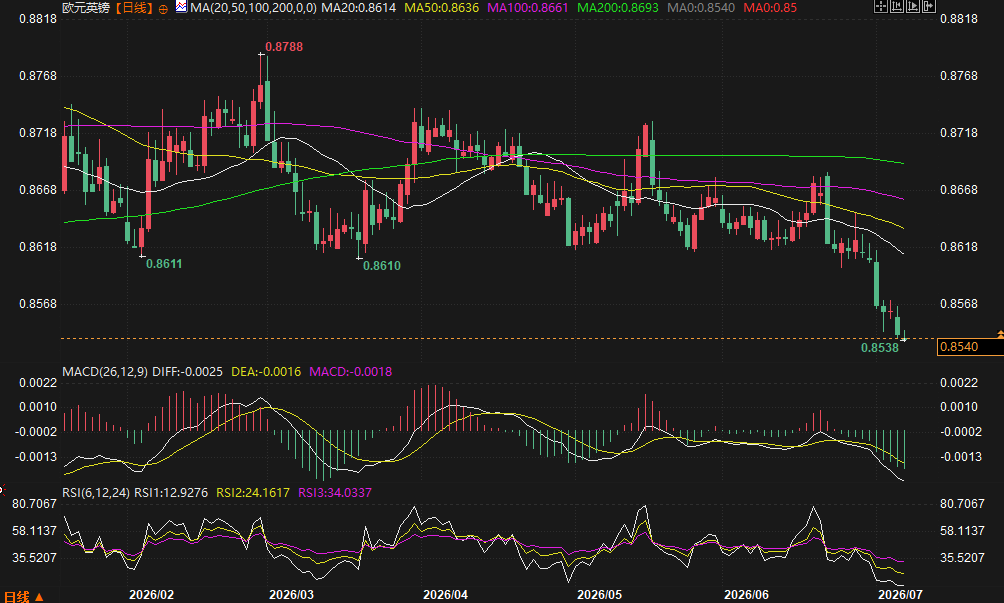
(Euro/Pound Sterling daily chart, source: FX678)
At 15:54 Beijing time on July 7, the euro was trading at 0.8539/40 against the pound.
German factory output rose 0.9% month-on-month in May, far exceeding market expectations of 0.2% and the previous value of 0.4%.
However, the euro failed to gain support from the strong data, as the continued pullback in market expectations for a European Central Bank (ECB) rate hike posed a greater macroeconomic drag – the euro has fallen more than 1% against the pound since last week, hitting its lowest level since July last year.
In the UK, the Lloyds House Price Index showed a 0.2% month-on-month increase in June, accelerating to 0.6% year-on-year, both exceeding expectations. European Central Bank President Christine Lagarde refused to commit to any specific interest rate path at the Sintra Forum, and her statement that "the risks to growth and inflation have become balanced" reinforced expectations of no change in interest rates in July, causing the euro to lose its previous advantage of monetary policy divergence relative to the Bank of England.
German industrial output exceeded expectations
Germany's industrial production data for May was quite impressive: it rose 0.9% month-on-month, far exceeding market expectations of 0.2% and significantly accelerating from April's 0.4%. This data should have been a short-term positive for the euro.
However, the market's reaction was intriguing—the euro received almost no boost from the data.
This phenomenon of "immunity to good news" reflects the core contradiction in current euro trading: market expectations of the European Central Bank's policies have become a more powerful pricing driver than economic data. Against the backdrop of waning expectations of ECB interest rate hikes, economic data from a single country is insufficient to reverse the overall weakness of the euro.
Furthermore, the "good" data needs to be examined within the energy context. Did the rebound in German industrial output benefit from the decline in energy prices? If so, then this rebound precisely indicates that "the energy shock is fading"—which in turn weakens the urgency for the ECB to raise interest rates. From this perspective, the strong industrial data may be interpreted by the market as a "normalization rebound after easing inflationary pressures," rather than a signal that "the economy is overheating and needs to raise interest rates."
The policy root of the euro's weakness: the continued erosion of expectations for a European Central Bank interest rate hike.
The euro has fallen more than 1% against the pound since last week, hitting its lowest level since July last year, due to a directional shift in ECB policy expectations.
Softening German consumer price data suggests that inflationary pressures from the Middle East conflict may have peaked, directly reducing the urgency for the ECB to raise interest rates in the near future. Lagarde's remarks at the Sintra Central Bank Forum last week further reinforced this expectation—she refused to commit to any specific interest rate path, while noting that the risks to growth and inflation have balanced out and denying any second-round inflationary effects.
Lagarde's stance is effectively paving the way for holding rates steady in July. Following the June rate hike, the ECB needs time to assess the actual transmission effects of the energy shock on economic activity and prices, rather than hastily continuing to tighten.
For the euro, the key issue is that a crucial supporting factor previously was the divergence in monetary policy between the ECB and the BoE, which was perceived as more hawkish. When this logic crumbled as expectations of ECB rate hikes faded, the euro lost a significant structural support.
Data support from the UK
In contrast to the divergence in data from the Eurozone, the data released by the UK also exceeded expectations.
The Lloyds House Price Index showed that UK house prices rose 0.2% month-on-month in June, reversing the 0.1% contraction in May and exceeding market expectations of a 0.1% increase. Year-on-year growth accelerated to 0.6% from 0.5% in May.
While house price data is not the Bank of England's most crucial consideration in monetary policy (wage and service sector inflation are more critical), its better-than-expected performance at least indicates that the UK economy has demonstrated some resilience in a rising interest rate environment. This is a marginally positive signal for the pound.
The Reversal of Monetary Policy Divergence: The Collapse of the Core Logic
The core narrative of the current euro/pound exchange rate movement can be summarized as a "directional reversal of expectations regarding the divergence in monetary policy."
In previous months, the market had anticipated that the ECB would maintain a more hawkish stance than the BoE for an extended period—an expectation that supported the euro trading above 0.8600. However, as:
German inflation data shows the energy shock is receding.
Lagarde explicitly refused to commit to a specific interest rate path.
Market expectations for an ECB rate hike in July have almost disappeared.
The euro's "interest rate premium" relative to the pound is rapidly narrowing. At the same time, while the Bank of England is also facing a pullback in its rate hike expectations (from two to one with only a 70% probability), the contraction is relatively mild, and the hawkish camp within the BoE is expanding (two members have advocated for a rate hike to 4.00% at the June meeting).
This policy path difference—the European Central Bank turning dovish while the Bank of England remains stable—is the fundamental reason why the euro fell to a one-year low against the pound.
Outlook: Directional choice after 0.8540
The euro is hovering around 0.8540 against the pound – its lowest level since July of last year. The short-term direction depends on the following variables:
First, the further evolution of policy expectations for the European Central Bank and the Bank of England. If Lagarde further hints at a "pause in rate hikes" in subsequent speeches, the euro may continue to fall towards the 0.8500 level; if ECB officials attempt to correct the market's over-interpretation of a "dovish turn," the euro may gain some breathing room.
Second, can German industrial output data continue to improve? While May's data was strong, a single month's figures are unlikely to reverse the overall trend. If subsequent PMI and ZEW economic sentiment indices show a sustained recovery, the market may reassess the Eurozone's growth prospects.
Third, UK inflation data (especially wage and services inflation) will be a key indicator of whether the pound can maintain its strength. If the data shows that a second wave of effects is forming, the market's expectation of a 70% probability of a Bank of England rate hike this year will move closer to 100%, and the pound will gain further upward momentum.
(Euro/Pound Sterling daily chart, source: FX678)
At 15:54 Beijing time on July 7, the euro was trading at 0.8539/40 against the pound.
- Risk Warning and Disclaimer
- The market involves risk, and trading may not be suitable for all investors. This article is for reference only and does not constitute personal investment advice, nor does it take into account certain users’ specific investment objectives, financial situation, or other needs. Any investment decisions made based on this information are at your own risk.