From "Privilege" to "Predicament": The Operating Rules and Twilight of Dollar Hegemony
2026-07-07 20:03:02
In 1971, when President Nixon announced the decoupling of the dollar from gold, then-US Treasury Secretary John Connally made an extremely arrogant remark in the face of angry European finance officials: "This is our dollar, but it's your problem."
More than half a century later, the renowned economist Kenneth Rogoff pointed out in his book that the lifespan of major reserve currencies in history (such as the Spanish peso, the Dutch guilder, and the British pound) is usually one to two centuries.
By this standard, the US dollar is in its "middle age." However, this largest financial machine in the world is being pushed towards a multipolar twilight by its own operating principles. To understand the future of the US dollar, one must first understand the three underlying principles that govern it.
The reason the US dollar has become a global anchor is because it can "import" macroeconomic stability for other countries.
However, any country that attempts to take shortcuts by relying on the dollar will trigger the "Mundell-Fleming trilemma" in macroeconomics:
No country can simultaneously achieve: a fixed exchange rate, free capital flow, and an independent monetary policy.
For a long time, from Mexico and Brazil in Latin America to Lebanon in the Middle East, countless developing countries have chosen to peg their currencies to the US dollar (fixed exchange rate) in order to stabilize their economies, while opening up their capital markets to attract foreign investment.
According to the "impossible trinity" principle, they must completely abandon independent monetary policies.
This means that once the Federal Reserve aggressively raises interest rates to address domestic problems in the United States, these countries, regardless of how weak their economies are, will be forced to follow suit and raise interest rates to prevent capital outflows.
The extreme vulnerability of this policy was fully exposed during the Asian financial crisis of the 1990s.
In order to survive in the gap of the "impossible triangle", the global economy has evolved the "Tokyo Consensus" (a compromise model between complete freedom and complete regulation): implementing a managed floating exchange rate while hoarding massive amounts of dollar assets (mainly US Treasury bonds) in central banks as a risk buffer.
This pattern leads to the following result: the more turbulent the world becomes, the more desperate foreign countries are for "safe assets" like US Treasury bonds, and the stronger the centripetal force of the US dollar becomes.
This global thirst for foreign debt (US debt) has granted the United States an unparalleled "exorbitant privilege".
As the world's only credit intermediary, the United States possesses almost unlimited low-cost financing capabilities, enabling it to transfer crises globally through money printing and wield the heavy stick of financial sanctions.
But this triggers a deeper underlying principle—the "Triffin Dilemma".
Historically, the traditional Triffin dilemma refers to the situation where the United States must export dollars through trade deficits to meet global trade demands, but this in turn erodes the United States' gold reserves and undermines confidence in the dollar.
After the collapse of the Bretton Woods system, Rogoff proposed the "modern Triffin dilemma":
The contradiction lies in the unlimited global demand for dollar assets and the limited overall debt repayment capacity of the United States.
It is precisely because the world (especially countries that have implemented the "Tokyo Consensus") needs to hoard US Treasury bonds as a safety net that the United States has been able to enjoy ultra-low interest rates for the past few decades and has fallen into a dangerous illusion that "borrowing is free".
The world's trust in the US dollar has become a highly potent drug, forcing Washington to constantly borrow new money to repay old debts and frantically increase the size of US debt.
For a long time, the dominance of the US dollar has relied not only on policies that actively consolidate its hegemony, but also on the contrast provided by its peers.
Rogoff analyzed the fate of challengers over the past few decades:
The Soviet Union withdrew from the competition in the later stages of the Cold War due to the loss of growth and innovation momentum.
Japan: In the 1980s, its economic output was approaching that of the United States, but under the asymmetric pressure of the Plaza Accord in 1985, it was forced to allow the yen to appreciate sharply, which eventually burst the domestic asset bubble and plunged it into a long period of stagnation.
Europe: Although it has launched the euro, it is currently unable to challenge the system due to structural crises, high inflation, and internal strife.
China: The internationalization of the RMB is still underway.
In an asymmetric world where there is no absolute disruptor from the outside, the real Achilles' heel of the dollar lies within Washington itself.
With the US debt-to-GDP ratio projected to soar to 166% by 2054, a frightening turning point has already emerged: in 2024, the US net foreign liabilities will surge from 17% of GDP in 2010 to 71% of GDP, officially exceeding the returns on its overseas assets.
This means that the United States is not only mortgaging its future, but also mortgaging the underlying confidence of global investors.
Worse still, the "independence of the Federal Reserve," which is the ultimate guarantee of the value of the dollar, is being severely eroded by political polarization in the United States and pressure from both parties.
If fiscal deficits completely hijack monetary policy, preventing the Federal Reserve from effectively curbing inflation, the world's "faith" in the US dollar will collapse instantly.
The dollar's supreme status will not suddenly collapse in the short term due to the rise of a rival, because there is no other system in the world that can support such a huge amount of capital.
But the dollar is irrevocably following its own inherent laws toward mediocrity.
The world will become more multipolar in the future. The dollar will remain on the throne, but that will be a situation where there are no tigers in the mountains.
When the tide of the dollar finally recedes, the stability of global finance will be severely shaken.
However, the US dollar index remains very strong and is likely to remain so for a very long time. As mentioned in previous articles, from a debt repayment perspective, the strength of the US dollar depends on the relationship between GDP growth and the 10-year Treasury yield. If the US can ensure GDP growth and keep the 10-year Treasury yield low, then from a debt repayment perspective, there is no way to be bearish on the US dollar.
The current turning point in the US dollar index is more likely a geopolitical turning point or a turning point in the US stock market.
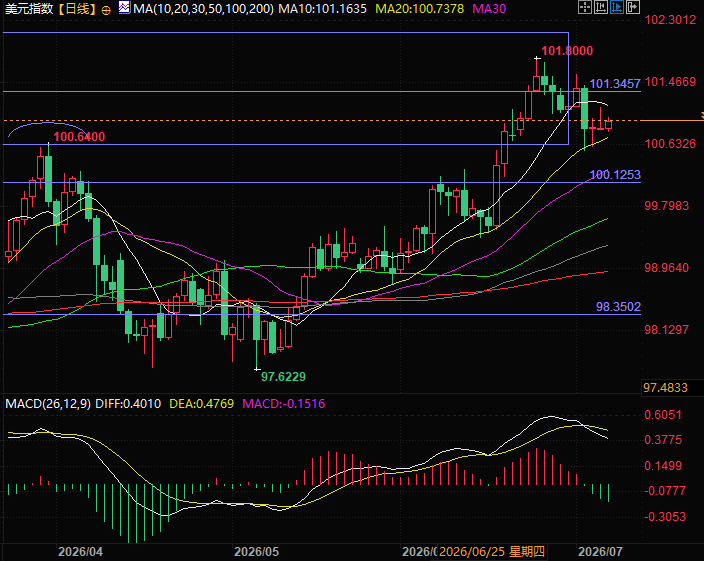
(US Dollar Index Daily Chart, Source: FX678)
At 20:00 Beijing time, the US dollar index is currently at 100.93.
More than half a century later, the renowned economist Kenneth Rogoff pointed out in his book that the lifespan of major reserve currencies in history (such as the Spanish peso, the Dutch guilder, and the British pound) is usually one to two centuries.
By this standard, the US dollar is in its "middle age." However, this largest financial machine in the world is being pushed towards a multipolar twilight by its own operating principles. To understand the future of the US dollar, one must first understand the three underlying principles that govern it.
Rule 1: The "impossible trinity" of peripheral countries and the centripetal force of the US dollar
The reason the US dollar has become a global anchor is because it can "import" macroeconomic stability for other countries.
However, any country that attempts to take shortcuts by relying on the dollar will trigger the "Mundell-Fleming trilemma" in macroeconomics:
No country can simultaneously achieve: a fixed exchange rate, free capital flow, and an independent monetary policy.
For a long time, from Mexico and Brazil in Latin America to Lebanon in the Middle East, countless developing countries have chosen to peg their currencies to the US dollar (fixed exchange rate) in order to stabilize their economies, while opening up their capital markets to attract foreign investment.
According to the "impossible trinity" principle, they must completely abandon independent monetary policies.
This means that once the Federal Reserve aggressively raises interest rates to address domestic problems in the United States, these countries, regardless of how weak their economies are, will be forced to follow suit and raise interest rates to prevent capital outflows.
The extreme vulnerability of this policy was fully exposed during the Asian financial crisis of the 1990s.
In order to survive in the gap of the "impossible triangle", the global economy has evolved the "Tokyo Consensus" (a compromise model between complete freedom and complete regulation): implementing a managed floating exchange rate while hoarding massive amounts of dollar assets (mainly US Treasury bonds) in central banks as a risk buffer.
This pattern leads to the following result: the more turbulent the world becomes, the more desperate foreign countries are for "safe assets" like US Treasury bonds, and the stronger the centripetal force of the US dollar becomes.
Pattern Two: The "Triffin Dilemma" and Drug-like Privileges in Dollar-Issuing Countries
This global thirst for foreign debt (US debt) has granted the United States an unparalleled "exorbitant privilege".
As the world's only credit intermediary, the United States possesses almost unlimited low-cost financing capabilities, enabling it to transfer crises globally through money printing and wield the heavy stick of financial sanctions.
But this triggers a deeper underlying principle—the "Triffin Dilemma".
Historically, the traditional Triffin dilemma refers to the situation where the United States must export dollars through trade deficits to meet global trade demands, but this in turn erodes the United States' gold reserves and undermines confidence in the dollar.
After the collapse of the Bretton Woods system, Rogoff proposed the "modern Triffin dilemma":
The contradiction lies in the unlimited global demand for dollar assets and the limited overall debt repayment capacity of the United States.
It is precisely because the world (especially countries that have implemented the "Tokyo Consensus") needs to hoard US Treasury bonds as a safety net that the United States has been able to enjoy ultra-low interest rates for the past few decades and has fallen into a dangerous illusion that "borrowing is free".
The world's trust in the US dollar has become a highly potent drug, forcing Washington to constantly borrow new money to repay old debts and frantically increase the size of US debt.
Rule Three: Asymmetric Competition and the Internal Collapse of Washington
For a long time, the dominance of the US dollar has relied not only on policies that actively consolidate its hegemony, but also on the contrast provided by its peers.
Rogoff analyzed the fate of challengers over the past few decades:
The Soviet Union withdrew from the competition in the later stages of the Cold War due to the loss of growth and innovation momentum.
Japan: In the 1980s, its economic output was approaching that of the United States, but under the asymmetric pressure of the Plaza Accord in 1985, it was forced to allow the yen to appreciate sharply, which eventually burst the domestic asset bubble and plunged it into a long period of stagnation.
Europe: Although it has launched the euro, it is currently unable to challenge the system due to structural crises, high inflation, and internal strife.
China: The internationalization of the RMB is still underway.
In an asymmetric world where there is no absolute disruptor from the outside, the real Achilles' heel of the dollar lies within Washington itself.
With the US debt-to-GDP ratio projected to soar to 166% by 2054, a frightening turning point has already emerged: in 2024, the US net foreign liabilities will surge from 17% of GDP in 2010 to 71% of GDP, officially exceeding the returns on its overseas assets.
This means that the United States is not only mortgaging its future, but also mortgaging the underlying confidence of global investors.
Worse still, the "independence of the Federal Reserve," which is the ultimate guarantee of the value of the dollar, is being severely eroded by political polarization in the United States and pressure from both parties.
If fiscal deficits completely hijack monetary policy, preventing the Federal Reserve from effectively curbing inflation, the world's "faith" in the US dollar will collapse instantly.
The dollar's supreme status will not suddenly collapse in the short term due to the rise of a rival, because there is no other system in the world that can support such a huge amount of capital.
But the dollar is irrevocably following its own inherent laws toward mediocrity.
Summarize:
The world will become more multipolar in the future. The dollar will remain on the throne, but that will be a situation where there are no tigers in the mountains.
When the tide of the dollar finally recedes, the stability of global finance will be severely shaken.
However, the US dollar index remains very strong and is likely to remain so for a very long time. As mentioned in previous articles, from a debt repayment perspective, the strength of the US dollar depends on the relationship between GDP growth and the 10-year Treasury yield. If the US can ensure GDP growth and keep the 10-year Treasury yield low, then from a debt repayment perspective, there is no way to be bearish on the US dollar.
The current turning point in the US dollar index is more likely a geopolitical turning point or a turning point in the US stock market.
(US Dollar Index Daily Chart, Source: FX678)
At 20:00 Beijing time, the US dollar index is currently at 100.93.
- Risk Warning and Disclaimer
- The market involves risk, and trading may not be suitable for all investors. This article is for reference only and does not constitute personal investment advice, nor does it take into account certain users’ specific investment objectives, financial situation, or other needs. Any investment decisions made based on this information are at your own risk.