The attack on Hormuz ignited safe-haven demand for the US dollar, causing the Australian dollar to fall to a two-day low. Will the Fed meeting minutes reverse the downward trend?
2026-07-08 08:22:14
On Wednesday (July 8) in early Asian trading, the Australian dollar fell to a two-day low against the US dollar, currently trading around 0.6925.
The geopolitical situation in the Middle East has suddenly escalated – another attack on ships has occurred in the Strait of Hormuz.
In response, U.S. Central Command announced a series of punitive airstrikes against Iranian targets, including air defense systems, coastal surveillance facilities, missile sites, and port infrastructure in southern Iran. Simultaneously, the U.S. revoked the general license that previously allowed Iran to sell oil on the international market, a decision that directly put significant pressure on the fragile ceasefire agreement reached last month.
The collapse of the US-Iran ceasefire agreement triggered a sharp rise in market risk aversion, leading to a broad strengthening of the US dollar and downward pressure on the Australian dollar.
On Tuesday, the fragile ceasefire agreement between the US and Iran entered a new phase of hostilities. Two merchant ships were reportedly attacked near the Strait of Hormuz.
In response, Washington reimposed sanctions on Iranian oil exports, and U.S. Central Command (CENTCOM) said it had launched strikes on Iranian weapons launch sites and air defense facilities, and expected further retaliatory actions to continue for several hours.
This development completely reversed the easing of tensions following the signing of the interim peace agreement last month, fueling expectations of soaring energy prices and inflation concerns, which further boosted safe-haven buying of the US dollar.
The U.S. trade deficit in goods and services widened in May, slightly below market expectations but higher than in April.
Meanwhile, the New York Fed’s consumer expectations survey showed that one-year inflation expectations rose to 3.7% in June from 3.5%, indicating that American households are increasingly worried about rising prices.
According to CME's FedWatch Tool, the probability of the Federal Reserve keeping interest rates unchanged in July is 73.3%, and the probability of a cumulative 25 basis point rate hike is 26.7%. The probability of the Fed keeping interest rates unchanged by September is 32.4%, the probability of a cumulative 25 basis point rate hike is 52.7%, and the probability of a cumulative 50 basis point rate hike is 14.9%.
The probability of the Federal Reserve keeping interest rates unchanged by December is 15.8%, the probability of a cumulative rate hike of 25 basis points is 40.6%, and the probability of a rate hike of at least 50 basis points is 43.6%.
According to Prime Terminal data, given the current geopolitical context and rising inflation expectations due to energy price increases, traders have fully priced in the possibility (100%) of the Federal Reserve raising interest rates in 2026.
This expectation provided additional support for the US dollar.
With no major economic data releases scheduled for today in Australia, market focus is on shifts in global risk sentiment.
The Reserve Bank of Australia (RBA) has raised interest rates three times in 2026, and the minutes of its most recent meeting showed a shift to a neutral stance, but still reserved the possibility of further rate hikes if necessary.
The Australian dollar's performance in the short term will be more driven by external factors.
This week, the US economic calendar will feature two key events: the release of the Federal Reserve's June meeting minutes (on Wednesday) and the initial jobless claims for the week ending July 4.
Both will provide the market with the latest clues about the future policy path of the Federal Reserve, potentially triggering a new round of volatility in the Australian dollar against the US dollar.
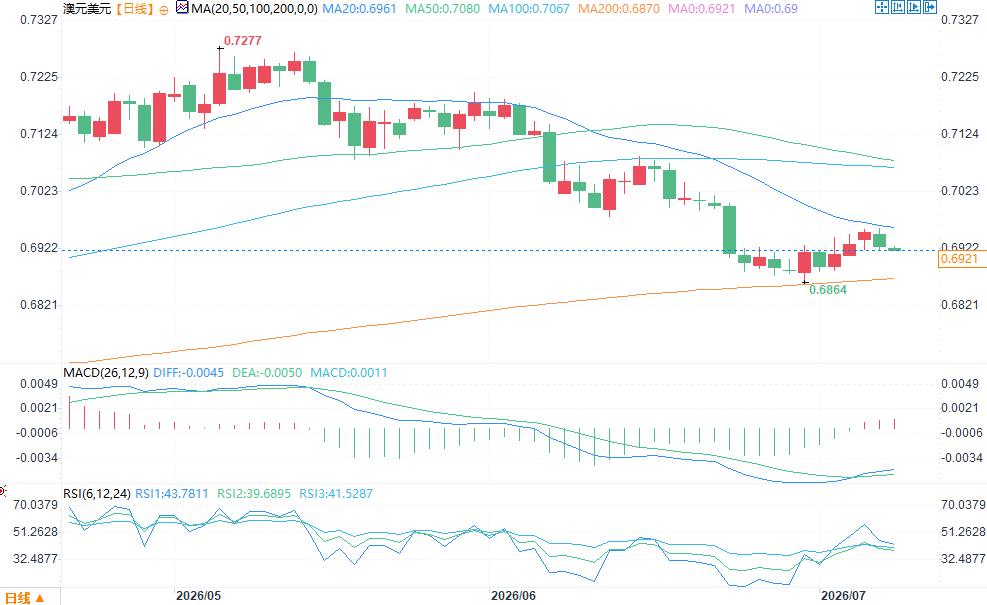
According to the daily chart, the Australian dollar against the US dollar has entered a medium-term downtrend from the previous high of 0.7277. The price has fallen continuously from its high, reaching a low of 0.6864 before rebounding, and is currently trading around 0.6925. The moving average system clearly shows a bearish pattern, with the short-term 20-day moving average (MA20) (0.6961) and the medium-term 50-day moving average (MA50) continuing to exert downward pressure. The price is under pressure below the 20-day moving average, with only the 200-day moving average (MA200) forming a key support zone below. The medium- to long-term trend remains bearish.
In terms of indicators, the MACD is below the zero line, the DIFF (-0.0045) is close to the DEA (-0.0050), the green bars are converging and the red bars are showing a slight increase, indicating that the bearish momentum has obviously weakened and there is a short-term need for correction.
(AUD/USD daily chart, source: FX678)
At 8:12 AM Beijing time on July 8, the Australian dollar was trading at 0.6926/27 against the US dollar.
The geopolitical situation in the Middle East has suddenly escalated – another attack on ships has occurred in the Strait of Hormuz.
In response, U.S. Central Command announced a series of punitive airstrikes against Iranian targets, including air defense systems, coastal surveillance facilities, missile sites, and port infrastructure in southern Iran. Simultaneously, the U.S. revoked the general license that previously allowed Iran to sell oil on the international market, a decision that directly put significant pressure on the fragile ceasefire agreement reached last month.
The collapse of the US-Iran ceasefire agreement triggered a sharp rise in market risk aversion, leading to a broad strengthening of the US dollar and downward pressure on the Australian dollar.
Geopolitics: Attacks in the Strait of Hormuz escalate US-Iran conflict once again.
On Tuesday, the fragile ceasefire agreement between the US and Iran entered a new phase of hostilities. Two merchant ships were reportedly attacked near the Strait of Hormuz.
In response, Washington reimposed sanctions on Iranian oil exports, and U.S. Central Command (CENTCOM) said it had launched strikes on Iranian weapons launch sites and air defense facilities, and expected further retaliatory actions to continue for several hours.
This development completely reversed the easing of tensions following the signing of the interim peace agreement last month, fueling expectations of soaring energy prices and inflation concerns, which further boosted safe-haven buying of the US dollar.
US economic data: Trade deficit widens, inflation expectations rise.
The U.S. trade deficit in goods and services widened in May, slightly below market expectations but higher than in April.
Meanwhile, the New York Fed’s consumer expectations survey showed that one-year inflation expectations rose to 3.7% in June from 3.5%, indicating that American households are increasingly worried about rising prices.
Monetary Policy: Markets Fully Price in Fed Rate Hike in 2026
According to CME's FedWatch Tool, the probability of the Federal Reserve keeping interest rates unchanged in July is 73.3%, and the probability of a cumulative 25 basis point rate hike is 26.7%. The probability of the Fed keeping interest rates unchanged by September is 32.4%, the probability of a cumulative 25 basis point rate hike is 52.7%, and the probability of a cumulative 50 basis point rate hike is 14.9%.
The probability of the Federal Reserve keeping interest rates unchanged by December is 15.8%, the probability of a cumulative rate hike of 25 basis points is 40.6%, and the probability of a rate hike of at least 50 basis points is 43.6%.
According to Prime Terminal data, given the current geopolitical context and rising inflation expectations due to energy price increases, traders have fully priced in the possibility (100%) of the Federal Reserve raising interest rates in 2026.
This expectation provided additional support for the US dollar.
Australia: Economic data vacuum, risk sentiment dominates.
With no major economic data releases scheduled for today in Australia, market focus is on shifts in global risk sentiment.
The Reserve Bank of Australia (RBA) has raised interest rates three times in 2026, and the minutes of its most recent meeting showed a shift to a neutral stance, but still reserved the possibility of further rate hikes if necessary.
The Australian dollar's performance in the short term will be more driven by external factors.
This week's focus: Federal Reserve meeting minutes and initial jobless claims data.
This week, the US economic calendar will feature two key events: the release of the Federal Reserve's June meeting minutes (on Wednesday) and the initial jobless claims for the week ending July 4.
Both will provide the market with the latest clues about the future policy path of the Federal Reserve, potentially triggering a new round of volatility in the Australian dollar against the US dollar.
Technical Analysis
According to the daily chart, the Australian dollar against the US dollar has entered a medium-term downtrend from the previous high of 0.7277. The price has fallen continuously from its high, reaching a low of 0.6864 before rebounding, and is currently trading around 0.6925. The moving average system clearly shows a bearish pattern, with the short-term 20-day moving average (MA20) (0.6961) and the medium-term 50-day moving average (MA50) continuing to exert downward pressure. The price is under pressure below the 20-day moving average, with only the 200-day moving average (MA200) forming a key support zone below. The medium- to long-term trend remains bearish.
In terms of indicators, the MACD is below the zero line, the DIFF (-0.0045) is close to the DEA (-0.0050), the green bars are converging and the red bars are showing a slight increase, indicating that the bearish momentum has obviously weakened and there is a short-term need for correction.
(AUD/USD daily chart, source: FX678)
At 8:12 AM Beijing time on July 8, the Australian dollar was trading at 0.6926/27 against the US dollar.
- Risk Warning and Disclaimer
- The market involves risk, and trading may not be suitable for all investors. This article is for reference only and does not constitute personal investment advice, nor does it take into account certain users’ specific investment objectives, financial situation, or other needs. Any investment decisions made based on this information are at your own risk.