The Strait of Hormuz suddenly erupts into war; is the surge in WTI crude oil prices due to a supply "cliff" or a "hype" of sentiment?
2026-07-08 10:01:19
On Wednesday (July 8) in early Asian trading, West Texas Intermediate (WTI) crude oil prices continued their strong performance, rising further after recording a 5% gain overnight, and are currently trading around $72 per barrel.
The immediate trigger for this surge in oil prices was the US military's new round of airstrikes against Iran, along with the revocation of key sanctions waivers that allowed Iran to conduct international oil sales.
This series of actions marks the formal breakdown of the fragile interim peace agreement between the US and Iran.
The latest round of US airstrikes against Iran marks a significant escalation in the military confrontation between the two countries. While a fragile peace framework had been maintained between the US and Iran in the preceding months, a fundamental lack of mutual trust existed between the two sides. The US revoking sanctions waivers on Iranian oil exports is the most direct means of cutting off the flow of Iranian crude oil into the international market.
According to estimates by the International Energy Agency, Iran previously exported approximately 1.5 million to 2 million barrels of crude oil per day. If these supplies were to completely withdraw from the market, it would rapidly tighten the global supply and demand balance.
The security situation in the Strait of Hormuz is even more problematic. Iran's attacks on Qatari LNG carriers and Saudi oil tankers demonstrate its intention to retaliate against US sanctions pressure by disrupting shipping. This waterway carries approximately one-third of the world's liquefied natural gas shipments and nearly one-fifth of its seaborne oil transport.
In the short term, shipowners will face higher war risk premiums, and some ships may be forced to detour around the Cape of Good Hope. This will not only increase transportation costs but also prolong the time it takes for supplies to reach their destination, effectively causing a temporary supply shortage.
The impact of this event on crude oil fundamentals is structural. Just last week, the market was still preoccupied with concerns about increased OPEC+ production, with institutions generally expecting a supply glut of hundreds of thousands or even millions of barrels per day in the second half of 2026.
However, the complete halt of Iranian oil exports and the potential disruption of shipping through the Strait of Hormuz have wiped out any expectations of a surplus overnight. If the supply gap from Iran cannot be quickly filled by other oil-producing countries—and given the spare capacity of countries like Saudi Arabia and the UAE, as well as the current risks inherent in the Strait, a rapid filling is extremely difficult—then global oil inventories will shift from accumulation to depletion.
Furthermore, the market needs to pay attention to the revaluation of risk premiums. Even if the military conflict does not escalate further, a permanent escalation of geopolitical risks in the Middle East means that crude oil prices need to reflect a higher risk premium. Previously, when oil prices hovered below $70 per barrel, market pricing reflected more pessimistic macroeconomic expectations and concerns about oversupply, while geopolitical risk premiums were severely underestimated. The current price increase is a correction to this bias.
In summary, WTI crude oil prices are expected to maintain a strong trend in the short term. Geopolitical events typically have a sudden and unpredictable impact on oil prices. Until the US and Iran demonstrate a clear willingness to return to the negotiating table, the market will continue to price in potential supply disruptions from the Middle East. Oil prices are expected to have further upside potential in the short term, with the next key resistance level appearing around $75 per barrel, a significant psychological barrier during the previous OPEC+ production policy negotiations.
However, investors must be highly vigilant about the rapidly changing situation. If diplomatic channels reopen or the US signals a de-escalation, oil prices could also fall quickly.
In the coming weeks, the market's core focus will be on whether normal passage through the Strait of Hormuz will resume, whether Iran will continue exporting oil through other channels (such as third-party countries), and how major OPEC+ oil-producing countries will respond to this supply shock. A significant increase in volatility will be the norm for crude oil trading during this period, with intraday price swings potentially widening considerably. For all energy market participants, risk management has become the highest priority in the current environment.
From a technical perspective, according to the daily chart, US crude oil futures have been in a medium- to long-term downtrend since the high of 110.93. The price has been declining in steps, reaching a low of 67.04 before finding support and rebounding with a positive candlestick. Currently, the moving averages are generally in a bearish alignment. The short-term MA20 at 73.63 forms direct resistance, while the MA50 and MA100 are also trending downwards. Only the MA200 at 74.20 provides medium-term resistance. The medium- to long-term downtrend structure has not yet reversed.
In terms of indicators, the MACD is running below the zero axis, and the DIFF value of -5.04 has slightly crossed the DEA value of -5.67 to form a golden cross at a low level. The red bars have slightly expanded, and the downward momentum of the bears has obviously weakened. The RSI has rebounded from the low oversold zone. The current RSI1 is 52.87, which has not entered the overbought zone above 70, and there is still room for short-term recovery and upward movement.
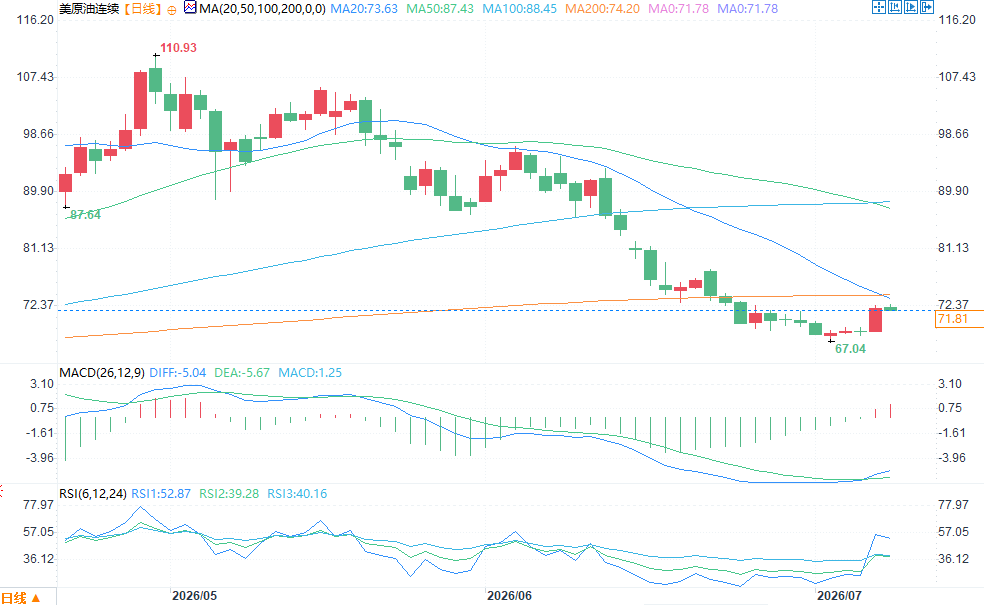
(US crude oil futures daily chart, source: FX678)
At 10:00 AM Beijing time on July 8, US crude oil futures were trading at $72.05 per barrel.
The immediate trigger for this surge in oil prices was the US military's new round of airstrikes against Iran, along with the revocation of key sanctions waivers that allowed Iran to conduct international oil sales.
This series of actions marks the formal breakdown of the fragile interim peace agreement between the US and Iran.
Geopolitical tipping point: The dual impact of US airstrikes and sanctions retraction
The latest round of US airstrikes against Iran marks a significant escalation in the military confrontation between the two countries. While a fragile peace framework had been maintained between the US and Iran in the preceding months, a fundamental lack of mutual trust existed between the two sides. The US revoking sanctions waivers on Iranian oil exports is the most direct means of cutting off the flow of Iranian crude oil into the international market.
According to estimates by the International Energy Agency, Iran previously exported approximately 1.5 million to 2 million barrels of crude oil per day. If these supplies were to completely withdraw from the market, it would rapidly tighten the global supply and demand balance.
The security situation in the Strait of Hormuz is even more problematic. Iran's attacks on Qatari LNG carriers and Saudi oil tankers demonstrate its intention to retaliate against US sanctions pressure by disrupting shipping. This waterway carries approximately one-third of the world's liquefied natural gas shipments and nearly one-fifth of its seaborne oil transport.
In the short term, shipowners will face higher war risk premiums, and some ships may be forced to detour around the Cape of Good Hope. This will not only increase transportation costs but also prolong the time it takes for supplies to reach their destination, effectively causing a temporary supply shortage.
Supply and demand dynamics reversed: from anticipated surplus to actual shortage
The impact of this event on crude oil fundamentals is structural. Just last week, the market was still preoccupied with concerns about increased OPEC+ production, with institutions generally expecting a supply glut of hundreds of thousands or even millions of barrels per day in the second half of 2026.
However, the complete halt of Iranian oil exports and the potential disruption of shipping through the Strait of Hormuz have wiped out any expectations of a surplus overnight. If the supply gap from Iran cannot be quickly filled by other oil-producing countries—and given the spare capacity of countries like Saudi Arabia and the UAE, as well as the current risks inherent in the Strait, a rapid filling is extremely difficult—then global oil inventories will shift from accumulation to depletion.
Furthermore, the market needs to pay attention to the revaluation of risk premiums. Even if the military conflict does not escalate further, a permanent escalation of geopolitical risks in the Middle East means that crude oil prices need to reflect a higher risk premium. Previously, when oil prices hovered below $70 per barrel, market pricing reflected more pessimistic macroeconomic expectations and concerns about oversupply, while geopolitical risk premiums were severely underestimated. The current price increase is a correction to this bias.
Outlook: Short-term uptrend unlikely to change, volatility to rise significantly.
In summary, WTI crude oil prices are expected to maintain a strong trend in the short term. Geopolitical events typically have a sudden and unpredictable impact on oil prices. Until the US and Iran demonstrate a clear willingness to return to the negotiating table, the market will continue to price in potential supply disruptions from the Middle East. Oil prices are expected to have further upside potential in the short term, with the next key resistance level appearing around $75 per barrel, a significant psychological barrier during the previous OPEC+ production policy negotiations.
However, investors must be highly vigilant about the rapidly changing situation. If diplomatic channels reopen or the US signals a de-escalation, oil prices could also fall quickly.
In the coming weeks, the market's core focus will be on whether normal passage through the Strait of Hormuz will resume, whether Iran will continue exporting oil through other channels (such as third-party countries), and how major OPEC+ oil-producing countries will respond to this supply shock. A significant increase in volatility will be the norm for crude oil trading during this period, with intraday price swings potentially widening considerably. For all energy market participants, risk management has become the highest priority in the current environment.
From a technical perspective, according to the daily chart, US crude oil futures have been in a medium- to long-term downtrend since the high of 110.93. The price has been declining in steps, reaching a low of 67.04 before finding support and rebounding with a positive candlestick. Currently, the moving averages are generally in a bearish alignment. The short-term MA20 at 73.63 forms direct resistance, while the MA50 and MA100 are also trending downwards. Only the MA200 at 74.20 provides medium-term resistance. The medium- to long-term downtrend structure has not yet reversed.
In terms of indicators, the MACD is running below the zero axis, and the DIFF value of -5.04 has slightly crossed the DEA value of -5.67 to form a golden cross at a low level. The red bars have slightly expanded, and the downward momentum of the bears has obviously weakened. The RSI has rebounded from the low oversold zone. The current RSI1 is 52.87, which has not entered the overbought zone above 70, and there is still room for short-term recovery and upward movement.
(US crude oil futures daily chart, source: FX678)
At 10:00 AM Beijing time on July 8, US crude oil futures were trading at $72.05 per barrel.
- Risk Warning and Disclaimer
- The market involves risk, and trading may not be suitable for all investors. This article is for reference only and does not constitute personal investment advice, nor does it take into account certain users’ specific investment objectives, financial situation, or other needs. Any investment decisions made based on this information are at your own risk.