Gold prices rallied before retreating and returning to range-bound trading.
2026-07-08 09:41:39
International gold prices came under pressure in Asian trading on Wednesday, with spot gold (XAU/USD) falling to around $4,100 per ounce. Gold had previously been supported by safe-haven inflows, but profit-taking by some investors as the market reassessed the impact of the Middle East situation and awaited signals from the Federal Reserve led to a price correction.

The recent decline in gold prices was primarily driven by market risk repricing. The United States indicated it would respond to Iranian actions following reports of attacks on three commercial oil tankers in and around the Strait of Hormuz. U.S. Central Command stated that the military action was intended to respond to the attacks on commercial vessels and increase the cost of further action by all parties involved.
The Strait of Hormuz is a crucial global energy transport route, and any shipping safety issues could impact global energy supply expectations. Recent market concerns about renewed regional tensions could lead to higher energy prices and increase global inflationary pressures. Since gold is a non-yielding asset, rising energy prices that drive up inflation expectations and simultaneously reduce market expectations of interest rate cuts could exert short-term downward pressure on gold prices.
However, gold's downside support remains strong, primarily due to global economic uncertainties and changing expectations regarding monetary policy. Previously released weak US employment data reduced market bets on further tightening by the Federal Reserve. Data showed that the US added only 57,000 non-farm payroll jobs in June, lower than the market expectation of 110,000, while May's non-farm payroll figure was revised down from 172,000 to 129,000.
The cooling job market has reinforced investors' assessment of a slowdown in the US economy and increased market expectations for a future shift towards looser monetary policy. Since gold prices are typically heavily influenced by real interest rates, a decline in real yields could revitalize gold's appeal if the Federal Reserve signals a more dovish policy stance in the future.
Market focus is currently on the minutes of the Federal Reserve's June meeting. Investors are looking for more information on the future path of interest rates, particularly officials' latest assessments of inflation, the job market, and the conditions for rate cuts. If the minutes show increased concerns among policymakers about economic growth, it could weaken the dollar and provide upward momentum for gold.
Meanwhile, the dollar's performance is also a significant factor influencing gold prices. Recently, the dollar has been fluctuating at high levels. If US interest rates are expected to continue declining, the dollar may face pressure, thereby reducing the cost of holding gold denominated in dollars.
From a market sentiment perspective, gold is currently in a phase of intertwined factors. On the one hand, escalating risks in the Middle East are boosting safe-haven buying; on the other hand, inflation concerns stemming from rising energy prices may delay expectations of further easing policies, putting downward pressure on gold. Therefore, in the short term, gold prices are likely to continue to fluctuate significantly, driven by macroeconomic policies and geopolitical news.
From a daily chart perspective, gold has recently undergone a correction at high levels, with prices retreating from their previous strong upward trend and currently undergoing a technical correction. The overall trend remains range-bound, but short-term momentum has weakened. The MACD indicator shows that bullish forces are beginning to contract, and the price pullback reflects some funds reducing their risk exposure. Currently, the key resistance level to watch is around $4150. A break above this level could lead to a further test of the $4200 mark. Support is seen around $4050; a break below this area could lead to further support at the psychological level of $4000.
From a 4-hour chart perspective, gold is showing a slightly weak and volatile short-term structure, with prices suppressed by short-term moving averages and market buying power declining. The RSI indicator has retreated from its highs, indicating a cooling of short-term bullish enthusiasm, but it has not yet entered a clearly oversold zone. If gold prices can hold the $4050-$4100 area and regain a foothold above $4120, the upside potential may reopen; however, a break below the $4050 support level could accelerate the correction towards the $4000 area. Currently, the short-term trend still depends on the Fed meeting minutes and further developments in the Middle East.
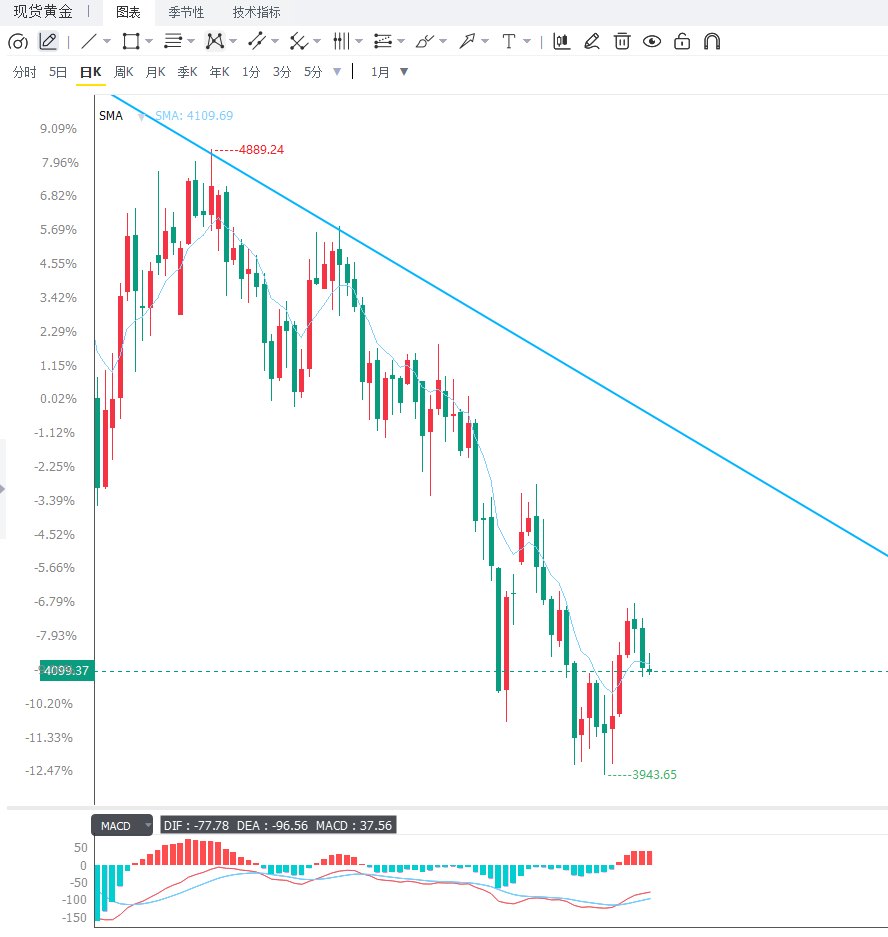
Editor's Summary : Gold is currently facing a tug-of-war between safe-haven demand and interest rate expectations. On the one hand, escalating shipping risks in the Middle East are boosting market risk aversion, providing a floor for gold; on the other hand, rising energy prices may push up inflation expectations and influence the Fed's future policy path, limiting gold's rise. In the short term, gold prices may continue to fluctuate at high levels, with the market focusing on the policy signals released in the Fed meeting minutes. If the Fed signals a more dovish stance, a weaker dollar and declining real yields could drive gold to strengthen again; however, if the market is again concerned about inflationary pressures, the upside potential for gold prices may be limited. Investors should pay close attention to the support level around $4100 and the resistance level above $4150 to determine the direction of the next trend.
The recent decline in gold prices was primarily driven by market risk repricing. The United States indicated it would respond to Iranian actions following reports of attacks on three commercial oil tankers in and around the Strait of Hormuz. U.S. Central Command stated that the military action was intended to respond to the attacks on commercial vessels and increase the cost of further action by all parties involved.
The Strait of Hormuz is a crucial global energy transport route, and any shipping safety issues could impact global energy supply expectations. Recent market concerns about renewed regional tensions could lead to higher energy prices and increase global inflationary pressures. Since gold is a non-yielding asset, rising energy prices that drive up inflation expectations and simultaneously reduce market expectations of interest rate cuts could exert short-term downward pressure on gold prices.
However, gold's downside support remains strong, primarily due to global economic uncertainties and changing expectations regarding monetary policy. Previously released weak US employment data reduced market bets on further tightening by the Federal Reserve. Data showed that the US added only 57,000 non-farm payroll jobs in June, lower than the market expectation of 110,000, while May's non-farm payroll figure was revised down from 172,000 to 129,000.
The cooling job market has reinforced investors' assessment of a slowdown in the US economy and increased market expectations for a future shift towards looser monetary policy. Since gold prices are typically heavily influenced by real interest rates, a decline in real yields could revitalize gold's appeal if the Federal Reserve signals a more dovish policy stance in the future.
Market focus is currently on the minutes of the Federal Reserve's June meeting. Investors are looking for more information on the future path of interest rates, particularly officials' latest assessments of inflation, the job market, and the conditions for rate cuts. If the minutes show increased concerns among policymakers about economic growth, it could weaken the dollar and provide upward momentum for gold.
Meanwhile, the dollar's performance is also a significant factor influencing gold prices. Recently, the dollar has been fluctuating at high levels. If US interest rates are expected to continue declining, the dollar may face pressure, thereby reducing the cost of holding gold denominated in dollars.
From a market sentiment perspective, gold is currently in a phase of intertwined factors. On the one hand, escalating risks in the Middle East are boosting safe-haven buying; on the other hand, inflation concerns stemming from rising energy prices may delay expectations of further easing policies, putting downward pressure on gold. Therefore, in the short term, gold prices are likely to continue to fluctuate significantly, driven by macroeconomic policies and geopolitical news.
From a daily chart perspective, gold has recently undergone a correction at high levels, with prices retreating from their previous strong upward trend and currently undergoing a technical correction. The overall trend remains range-bound, but short-term momentum has weakened. The MACD indicator shows that bullish forces are beginning to contract, and the price pullback reflects some funds reducing their risk exposure. Currently, the key resistance level to watch is around $4150. A break above this level could lead to a further test of the $4200 mark. Support is seen around $4050; a break below this area could lead to further support at the psychological level of $4000.
From a 4-hour chart perspective, gold is showing a slightly weak and volatile short-term structure, with prices suppressed by short-term moving averages and market buying power declining. The RSI indicator has retreated from its highs, indicating a cooling of short-term bullish enthusiasm, but it has not yet entered a clearly oversold zone. If gold prices can hold the $4050-$4100 area and regain a foothold above $4120, the upside potential may reopen; however, a break below the $4050 support level could accelerate the correction towards the $4000 area. Currently, the short-term trend still depends on the Fed meeting minutes and further developments in the Middle East.
Editor's Summary : Gold is currently facing a tug-of-war between safe-haven demand and interest rate expectations. On the one hand, escalating shipping risks in the Middle East are boosting market risk aversion, providing a floor for gold; on the other hand, rising energy prices may push up inflation expectations and influence the Fed's future policy path, limiting gold's rise. In the short term, gold prices may continue to fluctuate at high levels, with the market focusing on the policy signals released in the Fed meeting minutes. If the Fed signals a more dovish stance, a weaker dollar and declining real yields could drive gold to strengthen again; however, if the market is again concerned about inflationary pressures, the upside potential for gold prices may be limited. Investors should pay close attention to the support level around $4100 and the resistance level above $4150 to determine the direction of the next trend.
- Risk Warning and Disclaimer
- The market involves risk, and trading may not be suitable for all investors. This article is for reference only and does not constitute personal investment advice, nor does it take into account certain users’ specific investment objectives, financial situation, or other needs. Any investment decisions made based on this information are at your own risk.