Expectations of renewed yen intervention have resurfaced, causing the USD/JPY exchange rate to remain range-bound.
2026-07-08 10:48:20
The dollar edged lower against the yen in Asian trading on Wednesday, trading around 162.35. Following recent pressure on the yen, the market is refocusing on the risk of potential measures by the Japanese government and central bank to stabilize the exchange rate, while changes in US interest rate expectations have also dampened the dollar's upward momentum.

One of the main factors driving the yen's strength is the recent series of signals from Japanese authorities expressing concern about exchange rate fluctuations. Japanese Finance Minister Satsuki Katayama stated that the government is prepared to take necessary measures to support the yen and emphasized that Japan maintains close communication with the United States to coordinate foreign exchange policies. The market believes that if the dollar continues to rise rapidly against the yen, Japan may take more direct measures to limit further yen depreciation.
Meanwhile, expectations for US monetary policy are shifting. Previously released non-farm payroll data showed weaker-than-expected US job growth, leading investors to reduce their bets on further tightening by the Federal Reserve. Market surveys indicate that the market currently expects the Fed to raise interest rates by approximately 26 basis points by December, down from about 38 basis points expected a week ago.
A cooling job market has also diminished the dollar's appeal. New York Fed President John Williams stated that the recent decline in energy prices has reduced his concerns about the persistence of inflationary pressures, and he expects the downward trend in energy prices to likely continue. This statement reinforces market expectations of easing inflationary pressures in the US and further supports expectations of a future shift towards looser monetary policy.
In addition, Federal Reserve Governor Christopher Waller stated that forward guidance can be an effective tool when used appropriately, but if used improperly, it can also pose policy communication risks. The market is awaiting the minutes of the Fed's June meeting for further clues about the future path of interest rates. This is also the first major meeting minutes released since Kevin Warsh became Fed Chairman, so investors are watching closely for any new policy inclinations revealed.
From the perspective of the US dollar, the dollar index has recently declined due to adjustments in interest rate expectations. Previously, the market had bet that US interest rates would remain high for a longer period, but weak economic data has led investors to reassess the Federal Reserve's policy path. If subsequent economic data continues to show slowing growth, the dollar may face further pressure.
However, the USD/JPY exchange rate remains supported by the USD/JPY interest rate differential. Although the market has lowered its expectations for further US interest rate hikes, Japanese interest rates are still significantly lower than those in the US, and carry trade demand has not completely subsided. Therefore, the upside potential for the yen remains limited, and the market is more focused on whether Japan will take concrete action to intervene in the exchange rate.
Investors are currently focusing on three key factors: first, whether the Federal Reserve meeting minutes will release clearer interest rate signals; second, whether US inflation and employment data will continue to cool; and third, whether the Japanese government will escalate its intervention from verbal statements to actual foreign exchange market operations. These factors will determine the short-term direction of the USD/JPY exchange rate.
From a daily chart perspective, the USD/JPY pair has maintained a high-level consolidation pattern recently. Although the price has retreated from its recent highs, it remains within an overall uptrend zone. Currently, the exchange rate is adjusting due to short-term dollar weakness and expectations of Japanese intervention, but no clear trend reversal signal has yet formed. The technical structure indicates that the bullish trend still exists, but the upward momentum has slowed. Key resistance is around 163.50; a break above this level could lead to a retest of the psychological level around 165.00. Support is around 161.00; a break below this area could lead to further pullback to the 159.50-160.00 range. The MACD indicator shows signs of weakening bullish momentum, indicating the market has entered a high-level consolidation phase.
From a 4-hour chart perspective, the USD/JPY pair is showing a slightly weaker, oscillating trend in the short term. After breaking below some short-term moving averages, bearish pressure has increased. The RSI indicator has retreated from its highs, indicating that short-term buying power is cooling, but it has not yet entered a clearly oversold zone. If the exchange rate can regain the 162.80-163.00 area, there is still a chance for a short-term rebound; however, if it continues to be pressured and breaks below the 162.00 support level, it may open up further downside potential. The market is currently in a phase of rebalancing between bullish and bearish forces, with expectations of Fed policy and the risk of Japanese intervention being the main short-term drivers.
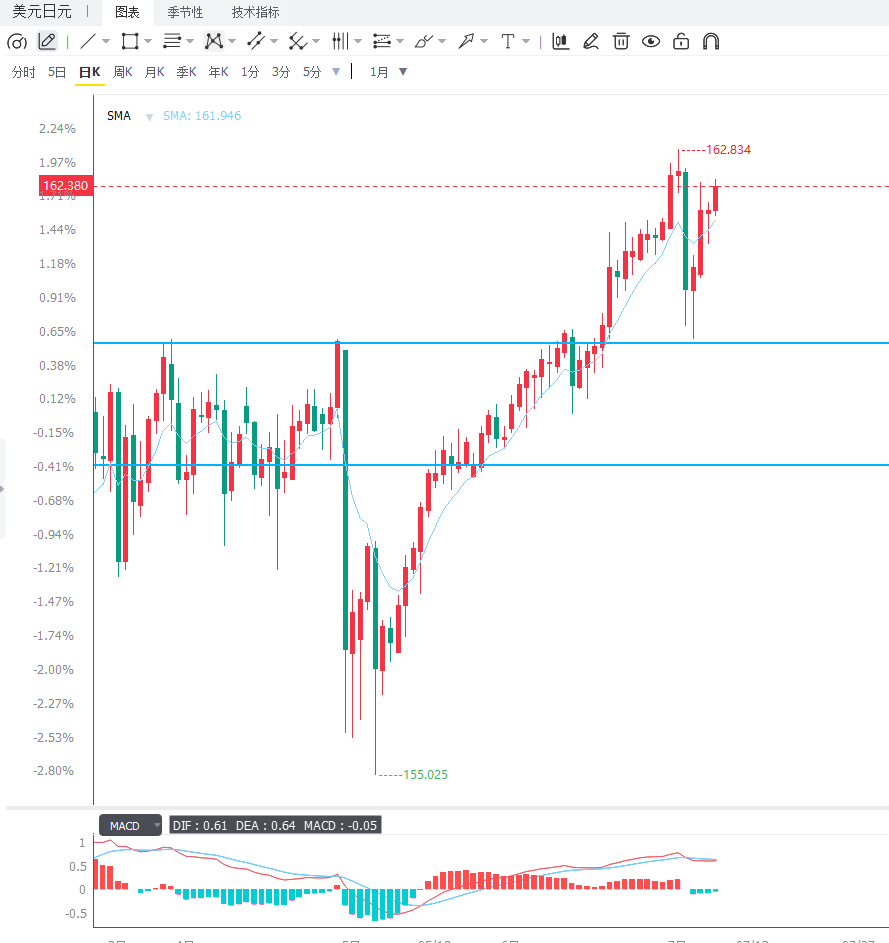
Editor's Summary : The recent upward trend of USD/JPY has been influenced by changes in policy expectations, and it faces some short-term downward pressure. Weak US employment data has reduced market expectations for further interest rate hikes, while the Japanese government's continued intervention signals have limited the dollar's potential for further rapid gains. However, due to the still significant interest rate differential between USD and Japan, USD/JPY has not completely entered a downward trend. Future movements will depend on the Fed's policy direction, Japan's exchange rate policy actions, and US economic data. If the Fed signals a more dovish stance, USD/JPY may adjust further; if US economic data strengthens again, the exchange rate may remain volatile at high levels. Investors should focus on the breakout of the 163.50 resistance level and the 161.00 support level in the short term.
One of the main factors driving the yen's strength is the recent series of signals from Japanese authorities expressing concern about exchange rate fluctuations. Japanese Finance Minister Satsuki Katayama stated that the government is prepared to take necessary measures to support the yen and emphasized that Japan maintains close communication with the United States to coordinate foreign exchange policies. The market believes that if the dollar continues to rise rapidly against the yen, Japan may take more direct measures to limit further yen depreciation.
Meanwhile, expectations for US monetary policy are shifting. Previously released non-farm payroll data showed weaker-than-expected US job growth, leading investors to reduce their bets on further tightening by the Federal Reserve. Market surveys indicate that the market currently expects the Fed to raise interest rates by approximately 26 basis points by December, down from about 38 basis points expected a week ago.
A cooling job market has also diminished the dollar's appeal. New York Fed President John Williams stated that the recent decline in energy prices has reduced his concerns about the persistence of inflationary pressures, and he expects the downward trend in energy prices to likely continue. This statement reinforces market expectations of easing inflationary pressures in the US and further supports expectations of a future shift towards looser monetary policy.
In addition, Federal Reserve Governor Christopher Waller stated that forward guidance can be an effective tool when used appropriately, but if used improperly, it can also pose policy communication risks. The market is awaiting the minutes of the Fed's June meeting for further clues about the future path of interest rates. This is also the first major meeting minutes released since Kevin Warsh became Fed Chairman, so investors are watching closely for any new policy inclinations revealed.
From the perspective of the US dollar, the dollar index has recently declined due to adjustments in interest rate expectations. Previously, the market had bet that US interest rates would remain high for a longer period, but weak economic data has led investors to reassess the Federal Reserve's policy path. If subsequent economic data continues to show slowing growth, the dollar may face further pressure.
However, the USD/JPY exchange rate remains supported by the USD/JPY interest rate differential. Although the market has lowered its expectations for further US interest rate hikes, Japanese interest rates are still significantly lower than those in the US, and carry trade demand has not completely subsided. Therefore, the upside potential for the yen remains limited, and the market is more focused on whether Japan will take concrete action to intervene in the exchange rate.
Investors are currently focusing on three key factors: first, whether the Federal Reserve meeting minutes will release clearer interest rate signals; second, whether US inflation and employment data will continue to cool; and third, whether the Japanese government will escalate its intervention from verbal statements to actual foreign exchange market operations. These factors will determine the short-term direction of the USD/JPY exchange rate.
From a daily chart perspective, the USD/JPY pair has maintained a high-level consolidation pattern recently. Although the price has retreated from its recent highs, it remains within an overall uptrend zone. Currently, the exchange rate is adjusting due to short-term dollar weakness and expectations of Japanese intervention, but no clear trend reversal signal has yet formed. The technical structure indicates that the bullish trend still exists, but the upward momentum has slowed. Key resistance is around 163.50; a break above this level could lead to a retest of the psychological level around 165.00. Support is around 161.00; a break below this area could lead to further pullback to the 159.50-160.00 range. The MACD indicator shows signs of weakening bullish momentum, indicating the market has entered a high-level consolidation phase.
From a 4-hour chart perspective, the USD/JPY pair is showing a slightly weaker, oscillating trend in the short term. After breaking below some short-term moving averages, bearish pressure has increased. The RSI indicator has retreated from its highs, indicating that short-term buying power is cooling, but it has not yet entered a clearly oversold zone. If the exchange rate can regain the 162.80-163.00 area, there is still a chance for a short-term rebound; however, if it continues to be pressured and breaks below the 162.00 support level, it may open up further downside potential. The market is currently in a phase of rebalancing between bullish and bearish forces, with expectations of Fed policy and the risk of Japanese intervention being the main short-term drivers.
Editor's Summary : The recent upward trend of USD/JPY has been influenced by changes in policy expectations, and it faces some short-term downward pressure. Weak US employment data has reduced market expectations for further interest rate hikes, while the Japanese government's continued intervention signals have limited the dollar's potential for further rapid gains. However, due to the still significant interest rate differential between USD and Japan, USD/JPY has not completely entered a downward trend. Future movements will depend on the Fed's policy direction, Japan's exchange rate policy actions, and US economic data. If the Fed signals a more dovish stance, USD/JPY may adjust further; if US economic data strengthens again, the exchange rate may remain volatile at high levels. Investors should focus on the breakout of the 163.50 resistance level and the 161.00 support level in the short term.
- Risk Warning and Disclaimer
- The market involves risk, and trading may not be suitable for all investors. This article is for reference only and does not constitute personal investment advice, nor does it take into account certain users’ specific investment objectives, financial situation, or other needs. Any investment decisions made based on this information are at your own risk.