Soaring oil prices strengthen bets on interest rate hikes, posing a risk of a breakdown for the euro against the dollar.
2026-07-08 10:23:34
On Wednesday (July 8) during the Asian session, the euro hovered around the 1.1400 level against the US dollar, but the upward momentum was clearly insufficient, and it was difficult to attract effective buying.
The conflict between the US and Iran has escalated again – the US launched a new round of airstrikes against Iran and revoked Iran's oil export licenses. Geopolitical risk premiums were quickly priced into the market, and the safe-haven US dollar strengthened across the board, becoming the core obstacle to suppressing the euro's rebound.
On Tuesday, following attacks on three oil tankers in the Strait of Hormuz, the U.S. military launched a new round of strikes against Iran. This move risks a substantial collapse of the interim peace agreement signed just last month.
Washington also revoked a key license that allowed Iran to sell oil on the international market, a decision that directly cut off Iran's oil export route.
The sudden escalation of geopolitical tensions quickly triggered a chain reaction in the markets: oil prices surged, concerns about energy-driven inflation resurfaced, and safe-haven funds accelerated their flow into the US dollar. The euro, as a risk currency, naturally bore the brunt, experiencing significant selling pressure in both cross-currency and direct currency pairs.
Rising oil prices have not only fueled inflation expectations but also directly reinforced market bets on a Federal Reserve rate hike this year. Traders are now fully pricing in a 100% probability of a Fed rate hike in 2026, causing US Treasury yields to rise and further widening the dollar's interest rate advantage.
It is worth noting that although the expectation of a Fed rate hike is beneficial to the dollar, there is still a divergence in the market's pricing of the magnitude of the rate hike—is it a "precautionary rate hike" or the "start of a rate hike cycle"?
The answer to this question will be found in tonight's FOMC meeting minutes.
The Federal Reserve will release the minutes of its June 16-17 meeting early Thursday morning Beijing time. Investors will closely watch the details of policymakers' discussions on the inflation outlook, the job market, and external risks (including geopolitics). The minutes may release the following key signals:
Do policymakers view the recent rise in energy prices as a "temporary" factor?
Is there a tendency to revise the assessment of the "neutral interest rate" level upwards?
The degree of disagreement among the committee members regarding the timing of the interest rate hike.
Any hawkish rhetoric could push the dollar higher, and the euro could fall below 1.1400 against the dollar; conversely, if the minutes are cautious or emphasize "data dependence," the euro could get a breather.
Goldman Sachs lowered its euro/dollar forecast in early July 2026, noting that the dollar's short-term strength is likely to continue and a broad-based dollar weakness is unlikely anytime soon. The bank revised its 3-month, 6-month, and 12-month targets to approximately 1.14, 1.12, and 1.12 (previously higher), primarily due to the "double whammy" of an AI boom and energy supply issues enhancing the attractiveness of US assets and pushing up expectations for the Federal Reserve's neutral interest rate.
Goldman Sachs stated that while the euro performed strongly and led the rebound in 2025, the dollar will be supported by unique US growth drivers (AI capital expenditure and inflation) in 2026. While signs of economic recovery exist in Europe (such as German fiscal spending), it remains relatively weak compared to the US, and energy price pressures and political uncertainty are weighing on the euro.
The bank emphasized that the US dollar is strong against low-yield currencies but diverges against high-yield currencies, but the overall US dollar index is unlikely to see a significant pullback.
In its July 2026 outlook, MUFG held a mildly bullish view on the euro against the US dollar, forecasting it to be around 1.16 in Q3, 1.18 in Q4, and rising to 1.20 in Q1 of 2027 before stabilizing.
The bank believes that the US dollar will gradually face pressure after short-term yield differentials and support from US data, while the stability and relative recovery of Eurozone policies will provide support.
From a technical perspective, according to the daily chart, the EUR/USD pair broke out of its medium-term downtrend from the previous high of 1.1796, with the price continuing to fluctuate downwards. After bottoming out at 1.1324, it entered a low-level consolidation phase. The moving average system clearly shows a bearish pattern, with the short-term MA20 (1.1451), MA50, and MA100 all trending downwards. The price continues to be pressured below the 20-day moving average, and the medium- to long-term downtrend has not reversed, with only the MA200 forming strong long-term resistance above.
In terms of indicators, the MACD is below the zero line, and the DIFF (-0.0046) has slightly crossed the DEA (-0.0053) to form a golden cross at a low level, with a small amount of red bars appearing. The bearish momentum continues to narrow, and there is potential for a short-term rebound. The RSI lines have gently rebounded from the oversold range, and the current RSI1 is 40.86, which has not yet reached the 70 overbought range, indicating that there is still room for a slight upward rebound in the short term.
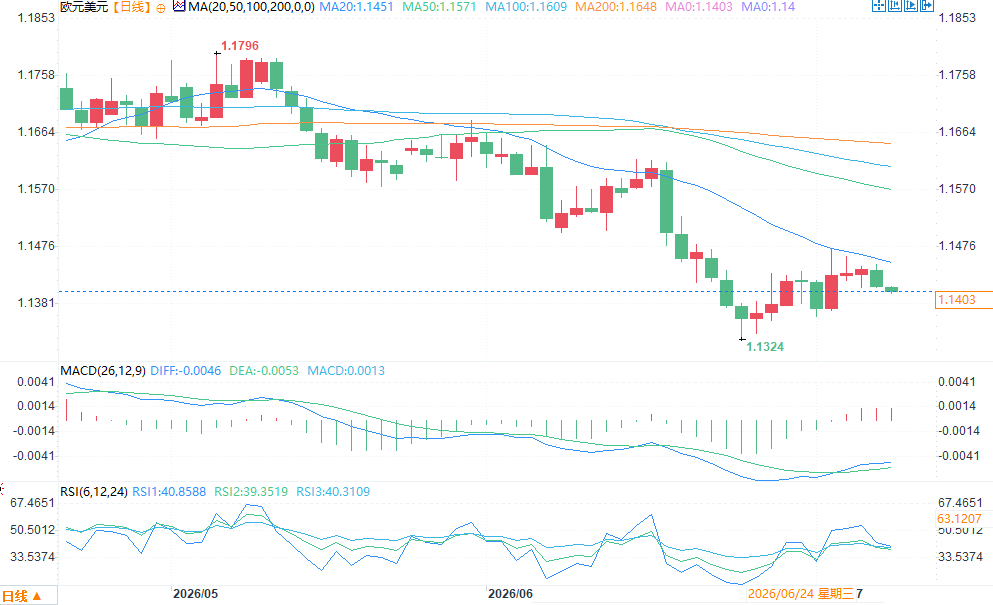
(Euro/USD daily chart, source: FX678)
At 10:23 Beijing time on July 8, the euro was trading at 1.1409/10 against the US dollar.
The conflict between the US and Iran has escalated again – the US launched a new round of airstrikes against Iran and revoked Iran's oil export licenses. Geopolitical risk premiums were quickly priced into the market, and the safe-haven US dollar strengthened across the board, becoming the core obstacle to suppressing the euro's rebound.
Geopolitics: US launches new airstrikes, tensions with Iran escalate rapidly.
On Tuesday, following attacks on three oil tankers in the Strait of Hormuz, the U.S. military launched a new round of strikes against Iran. This move risks a substantial collapse of the interim peace agreement signed just last month.
Washington also revoked a key license that allowed Iran to sell oil on the international market, a decision that directly cut off Iran's oil export route.
The sudden escalation of geopolitical tensions quickly triggered a chain reaction in the markets: oil prices surged, concerns about energy-driven inflation resurfaced, and safe-haven funds accelerated their flow into the US dollar. The euro, as a risk currency, naturally bore the brunt, experiencing significant selling pressure in both cross-currency and direct currency pairs.
Monetary Policy: Renewed Expectations of Interest Rate Hikes Provide Additional Support for US Treasury Yields
Rising oil prices have not only fueled inflation expectations but also directly reinforced market bets on a Federal Reserve rate hike this year. Traders are now fully pricing in a 100% probability of a Fed rate hike in 2026, causing US Treasury yields to rise and further widening the dollar's interest rate advantage.
It is worth noting that although the expectation of a Fed rate hike is beneficial to the dollar, there is still a divergence in the market's pricing of the magnitude of the rate hike—is it a "precautionary rate hike" or the "start of a rate hike cycle"?
The answer to this question will be found in tonight's FOMC meeting minutes.
Market Focus: Awaiting Direction from FOMC Meeting Minutes
The Federal Reserve will release the minutes of its June 16-17 meeting early Thursday morning Beijing time. Investors will closely watch the details of policymakers' discussions on the inflation outlook, the job market, and external risks (including geopolitics). The minutes may release the following key signals:
Do policymakers view the recent rise in energy prices as a "temporary" factor?
Is there a tendency to revise the assessment of the "neutral interest rate" level upwards?
The degree of disagreement among the committee members regarding the timing of the interest rate hike.
Any hawkish rhetoric could push the dollar higher, and the euro could fall below 1.1400 against the dollar; conversely, if the minutes are cautious or emphasize "data dependence," the euro could get a breather.
Institutional Views
Goldman Sachs lowered its euro/dollar forecast in early July 2026, noting that the dollar's short-term strength is likely to continue and a broad-based dollar weakness is unlikely anytime soon. The bank revised its 3-month, 6-month, and 12-month targets to approximately 1.14, 1.12, and 1.12 (previously higher), primarily due to the "double whammy" of an AI boom and energy supply issues enhancing the attractiveness of US assets and pushing up expectations for the Federal Reserve's neutral interest rate.
Goldman Sachs stated that while the euro performed strongly and led the rebound in 2025, the dollar will be supported by unique US growth drivers (AI capital expenditure and inflation) in 2026. While signs of economic recovery exist in Europe (such as German fiscal spending), it remains relatively weak compared to the US, and energy price pressures and political uncertainty are weighing on the euro.
The bank emphasized that the US dollar is strong against low-yield currencies but diverges against high-yield currencies, but the overall US dollar index is unlikely to see a significant pullback.
In its July 2026 outlook, MUFG held a mildly bullish view on the euro against the US dollar, forecasting it to be around 1.16 in Q3, 1.18 in Q4, and rising to 1.20 in Q1 of 2027 before stabilizing.
The bank believes that the US dollar will gradually face pressure after short-term yield differentials and support from US data, while the stability and relative recovery of Eurozone policies will provide support.
From a technical perspective, according to the daily chart, the EUR/USD pair broke out of its medium-term downtrend from the previous high of 1.1796, with the price continuing to fluctuate downwards. After bottoming out at 1.1324, it entered a low-level consolidation phase. The moving average system clearly shows a bearish pattern, with the short-term MA20 (1.1451), MA50, and MA100 all trending downwards. The price continues to be pressured below the 20-day moving average, and the medium- to long-term downtrend has not reversed, with only the MA200 forming strong long-term resistance above.
In terms of indicators, the MACD is below the zero line, and the DIFF (-0.0046) has slightly crossed the DEA (-0.0053) to form a golden cross at a low level, with a small amount of red bars appearing. The bearish momentum continues to narrow, and there is potential for a short-term rebound. The RSI lines have gently rebounded from the oversold range, and the current RSI1 is 40.86, which has not yet reached the 70 overbought range, indicating that there is still room for a slight upward rebound in the short term.
(Euro/USD daily chart, source: FX678)
At 10:23 Beijing time on July 8, the euro was trading at 1.1409/10 against the US dollar.
- Risk Warning and Disclaimer
- The market involves risk, and trading may not be suitable for all investors. This article is for reference only and does not constitute personal investment advice, nor does it take into account certain users’ specific investment objectives, financial situation, or other needs. Any investment decisions made based on this information are at your own risk.