The resurgence of conflict in the Middle East and the correction of the AI bubble are considered tail risks. Why is the Reserve Bank of New Zealand so wary of this "double-edged sword"?
2026-07-08 11:10:11
On Wednesday (July 8) during Asian trading hours, the New Zealand dollar rose against the US dollar, gaining as much as 0.5% to 0.5704, recovering all of Tuesday's losses. The direct driver of the exchange rate's rise came from a clear hawkish signal from the Reserve Bank of New Zealand – as inflation remains above the target range and economic activity is expected to gradually strengthen, the committee believes it is necessary to further reduce monetary stimulus to ensure that inflation returns to the 2% target in the medium term.
On Wednesday, the Reserve Bank of New Zealand's Monetary Policy Committee unanimously agreed to raise the official cash rate by 25 basis points to 2.50%. This rate hike came against the backdrop of the partial reopening of the Strait of Hormuz and a significant decline in global energy prices.
The committee believes that although inflationary pressures have eased recently, the effects of the energy shock will persist for some time, and the medium-term inflation outlook remains highly uncertain.
The committee emphasized that the current monetary policy stance aims to bring inflation back to the target level while avoiding unnecessary economic instability. Inflation is expected to fall to around 2% over the next 12 months, and the economic recovery is expected to restart in the second half of this year, with idle capacity being gradually absorbed.

Since the easing of tensions in the Middle East, global oil, natural gas, and fertilizer prices have all fallen significantly. However, the committee noted that supply chain adjustments will take time, geopolitical uncertainties remain significant, and energy and related product prices are likely to remain volatile at high levels in the short term.
New Zealand's annual inflation rate is projected to peak at 3.9% in the June 2026 quarter, before falling back to 3.3% in the September quarter. This forecast is a significant downward revision from the May statement, primarily reflecting the weakening direct price effect of falling oil prices and the restrained transmission to other consumer goods prices.
The committee specifically noted that prior to the outbreak of the Middle East conflict, New Zealand's inflation was already above the target range, and non-tradable inflation remained high given the existence of spare capacity. The annual inflation rate is projected to return to the midpoint of the 2% target by mid-2027. Medium-term inflationary pressures will depend on corporate pricing behavior and the rate at which the economy absorbs spare capacity.
The Committee noted that despite multiple headwinds, the global economy remained strong throughout 2025 and into early 2026. However, high-frequency indicators of economic activity, as well as business and consumer confidence, declined in the June 2026 quarter.
It is worth noting that while overall inflation has risen in several of New Zealand's trading partners, the indirect transmission effect on most major economies remains limited. Consensus forecasts indicate that trade-weighted global inflation will fall back to near 2% by 2027.
The committee specifically discussed the continued strong investment in artificial intelligence technologies, as well as increased spending in the economic and military security sectors, factors that could provide stronger-than-expected support for the global economy.
The committee concluded that recent economic data supported the earlier assessment that the New Zealand economy was on a recovery path prior to the outbreak of the Middle East conflict. Although the 0.8% GDP growth in the March 2026 quarter was slightly below expectations, the absolute level of GDP was higher than the assumptions made in the May statement, reflecting upward revisions to data from previous quarters.
However, domestic economic activity slowed in the June quarter. High-frequency indicators showed weakening demand: electronic card transactions, services, and manufacturing indices were weak, housing market activity remained sluggish, and home prices fell 0.4% year-on-year in May. Despite strong growth in new residential permits over the past 12 months, residential investment continued to contract.
Feedback from business visits conducted before the signing of the US-Iran memorandum of understanding in early June revealed a highly uneven economic situation across industries and regions—export sectors such as agriculture and tourism remained strong, while discretionary consumption and construction remained weak.
Domestic economic growth is expected to recover in the September 2026 quarter, with lower fuel prices supporting a recovery in consumption. Business confidence and some activity indicators rebounded in June, while cost and price expectations declined. The Reserve Bank of New Zealand's real-time GDP forecast model projects growth of 0.6% in the September 2026 quarter.
The committee noted that domestic financial conditions have generally eased, reflected in lower wholesale interest rates and a depreciating currency. Recent declines in inflation expectations have driven down market pricing of the benchmark interest rate (OCR). Policy rate expectations relative to major trading partners, particularly the United States, have also decreased, leading to a depreciation of the trade-weighted New Zealand dollar.
Since the May announcement, short-term mortgage rates have continued to rise, while long-term mortgage rates have declined. Mortgage rates rose in the first half of the year due to higher wholesale rates, reflecting increased short-term expectations of the OCR. The recent decline in wholesale rates has widened the spread between mortgage rates and wholesale rates, easing pressure for further increases in some term mortgage rates.
The committee approved a plan to reduce all holdings under the large-scale asset purchase program by June 30, 2027. According to the proposal, NZ$141 million in government bonds originally due in July 2027 will be sold in June 2027, and local government financing agency securities maturing after June 2027 (totaling NZ$392 million) will also be liquidated.
The committee noted that, given the relatively small size of the affected positions, this move would not have a substantial impact on the level of monetary stimulus.
The committee held a detailed discussion on the risks to the global economic and inflation outlook.
Upside risks: Lower energy prices could support a stronger recovery in business and consumer confidence; easing global financial conditions (through lower short-term real interest rates and higher global stock markets) could boost aggregate demand; and increased investment in the economic and military security sectors could provide additional impetus to the global economy, thereby supporting New Zealand's export demand.
Downside risks: A renewed escalation of conflict in the Middle East could disrupt energy markets, pushing up short-term inflation while suppressing global growth; the risk of price corrections in AI-related assets could impact financial conditions, financial stability, and global demand; and the high and continuing rise in global government debt ratios, coupled with increased geopolitical fragmentation, could push up long-term bond yields and drag down global growth.
The Committee assessed that the current level of the Open Rate of Return (OCR) remains accommodative, and further reduction in monetary stimulus is appropriate. The Committee unanimously agreed that this 25 basis point rate hike was in line with its mandate to ensure low and stable inflation while avoiding unnecessary instability in output, employment, interest rates, and exchange rates.
High inflation erodes household purchasing power and dampens domestic demand; a return of inflation to the midpoint of the target will help ensure a sustainable recovery in economic growth and the labor market. The Committee noted that financial conditions have eased in recent weeks, following a significant tightening earlier this year. This rate hike is partly aimed at preventing further unwarranted easing of financial conditions.
The Committee agreed that while a further increase in the OCR appears possible at future meetings, the timing remains highly uncertain. Future OCR decisions will depend on the Committee's assessment of how pricing behavior and spare capacity affect inflationary pressures over the medium term.
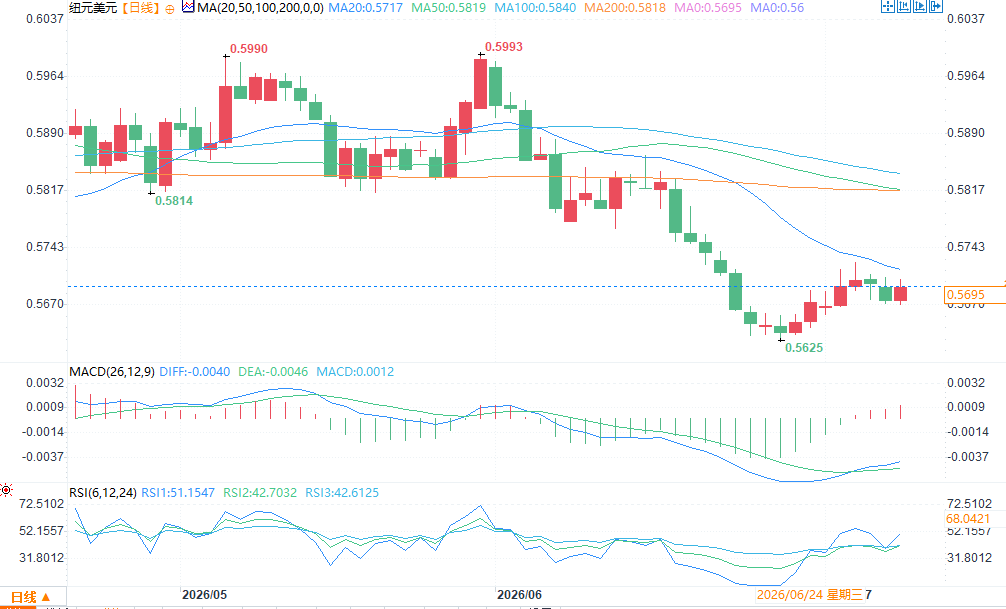
(NZD/USD daily chart, source: FX678)
At 11:08 Beijing time on July 8, the New Zealand dollar was trading at 0.5696/97 against the US dollar.
On Wednesday, the Reserve Bank of New Zealand's Monetary Policy Committee unanimously agreed to raise the official cash rate by 25 basis points to 2.50%. This rate hike came against the backdrop of the partial reopening of the Strait of Hormuz and a significant decline in global energy prices.
The committee believes that although inflationary pressures have eased recently, the effects of the energy shock will persist for some time, and the medium-term inflation outlook remains highly uncertain.
The committee emphasized that the current monetary policy stance aims to bring inflation back to the target level while avoiding unnecessary economic instability. Inflation is expected to fall to around 2% over the next 12 months, and the economic recovery is expected to restart in the second half of this year, with idle capacity being gradually absorbed.
Inflation Outlook: Recent pressures have eased, but medium-term concerns remain.
Since the easing of tensions in the Middle East, global oil, natural gas, and fertilizer prices have all fallen significantly. However, the committee noted that supply chain adjustments will take time, geopolitical uncertainties remain significant, and energy and related product prices are likely to remain volatile at high levels in the short term.
New Zealand's annual inflation rate is projected to peak at 3.9% in the June 2026 quarter, before falling back to 3.3% in the September quarter. This forecast is a significant downward revision from the May statement, primarily reflecting the weakening direct price effect of falling oil prices and the restrained transmission to other consumer goods prices.
The committee specifically noted that prior to the outbreak of the Middle East conflict, New Zealand's inflation was already above the target range, and non-tradable inflation remained high given the existence of spare capacity. The annual inflation rate is projected to return to the midpoint of the 2% target by mid-2027. Medium-term inflationary pressures will depend on corporate pricing behavior and the rate at which the economy absorbs spare capacity.
Global Economy: Resilience Exceeds Expectations, AI Investment Becomes a Key Support
The Committee noted that despite multiple headwinds, the global economy remained strong throughout 2025 and into early 2026. However, high-frequency indicators of economic activity, as well as business and consumer confidence, declined in the June 2026 quarter.
It is worth noting that while overall inflation has risen in several of New Zealand's trading partners, the indirect transmission effect on most major economies remains limited. Consensus forecasts indicate that trade-weighted global inflation will fall back to near 2% by 2027.
The committee specifically discussed the continued strong investment in artificial intelligence technologies, as well as increased spending in the economic and military security sectors, factors that could provide stronger-than-expected support for the global economy.
Domestic Economy: Lost momentum in the June quarter, expected to recover in the September quarter.
The committee concluded that recent economic data supported the earlier assessment that the New Zealand economy was on a recovery path prior to the outbreak of the Middle East conflict. Although the 0.8% GDP growth in the March 2026 quarter was slightly below expectations, the absolute level of GDP was higher than the assumptions made in the May statement, reflecting upward revisions to data from previous quarters.
However, domestic economic activity slowed in the June quarter. High-frequency indicators showed weakening demand: electronic card transactions, services, and manufacturing indices were weak, housing market activity remained sluggish, and home prices fell 0.4% year-on-year in May. Despite strong growth in new residential permits over the past 12 months, residential investment continued to contract.
Feedback from business visits conducted before the signing of the US-Iran memorandum of understanding in early June revealed a highly uneven economic situation across industries and regions—export sectors such as agriculture and tourism remained strong, while discretionary consumption and construction remained weak.
Domestic economic growth is expected to recover in the September 2026 quarter, with lower fuel prices supporting a recovery in consumption. Business confidence and some activity indicators rebounded in June, while cost and price expectations declined. The Reserve Bank of New Zealand's real-time GDP forecast model projects growth of 0.6% in the September 2026 quarter.
Financial conditions: Overall trend is towards easing, with mortgage rates showing a divergent trend.
The committee noted that domestic financial conditions have generally eased, reflected in lower wholesale interest rates and a depreciating currency. Recent declines in inflation expectations have driven down market pricing of the benchmark interest rate (OCR). Policy rate expectations relative to major trading partners, particularly the United States, have also decreased, leading to a depreciation of the trade-weighted New Zealand dollar.
Since the May announcement, short-term mortgage rates have continued to rise, while long-term mortgage rates have declined. Mortgage rates rose in the first half of the year due to higher wholesale rates, reflecting increased short-term expectations of the OCR. The recent decline in wholesale rates has widened the spread between mortgage rates and wholesale rates, easing pressure for further increases in some term mortgage rates.
Large-scale asset purchase plan to be liquidated: Approval to complete all share reductions by June 2027.
The committee approved a plan to reduce all holdings under the large-scale asset purchase program by June 30, 2027. According to the proposal, NZ$141 million in government bonds originally due in July 2027 will be sold in June 2027, and local government financing agency securities maturing after June 2027 (totaling NZ$392 million) will also be liquidated.
The committee noted that, given the relatively small size of the affected positions, this move would not have a substantial impact on the level of monetary stimulus.
Risk Discussion: Dual Risks from the Global Economic and Inflation Outlook
The committee held a detailed discussion on the risks to the global economic and inflation outlook.
Upside risks: Lower energy prices could support a stronger recovery in business and consumer confidence; easing global financial conditions (through lower short-term real interest rates and higher global stock markets) could boost aggregate demand; and increased investment in the economic and military security sectors could provide additional impetus to the global economy, thereby supporting New Zealand's export demand.
Downside risks: A renewed escalation of conflict in the Middle East could disrupt energy markets, pushing up short-term inflation while suppressing global growth; the risk of price corrections in AI-related assets could impact financial conditions, financial stability, and global demand; and the high and continuing rise in global government debt ratios, coupled with increased geopolitical fragmentation, could push up long-term bond yields and drag down global growth.
Policy Outlook: Further interest rate hikes are highly likely, but the timing is uncertain.
The Committee assessed that the current level of the Open Rate of Return (OCR) remains accommodative, and further reduction in monetary stimulus is appropriate. The Committee unanimously agreed that this 25 basis point rate hike was in line with its mandate to ensure low and stable inflation while avoiding unnecessary instability in output, employment, interest rates, and exchange rates.
High inflation erodes household purchasing power and dampens domestic demand; a return of inflation to the midpoint of the target will help ensure a sustainable recovery in economic growth and the labor market. The Committee noted that financial conditions have eased in recent weeks, following a significant tightening earlier this year. This rate hike is partly aimed at preventing further unwarranted easing of financial conditions.
The Committee agreed that while a further increase in the OCR appears possible at future meetings, the timing remains highly uncertain. Future OCR decisions will depend on the Committee's assessment of how pricing behavior and spare capacity affect inflationary pressures over the medium term.
(NZD/USD daily chart, source: FX678)
At 11:08 Beijing time on July 8, the New Zealand dollar was trading at 0.5696/97 against the US dollar.
- Risk Warning and Disclaimer
- The market involves risk, and trading may not be suitable for all investors. This article is for reference only and does not constitute personal investment advice, nor does it take into account certain users’ specific investment objectives, financial situation, or other needs. Any investment decisions made based on this information are at your own risk.