Geopolitical risk aversion and soaring oil prices vie for control of the USD/CAD pair, awaiting Warsh's first minutes.
2026-07-08 13:20:36
On Wednesday (July 8) during the Asian session, the US dollar traded in a narrow range at high levels against the Canadian dollar, currently trading below 1.4200.
Renewed geopolitical risks – US airstrikes on Iran and the revocation of its oil export licenses have driven a broad-based strengthening of the safe-haven US dollar, becoming the core factor putting pressure on the Canadian dollar.
On Tuesday, the U.S. military launched a new round of airstrikes against Iran and revoked key sanctions waivers that allow Iran to export oil. This escalation was a response to attacks on merchant ships in the Strait of Hormuz—including a Qatari LNG carrier and a Saudi oil tanker.
The interim peace agreement signed between the US and Iran last month is facing the risk of substantial collapse, and concerns about disruptions to global energy supplies have suddenly intensified.
For the Canadian dollar, this situation has a twofold impact: on the one hand, risk aversion pushes up the US dollar, putting pressure on the Canadian dollar; on the other hand, international oil prices have surged due to supply concerns, and as a major oil exporter, Canada's currency typically benefits from rising oil prices. These two forces offset each other, resulting in relatively mild fluctuations in the US dollar against the Canadian dollar, far less than the declines in non-commodity currencies such as the euro against the US dollar.
While safe-haven demand supported the dollar, cooling market expectations for Federal Reserve rate hikes are limiting its further strength. Last week's US June non-farm payroll data showed an increase of only 57,000 jobs, far below market expectations, prompting traders to significantly reduce their rate hike bets. According to data from the London Stock Exchange Group (LSEG), market pricing in cumulative rate hikes by the Fed before the end of the year has fallen from 38 basis points a week ago to approximately 26 basis points.
Recent statements from Federal Reserve officials have also revealed subtle divergences. Fed Governor Christopher Waller expressed caution regarding policy communication on Monday, noting that forward guidance can be a valuable tool under appropriate conditions, but can easily cause problems if used improperly. In contrast, New York Fed President John Williams offered a more reassuring signal on Tuesday, stating that his concerns about domestic price pressures have eased due to the recent decline in energy prices (and the expectation that this trend will continue).
The Federal Reserve will release the minutes of its June 16-17 meeting early Thursday morning Beijing time. This is the first meeting minutes since Kevin Warsh took over as Fed Chair, and market attention is extremely high. Investors will be looking for the following key clues:
The policy inclinations of the new chairman, Walsh, will be to continue the gradual path of the Powell era, or to show a clearer hawkish or dovish shift.
Policymakers' assessment of recent energy price fluctuations – whether to view them as a "temporary" shock or to begin to worry about the effects of double-dip inflation;
The committee members weighed the trade-offs between the labor market slowdown and the risks of inflation.
Is there a tendency to raise the level of the "neutral interest rate" in the discussion?
Any hawkish rhetoric could push the dollar higher, with USD/CAD potentially breaking through the 1.4250 resistance level; conversely, if the minutes are cautious, the exchange rate may retest the 1.4100-1.4150 support zone.
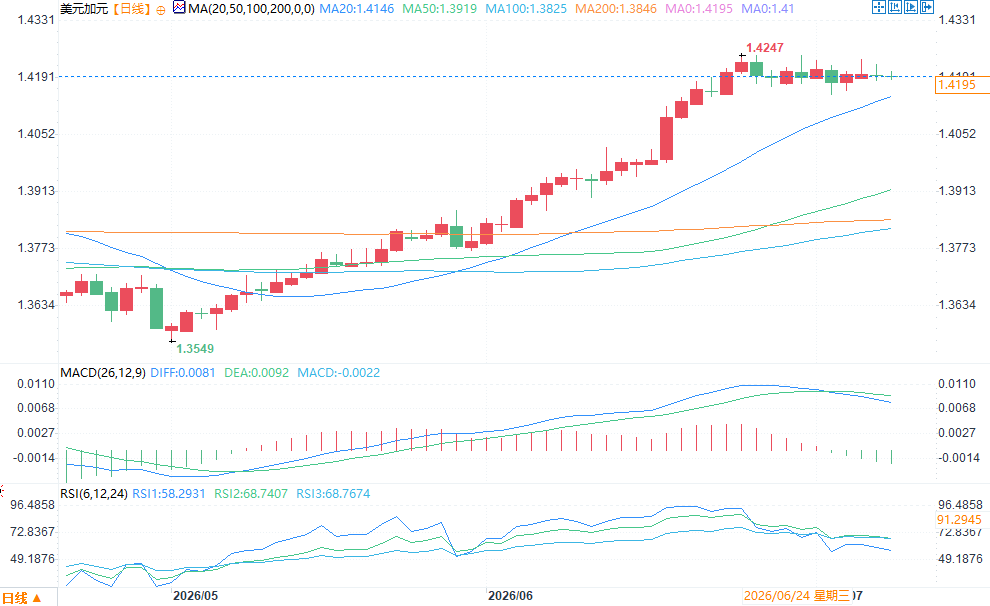
(USD/CAD daily chart, source: EasyForex)
At 13:12 Beijing time on July 8, the USD/CAD exchange rate was 1.4188/89.
Renewed geopolitical risks – US airstrikes on Iran and the revocation of its oil export licenses have driven a broad-based strengthening of the safe-haven US dollar, becoming the core factor putting pressure on the Canadian dollar.
Geopolitics: US airstrikes on Iran cause oil prices to surge, providing a hedge for the Canadian dollar.
On Tuesday, the U.S. military launched a new round of airstrikes against Iran and revoked key sanctions waivers that allow Iran to export oil. This escalation was a response to attacks on merchant ships in the Strait of Hormuz—including a Qatari LNG carrier and a Saudi oil tanker.
The interim peace agreement signed between the US and Iran last month is facing the risk of substantial collapse, and concerns about disruptions to global energy supplies have suddenly intensified.
For the Canadian dollar, this situation has a twofold impact: on the one hand, risk aversion pushes up the US dollar, putting pressure on the Canadian dollar; on the other hand, international oil prices have surged due to supply concerns, and as a major oil exporter, Canada's currency typically benefits from rising oil prices. These two forces offset each other, resulting in relatively mild fluctuations in the US dollar against the Canadian dollar, far less than the declines in non-commodity currencies such as the euro against the US dollar.
Monetary Policy: Cooling expectations of interest rate hikes limit upside potential for the US dollar.
While safe-haven demand supported the dollar, cooling market expectations for Federal Reserve rate hikes are limiting its further strength. Last week's US June non-farm payroll data showed an increase of only 57,000 jobs, far below market expectations, prompting traders to significantly reduce their rate hike bets. According to data from the London Stock Exchange Group (LSEG), market pricing in cumulative rate hikes by the Fed before the end of the year has fallen from 38 basis points a week ago to approximately 26 basis points.
Recent statements from Federal Reserve officials have also revealed subtle divergences. Fed Governor Christopher Waller expressed caution regarding policy communication on Monday, noting that forward guidance can be a valuable tool under appropriate conditions, but can easily cause problems if used improperly. In contrast, New York Fed President John Williams offered a more reassuring signal on Tuesday, stating that his concerns about domestic price pressures have eased due to the recent decline in energy prices (and the expectation that this trend will continue).
Market Focus: Awaiting the First FOMC Meeting Minutes Under Warsh's Leadership
The Federal Reserve will release the minutes of its June 16-17 meeting early Thursday morning Beijing time. This is the first meeting minutes since Kevin Warsh took over as Fed Chair, and market attention is extremely high. Investors will be looking for the following key clues:
The policy inclinations of the new chairman, Walsh, will be to continue the gradual path of the Powell era, or to show a clearer hawkish or dovish shift.
Policymakers' assessment of recent energy price fluctuations – whether to view them as a "temporary" shock or to begin to worry about the effects of double-dip inflation;
The committee members weighed the trade-offs between the labor market slowdown and the risks of inflation.
Is there a tendency to raise the level of the "neutral interest rate" in the discussion?
Any hawkish rhetoric could push the dollar higher, with USD/CAD potentially breaking through the 1.4250 resistance level; conversely, if the minutes are cautious, the exchange rate may retest the 1.4100-1.4150 support zone.
(USD/CAD daily chart, source: EasyForex)
At 13:12 Beijing time on July 8, the USD/CAD exchange rate was 1.4188/89.
- Risk Warning and Disclaimer
- The market involves risk, and trading may not be suitable for all investors. This article is for reference only and does not constitute personal investment advice, nor does it take into account certain users’ specific investment objectives, financial situation, or other needs. Any investment decisions made based on this information are at your own risk.