Geopolitical risks are driving up safe-haven demand, supporting the US dollar index, which is expected to remain volatile at high levels in the short term.
2026-07-08 14:13:01
The US dollar index maintained its strength during Asian trading hours on Wednesday, rising for the second consecutive session and currently trading around 101.10. Recent increases in market risk aversion have provided short-term support for the dollar, but changes in expectations regarding US monetary policy are still limiting further gains.
The main factor driving the dollar's rise is the decline in global risk appetite. Recent tensions in the Middle East, including a US military response to Iranian actions and reports of attacks on commercial vessels near the Strait of Hormuz, including a Qatari LNG carrier and a Saudi oil tanker, have reignited market concerns about energy transport security and driven funds towards traditional safe-haven assets such as the dollar.
The Strait of Hormuz is a vital global energy transport route, and any disruption to this transport could impact the stability of international energy supplies. Market concerns exist that if regional tensions persist, oil prices could be driven up, potentially reigniting global inflationary pressures. Driven by these risk events, short-term demand for the US dollar as a safe haven has increased.
However, the dollar's upward momentum is not entirely solid. Previously released US non-farm payroll data fell short of market expectations, prompting investors to readjust the Federal Reserve's policy path. According to market data, investors currently expect the Fed to raise interest rates by approximately 26 basis points by December, significantly lower than the approximately 38 basis points expected a week ago.
A cooling job market has reduced market confidence in a continued rise in US interest rates, putting pressure on the dollar. If future economic data continues to show slowing growth, the Federal Reserve may focus more on changes in the job market rather than further tightening policies. Recent remarks by Fed officials also reflect the complexity of the policy stance. Fed Governor Christopher Waller stated that forward guidance can be effective when appropriate, but if used improperly, it can also lead to policy communication problems. This statement indicates that the Fed still wants to maintain policy flexibility and adjust its direction based on changes in economic data.
Meanwhile, New York Federal Reserve President John Williams stated that his concerns about U.S. inflationary pressures have eased due to recent declines in energy prices, and he expects the downward trend in energy prices to likely continue. He believes that U.S. economic growth remains stable and the risks in the labor market are relatively balanced, but inflation remains at a high level, and future policy will still need to rely on data performance.
Overall, the US dollar is currently influenced by both safe-haven demand and adjustments in policy expectations. On the one hand, geopolitical risks are increasing the dollar's attractiveness; on the other hand, lowered market expectations for interest rate hikes are limiting the dollar's upside potential. Investors are currently focused on the Fed's June meeting minutes, as well as future inflation, employment, and consumption data, to determine the dollar's medium-term direction.
In terms of market sentiment indicators, expectations for Federal Reserve policy remain biased towards tightening, but the hawkish stance has weakened somewhat. The market believes that the Fed will not quickly shift to easing in the short term, but future policy changes will depend more heavily on economic data.
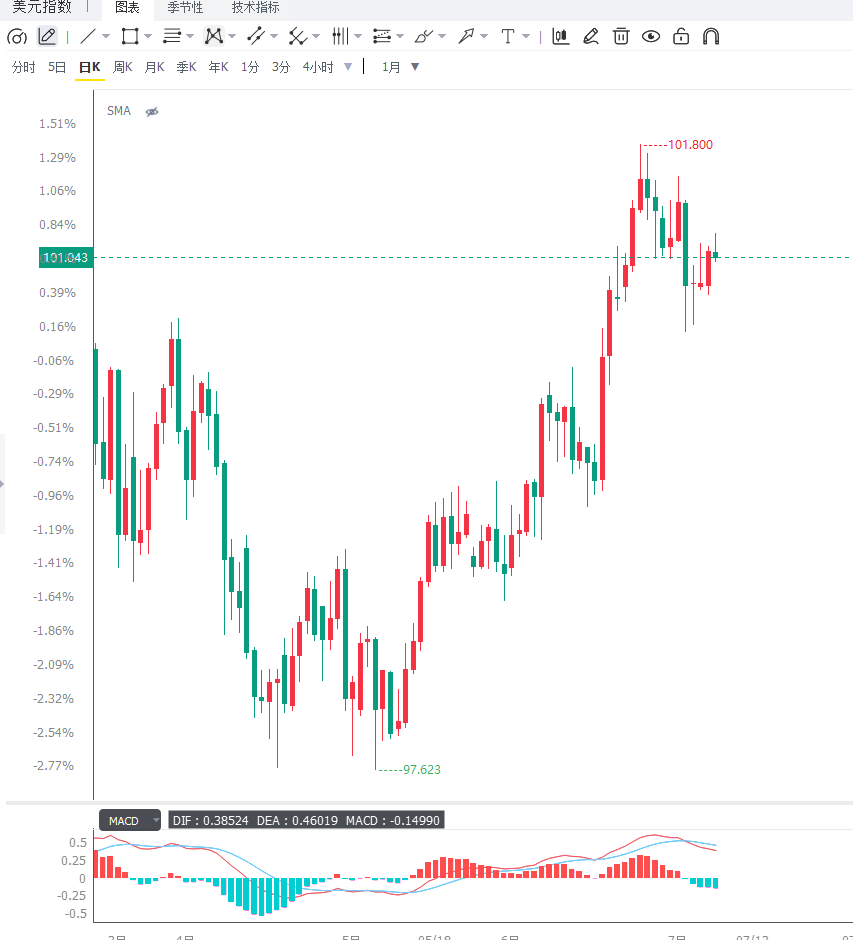
From a daily chart perspective, the US dollar index rebounded after finding support near the 100 level and has now climbed back above 101, indicating a recovery in short-term bullish momentum. However, it remains in a consolidation phase and has not yet formed a clear trend breakout. The MACD indicator shows that bearish momentum is gradually weakening, but the moving average system still needs further improvement to confirm an upward trend. Key resistance to watch is around 101.80; a break above this level could lead the dollar index to test the 102.50 area. Support is seen around 100.50; a break below this level could see a return to the 99.80 area.
From a 4-hour chart perspective, the US dollar index is showing a short-term upward trend with fluctuations. The price has rebounded continuously and remained above the short-term moving average, indicating increased buying pressure. The RSI indicator is in a recovery phase, showing improved short-term momentum, but it has not yet entered a strong zone. If the US dollar index can break through the 101.80 resistance level, it is expected to continue its rebound in the short term; if the rise is hindered, it may retrace to the support level around 100.50. Currently, the market remains in a news-driven phase, with the Fed meeting minutes and changes in geopolitical risks being the main influencing factors in the short term.
Editor's Summary : The recent rebound in the US dollar index has been primarily driven by safe-haven flows, with escalating tensions in the Middle East increasing market demand for the dollar's safe-haven asset status. However, a cooling US job market and declining expectations of a Fed rate hike are limiting the dollar's continued rise. The future direction of the dollar will depend on two factors: whether global risk events escalate further, and whether US economic data supports the Fed maintaining a tight policy stance. If risk sentiment continues to deteriorate, the dollar may receive further support; however, if economic data remains weak and the market re-emphasizes expectations of a policy shift, the dollar's upside potential may be limited. Investors should pay close attention to whether the resistance level around 101.80 and the support level around 100.50 are broken.
The main factor driving the dollar's rise is the decline in global risk appetite. Recent tensions in the Middle East, including a US military response to Iranian actions and reports of attacks on commercial vessels near the Strait of Hormuz, including a Qatari LNG carrier and a Saudi oil tanker, have reignited market concerns about energy transport security and driven funds towards traditional safe-haven assets such as the dollar.
The Strait of Hormuz is a vital global energy transport route, and any disruption to this transport could impact the stability of international energy supplies. Market concerns exist that if regional tensions persist, oil prices could be driven up, potentially reigniting global inflationary pressures. Driven by these risk events, short-term demand for the US dollar as a safe haven has increased.
However, the dollar's upward momentum is not entirely solid. Previously released US non-farm payroll data fell short of market expectations, prompting investors to readjust the Federal Reserve's policy path. According to market data, investors currently expect the Fed to raise interest rates by approximately 26 basis points by December, significantly lower than the approximately 38 basis points expected a week ago.
A cooling job market has reduced market confidence in a continued rise in US interest rates, putting pressure on the dollar. If future economic data continues to show slowing growth, the Federal Reserve may focus more on changes in the job market rather than further tightening policies. Recent remarks by Fed officials also reflect the complexity of the policy stance. Fed Governor Christopher Waller stated that forward guidance can be effective when appropriate, but if used improperly, it can also lead to policy communication problems. This statement indicates that the Fed still wants to maintain policy flexibility and adjust its direction based on changes in economic data.
Meanwhile, New York Federal Reserve President John Williams stated that his concerns about U.S. inflationary pressures have eased due to recent declines in energy prices, and he expects the downward trend in energy prices to likely continue. He believes that U.S. economic growth remains stable and the risks in the labor market are relatively balanced, but inflation remains at a high level, and future policy will still need to rely on data performance.
Overall, the US dollar is currently influenced by both safe-haven demand and adjustments in policy expectations. On the one hand, geopolitical risks are increasing the dollar's attractiveness; on the other hand, lowered market expectations for interest rate hikes are limiting the dollar's upside potential. Investors are currently focused on the Fed's June meeting minutes, as well as future inflation, employment, and consumption data, to determine the dollar's medium-term direction.
In terms of market sentiment indicators, expectations for Federal Reserve policy remain biased towards tightening, but the hawkish stance has weakened somewhat. The market believes that the Fed will not quickly shift to easing in the short term, but future policy changes will depend more heavily on economic data.
From a daily chart perspective, the US dollar index rebounded after finding support near the 100 level and has now climbed back above 101, indicating a recovery in short-term bullish momentum. However, it remains in a consolidation phase and has not yet formed a clear trend breakout. The MACD indicator shows that bearish momentum is gradually weakening, but the moving average system still needs further improvement to confirm an upward trend. Key resistance to watch is around 101.80; a break above this level could lead the dollar index to test the 102.50 area. Support is seen around 100.50; a break below this level could see a return to the 99.80 area.
From a 4-hour chart perspective, the US dollar index is showing a short-term upward trend with fluctuations. The price has rebounded continuously and remained above the short-term moving average, indicating increased buying pressure. The RSI indicator is in a recovery phase, showing improved short-term momentum, but it has not yet entered a strong zone. If the US dollar index can break through the 101.80 resistance level, it is expected to continue its rebound in the short term; if the rise is hindered, it may retrace to the support level around 100.50. Currently, the market remains in a news-driven phase, with the Fed meeting minutes and changes in geopolitical risks being the main influencing factors in the short term.
Editor's Summary : The recent rebound in the US dollar index has been primarily driven by safe-haven flows, with escalating tensions in the Middle East increasing market demand for the dollar's safe-haven asset status. However, a cooling US job market and declining expectations of a Fed rate hike are limiting the dollar's continued rise. The future direction of the dollar will depend on two factors: whether global risk events escalate further, and whether US economic data supports the Fed maintaining a tight policy stance. If risk sentiment continues to deteriorate, the dollar may receive further support; however, if economic data remains weak and the market re-emphasizes expectations of a policy shift, the dollar's upside potential may be limited. Investors should pay close attention to whether the resistance level around 101.80 and the support level around 100.50 are broken.
- Risk Warning and Disclaimer
- The market involves risk, and trading may not be suitable for all investors. This article is for reference only and does not constitute personal investment advice, nor does it take into account certain users’ specific investment objectives, financial situation, or other needs. Any investment decisions made based on this information are at your own risk.