The euro's rebound is hampered by a combination of hawkish signals from the ECB and growth concerns.
2026-07-08 14:08:30
On Wednesday (July 8) during the Asian session, the euro remained range-bound against the US dollar, currently trading slightly higher around 1.1420. The US dollar weakened slightly after recent volatility, providing minor support for the euro.
Market attention is focused on the release of the Federal Reserve (Fed) meeting minutes later today—the first minutes since new Chairman Kevin Warsh took office, and investors are hoping to glean key clues about the future path of U.S. interest rates.
The US dollar index weakened slightly, but its decline was limited. On the one hand, market concerns about global geopolitical tensions continued to rise, providing potential support for the dollar through safe-haven demand; on the other hand, the US airstrikes against Iran in response to Iran's attacks on merchant ships (including a Qatari LNG carrier and a Saudi oil tanker) in the Strait of Hormuz further escalated regional tensions.
Iran reacted strongly. Parliament Speaker Mohammad Bagher Ghalibaf stated unequivocally that "the era of bullying and blackmail is over," emphasizing that Iran would not yield to pressure.
Meanwhile, Iran’s Supreme Joint Military Command condemned the U.S. airstrikes on southern Iran as “blatant aggression” and vowed to give a “devastating military response.”
Tehran also reiterated its firm stance against any US interference in the management and governance of the Strait of Hormuz, highlighting its intention to maintain absolute control over this strategic waterway.
Within the Eurozone, policymakers' rhetoric has leaned towards a hawkish tone.
European Central Bank (ECB) Governing Council member Isabel Schnabel warned that the ongoing conflict in Iran is pushing up core inflation, fueling market expectations for further ECB interest rate hikes.
Meanwhile, Fabio Panetta, a member of the ECB Governing Council and Governor of the Bank of Italy, pointed out that the risk of inflation in the Eurozone remains high due to uncertainty surrounding energy supplies from the Strait of Hormuz.
This statement has significant practical implications in the current geopolitical environment.
Panetta's speech focused on the uncertainties surrounding the Strait of Hormuz and the increasingly frequent supply shocks, which reinforced the assessment that the upside risks to inflation will persist, and the overall tone was hawkish.
However, Panetta also clearly expressed concern about the downside risks to economic growth and emphasized that the economic outlook remains fragile. This dual risk pattern of "rising inflation + declining growth" actually reveals the limited policy space of the ECB.
For the foreign exchange market, this combination is unlikely to provide sustained support for the euro – the market is more likely to price in the continued existence of risk premiums rather than full confidence in the future path of policy tightening.
Overall, the euro's slight strengthening against the dollar during the Asian session was largely due to a technical correction in the dollar after its recent volatility, rather than a significant improvement in the euro's own momentum. While geopolitical risks brought some safe-haven buying to the euro in the short term, the potential impact of energy supply uncertainty on the Eurozone economy, and the ECB's limited policy space amid high inflation and weak growth, both restricted further upside potential for the euro.
Looking ahead, the market will be closely watching any hints about the interest rate path in tonight's Federal Reserve meeting minutes. If the minutes release a hawkish signal, the dollar is likely to regain upward momentum, and the euro/dollar exchange rate may come under renewed pressure; conversely, if the minutes are dovish, the euro may take the opportunity to continue its rebound. However, before the situation in the Strait of Hormuz becomes clearer, market risk appetite is unlikely to recover significantly, and the euro's overall trend is expected to remain volatile.
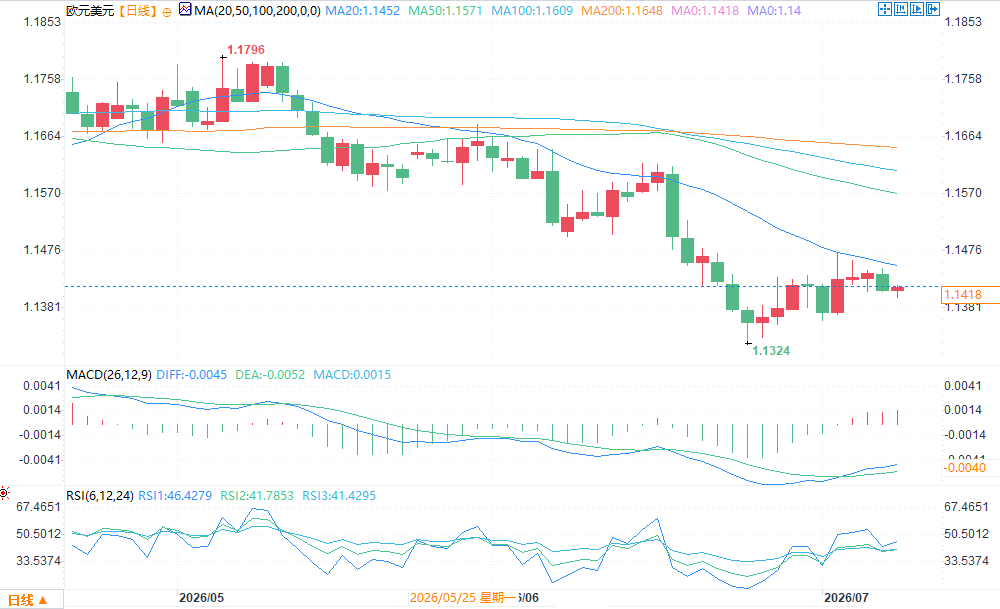
(Euro/USD daily chart, source: FX678)
At 14:08 Beijing time on July 8, the euro was trading at 1.1419/20 against the US dollar.
Market attention is focused on the release of the Federal Reserve (Fed) meeting minutes later today—the first minutes since new Chairman Kevin Warsh took office, and investors are hoping to glean key clues about the future path of U.S. interest rates.
The dollar is under pressure but has limited downside: geopolitical risks provide safe-haven support.
The US dollar index weakened slightly, but its decline was limited. On the one hand, market concerns about global geopolitical tensions continued to rise, providing potential support for the dollar through safe-haven demand; on the other hand, the US airstrikes against Iran in response to Iran's attacks on merchant ships (including a Qatari LNG carrier and a Saudi oil tanker) in the Strait of Hormuz further escalated regional tensions.
Iran reacted strongly. Parliament Speaker Mohammad Bagher Ghalibaf stated unequivocally that "the era of bullying and blackmail is over," emphasizing that Iran would not yield to pressure.
Meanwhile, Iran’s Supreme Joint Military Command condemned the U.S. airstrikes on southern Iran as “blatant aggression” and vowed to give a “devastating military response.”
Tehran also reiterated its firm stance against any US interference in the management and governance of the Strait of Hormuz, highlighting its intention to maintain absolute control over this strategic waterway.
ECB officials have spoken out in quick succession, stating that inflation risks remain a core concern.
Within the Eurozone, policymakers' rhetoric has leaned towards a hawkish tone.
European Central Bank (ECB) Governing Council member Isabel Schnabel warned that the ongoing conflict in Iran is pushing up core inflation, fueling market expectations for further ECB interest rate hikes.
Meanwhile, Fabio Panetta, a member of the ECB Governing Council and Governor of the Bank of Italy, pointed out that the risk of inflation in the Eurozone remains high due to uncertainty surrounding energy supplies from the Strait of Hormuz.
This statement has significant practical implications in the current geopolitical environment.
Panetta's speech analysis: Hawkish stance but limited confidence; the euro's downward pressure is unlikely to change.
Panetta's speech focused on the uncertainties surrounding the Strait of Hormuz and the increasingly frequent supply shocks, which reinforced the assessment that the upside risks to inflation will persist, and the overall tone was hawkish.
However, Panetta also clearly expressed concern about the downside risks to economic growth and emphasized that the economic outlook remains fragile. This dual risk pattern of "rising inflation + declining growth" actually reveals the limited policy space of the ECB.
For the foreign exchange market, this combination is unlikely to provide sustained support for the euro – the market is more likely to price in the continued existence of risk premiums rather than full confidence in the future path of policy tightening.
Summary: The euro has stabilized in the short term, but its upside potential is limited by multiple headwinds.
Overall, the euro's slight strengthening against the dollar during the Asian session was largely due to a technical correction in the dollar after its recent volatility, rather than a significant improvement in the euro's own momentum. While geopolitical risks brought some safe-haven buying to the euro in the short term, the potential impact of energy supply uncertainty on the Eurozone economy, and the ECB's limited policy space amid high inflation and weak growth, both restricted further upside potential for the euro.
Looking ahead, the market will be closely watching any hints about the interest rate path in tonight's Federal Reserve meeting minutes. If the minutes release a hawkish signal, the dollar is likely to regain upward momentum, and the euro/dollar exchange rate may come under renewed pressure; conversely, if the minutes are dovish, the euro may take the opportunity to continue its rebound. However, before the situation in the Strait of Hormuz becomes clearer, market risk appetite is unlikely to recover significantly, and the euro's overall trend is expected to remain volatile.
(Euro/USD daily chart, source: FX678)
At 14:08 Beijing time on July 8, the euro was trading at 1.1419/20 against the US dollar.
- Risk Warning and Disclaimer
- The market involves risk, and trading may not be suitable for all investors. This article is for reference only and does not constitute personal investment advice, nor does it take into account certain users’ specific investment objectives, financial situation, or other needs. Any investment decisions made based on this information are at your own risk.