$4,180 becomes a key threshold; gold's counterattack still needs one more push.
2026-07-08 15:33:28
On Wednesday, July 8th, spot gold recovered slightly after the previous trading day's decline, currently trading above $4100, with a daily gain of approximately 0.5%, but still down about 3.08% over the past month. This suggests that the current rally is not simply driven by safe-haven demand, but rather by the combined forces of conflict premium, oil price rebound, and interest rate expectation repricing. Meanwhile, the minutes of the Federal Reserve's June meeting are scheduled for release at 2:00 AM on Thursday, with the market awaiting further signals regarding the future path of interest rates.
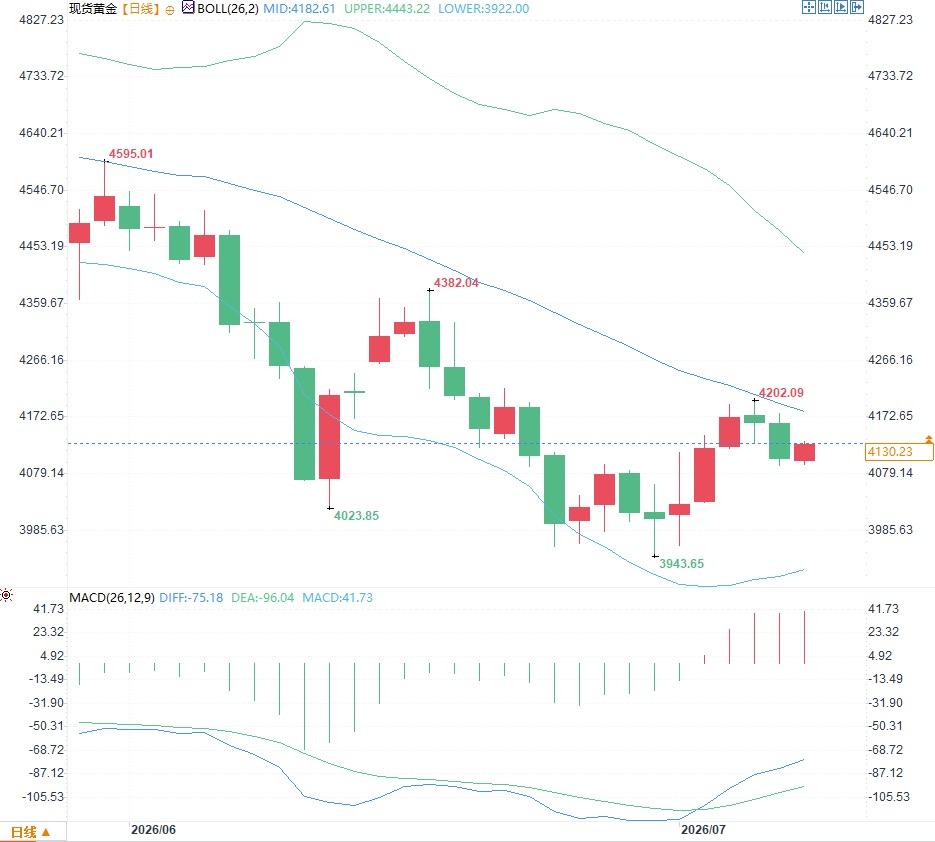
From a technical perspective, spot gold is holding above $4100 in the short term, but upward momentum is not strong. The daily chart shows that the price previously fell from around $4595, reaching a low of $3943, before rebounding to around $4130. The Bollinger Band middle line is around $4182, meaning that the price has not yet regained its position above the medium-term resistance level. Unless the price can effectively recover the middle line, the rebound is more of a technical correction than a trend reversal.
The problem with gold is that it simultaneously benefits from conflict uncertainty while being suppressed by interest rate expectations. Escalating conflicts typically increase safe-haven demand, but rising oil prices can reignite inflation concerns, leading the market to bet on the Federal Reserve maintaining a tight interest rate environment. For non-interest-bearing assets, rising nominal and real interest rates directly increase holding costs. Therefore, while gold appears to be supported by safe-haven demand in the short term, its potential upside is actually limited by the repricing of interest rates.
The recent gold rally failed to gain traction, with oil prices being a key variable. Brent crude is currently up to $76 per barrel, while West Texas Intermediate crude is up to $72 per barrel. Renewed risks associated with the Strait of Hormuz have brought energy supply concerns back into the spotlight for traders; this passage handles approximately one-fifth of the world's oil supply.
This isn't a one-sided positive for gold. Rising oil prices first create safe-haven demand, and secondly, they lead to expectations of sticky inflation. If the market believes that energy prices will push up inflation again, US Treasury yields and the US dollar will often find support, and gold's safe-haven appeal will be partially offset by interest rate pressures. This is why gold prices didn't break through directly due to conflict news, but instead fluctuated above $4100.
The Federal Reserve's June statement indicated that the target range for the federal funds rate remained at 3.50% to 3.75%, while emphasizing that inflation remained above the 2% target, with some price pressures stemming from supply shocks, including in the energy sector. The official schedule shows that the meeting minutes will be released during the North American session. Traders are not focusing on whether interest rates have already been raised, but rather on the committee's internal weighing of the energy shock, slowing employment, and sticky inflation.
Recent data is not one-sided. Non-farm payrolls increased by only 57,000 in June, with the unemployment rate at 4.2%. The combined downward revision of April and May's employment figures by 74,000 indicates a slowdown in the pace of labor market expansion. Meanwhile, the June services PMI was 54.0, still in expansion territory, but lower than May's 54.5, indicating a cooling in both new orders and business activity. Although the price index fell to 67.7, it remains at a relatively high level.
This data combination is particularly complex for gold. While a slowdown in employment should have weakened expectations of interest rate hikes, a rebound in energy prices has brought inflation risks back to the forefront. Interest rate futures pricing shows that the probability of a September rate hike has risen from about 57% the previous day to over 63%, indicating that the market is repricing conflict and oil price risks with a higher probability of policy rates.
From a daily chart perspective, gold's technical signals are improving, but not yet strong enough. The MACD histogram has returned to positive territory, indicating that downward momentum has eased somewhat; however, the DIFF and DEA are still below the zero line, suggesting that the medium-term trend has not yet been fully repaired. The price's short-term stabilization around $4100 only indicates that buying pressure remains, but the $4180 to $4200 range is the more significant resistance zone.
If the minutes reveal a stronger anti-inflationary stance, gold may continue to be pressured by interest rates, and the effectiveness of the support level around $4,100 will be tested again. If the minutes give more weight to the cooling employment situation, the market may reduce its bets on further rate hikes, giving gold a stronger reason to challenge above $4,180. The current trading logic is not simply about the conflict, but rather whether the conflict will transmit through oil prices to higher inflation, which in turn will suppress gold prices through interest rate expectations.
Gold's rebound is weak, with the core pressure coming from expectations of real interest rates.
From a technical perspective, spot gold is holding above $4100 in the short term, but upward momentum is not strong. The daily chart shows that the price previously fell from around $4595, reaching a low of $3943, before rebounding to around $4130. The Bollinger Band middle line is around $4182, meaning that the price has not yet regained its position above the medium-term resistance level. Unless the price can effectively recover the middle line, the rebound is more of a technical correction than a trend reversal.
The problem with gold is that it simultaneously benefits from conflict uncertainty while being suppressed by interest rate expectations. Escalating conflicts typically increase safe-haven demand, but rising oil prices can reignite inflation concerns, leading the market to bet on the Federal Reserve maintaining a tight interest rate environment. For non-interest-bearing assets, rising nominal and real interest rates directly increase holding costs. Therefore, while gold appears to be supported by safe-haven demand in the short term, its potential upside is actually limited by the repricing of interest rates.
The rebound in oil prices has changed market pricing of inflation.
The recent gold rally failed to gain traction, with oil prices being a key variable. Brent crude is currently up to $76 per barrel, while West Texas Intermediate crude is up to $72 per barrel. Renewed risks associated with the Strait of Hormuz have brought energy supply concerns back into the spotlight for traders; this passage handles approximately one-fifth of the world's oil supply.
This isn't a one-sided positive for gold. Rising oil prices first create safe-haven demand, and secondly, they lead to expectations of sticky inflation. If the market believes that energy prices will push up inflation again, US Treasury yields and the US dollar will often find support, and gold's safe-haven appeal will be partially offset by interest rate pressures. This is why gold prices didn't break through directly due to conflict news, but instead fluctuated above $4100.
The Fed minutes become a watershed moment for short-term pricing.
The Federal Reserve's June statement indicated that the target range for the federal funds rate remained at 3.50% to 3.75%, while emphasizing that inflation remained above the 2% target, with some price pressures stemming from supply shocks, including in the energy sector. The official schedule shows that the meeting minutes will be released during the North American session. Traders are not focusing on whether interest rates have already been raised, but rather on the committee's internal weighing of the energy shock, slowing employment, and sticky inflation.
Recent data is not one-sided. Non-farm payrolls increased by only 57,000 in June, with the unemployment rate at 4.2%. The combined downward revision of April and May's employment figures by 74,000 indicates a slowdown in the pace of labor market expansion. Meanwhile, the June services PMI was 54.0, still in expansion territory, but lower than May's 54.5, indicating a cooling in both new orders and business activity. Although the price index fell to 67.7, it remains at a relatively high level.
This data combination is particularly complex for gold. While a slowdown in employment should have weakened expectations of interest rate hikes, a rebound in energy prices has brought inflation risks back to the forefront. Interest rate futures pricing shows that the probability of a September rate hike has risen from about 57% the previous day to over 63%, indicating that the market is repricing conflict and oil price risks with a higher probability of policy rates.
Technical indicators suggest a recovery, but a key breakout is still needed to confirm the trend.
From a daily chart perspective, gold's technical signals are improving, but not yet strong enough. The MACD histogram has returned to positive territory, indicating that downward momentum has eased somewhat; however, the DIFF and DEA are still below the zero line, suggesting that the medium-term trend has not yet been fully repaired. The price's short-term stabilization around $4100 only indicates that buying pressure remains, but the $4180 to $4200 range is the more significant resistance zone.
If the minutes reveal a stronger anti-inflationary stance, gold may continue to be pressured by interest rates, and the effectiveness of the support level around $4,100 will be tested again. If the minutes give more weight to the cooling employment situation, the market may reduce its bets on further rate hikes, giving gold a stronger reason to challenge above $4,180. The current trading logic is not simply about the conflict, but rather whether the conflict will transmit through oil prices to higher inflation, which in turn will suppress gold prices through interest rate expectations.
- Risk Warning and Disclaimer
- The market involves risk, and trading may not be suitable for all investors. This article is for reference only and does not constitute personal investment advice, nor does it take into account certain users’ specific investment objectives, financial situation, or other needs. Any investment decisions made based on this information are at your own risk.