Risks in the Strait of Hormuz increased demand for the US dollar as a safe haven, while the euro remained range-bound against the dollar awaiting the release of the Federal Reserve minutes.
2026-07-08 16:23:58
The euro remained relatively stable against the dollar in Asian trading on Wednesday, trading around 1.1410. After a slight decline in the previous session, the market lacked clear direction, with investors primarily awaiting the release of the Federal Reserve's June meeting minutes for clues about future changes in US interest rate policy.

The US dollar has been volatile recently. Although it has retreated in the short term, safe-haven demand may still drive it higher again. Recent US military action against Iran, following attacks on commercial vessels near the Strait of Hormuz, including a Qatari LNG carrier and a Saudi oil tanker, have increased market concerns about energy supply security and prompted investors to increase their exposure to risky assets.
Escalating geopolitical risks have restored the US dollar's safe-haven appeal. Market concerns suggest that further deterioration in the Strait of Hormuz could disrupt global energy transport and drive up oil prices, thus increasing inflationary pressures.
Iran has recently sent a strong signal. Iranian Parliament Speaker Mohammad Bagher Ghalibaf stated that external pressure cannot force Iran to back down and emphasized that Iran will not accept such pressure. Meanwhile, Iran's Supreme Joint Military Command condemned the actions targeting the southern region and stated that it would take retaliatory measures. Uncertainty surrounding control of the Strait of Hormuz continues to keep the market focused on energy supply risks.
In Europe, expectations for the European Central Bank's policy have shifted. ECB Executive Board member Isabel Schnabel previously stated that related conflicts could lead to persistent core inflationary pressures, increasing market expectations that the ECB will maintain its tight monetary policy.
Meanwhile, Italian central bank governor Fabio Panetta also pointed out that the risk of inflation in the eurozone remains high due to uncertainties in energy supply from the Strait of Hormuz. He believes that energy supply shocks could affect future price trends, putting the European Central Bank under greater constraints in policy adjustments.
However, the stance of European Central Bank officials has not entirely shifted to a hawkish position. Panetta also emphasized that the eurozone economic outlook remains fragile, with both upside risks to inflation and downside risks to economic growth present. This implies that the ECB's future policy space is limited, and the market remains cautious about a continued strengthening of the euro.
From a monetary policy perspective, the euro is currently influenced by two forces against the dollar. On the one hand, changes in the Federal Reserve's interest rate expectations limit the dollar's upside potential; on the other hand, geopolitical risks and rising energy prices increase the demand for the dollar as a safe haven.
The market is currently most focused on the minutes of the Federal Reserve's June meeting. Since this meeting took place before the release of the latest US employment data, investors will be closely watching whether the Fed officials' assessments of inflation and the job market at that time still align with current market expectations.
If the meeting minutes release a hawkish signal, the dollar may receive further support, while the euro may continue to be under pressure against the dollar; if the market believes that a slowdown in employment will push the Fed's policy to become more dovish, the dollar may fall back, while the euro may have a chance to rebound.
From a daily chart perspective, the euro/dollar pair has recently maintained a high-level consolidation trend, finding support around 1.1400, but the upward momentum has weakened compared to before. The overall trend remains range-bound, with the MACD indicator showing a gradual contraction of bullish momentum, indicating the market is entering a correction phase. Key resistance to watch is around 1.1450; a break above this level could lead to a further test of the 1.1500 area. Support levels to watch are 1.1380 and 1.1360; a break below 1.1360 could open up further downside potential.
From a 4-hour chart perspective, the EUR/USD pair is currently in a short-term consolidation phase, fluctuating around 1.1410. Short-term moving averages are flattening, and the market is awaiting a directional move. The RSI indicator remains in neutral territory, indicating a temporary balance between bullish and bearish forces. If the pair breaks through the 1.1430 resistance level, short-term pressure may ease, and it could potentially retest 1.1450; conversely, a break below the 1.1390 support level could lead to further testing of the 1.1360 area. The current technical trend leans towards range-bound trading, awaiting new catalysts from the Fed meeting minutes.
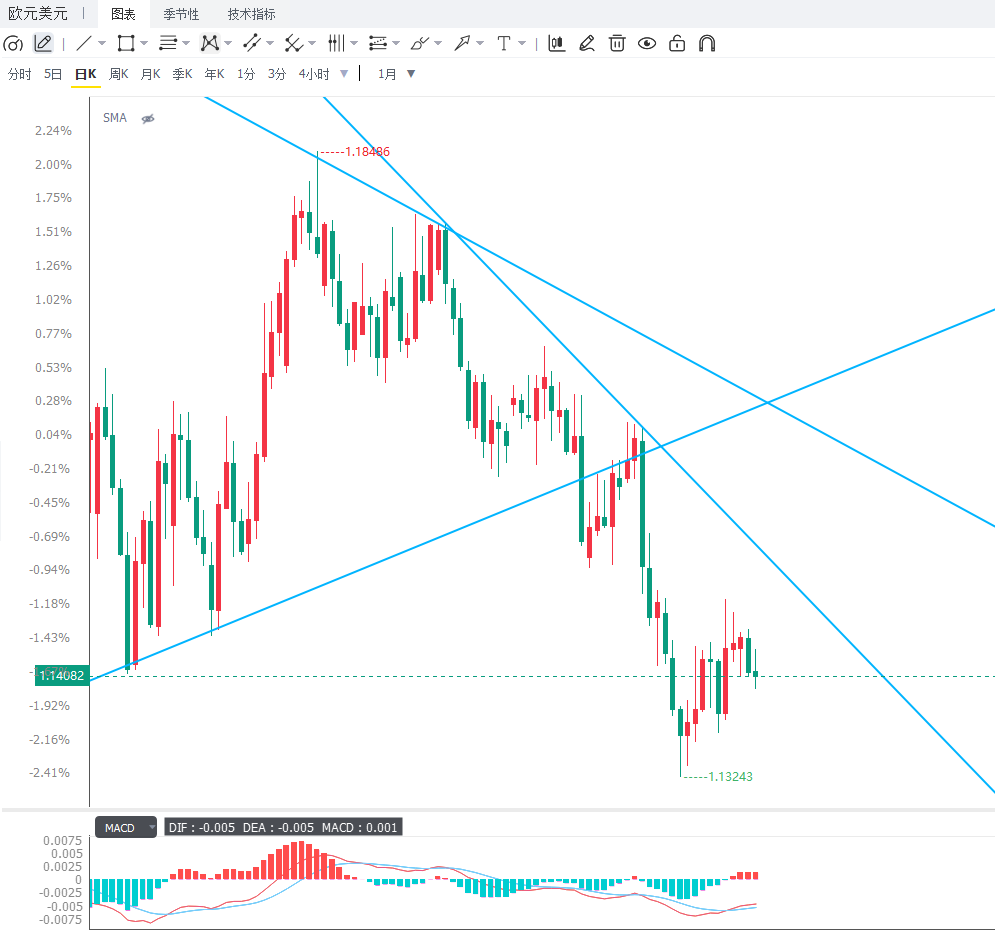
Editor's Summary : The euro/dollar exchange rate is currently in a tug-of-war between safe-haven demand for the dollar and concerns about European Central Bank inflation. Geopolitical risks are supporting the dollar, while energy supply uncertainty is increasing European inflation risks, allowing the euro to maintain some resilience. In the short term, market direction still depends on the Fed's policy signals and changes in global risk sentiment. If the Fed minutes lean towards tightening, the dollar may continue to dominate; if the market lowers interest rate expectations again, the euro may have a chance to rebound. The key focus now is on the 1.1450 resistance and 1.1360 support area; a breakout will determine the next phase of the trend.
The US dollar has been volatile recently. Although it has retreated in the short term, safe-haven demand may still drive it higher again. Recent US military action against Iran, following attacks on commercial vessels near the Strait of Hormuz, including a Qatari LNG carrier and a Saudi oil tanker, have increased market concerns about energy supply security and prompted investors to increase their exposure to risky assets.
Escalating geopolitical risks have restored the US dollar's safe-haven appeal. Market concerns suggest that further deterioration in the Strait of Hormuz could disrupt global energy transport and drive up oil prices, thus increasing inflationary pressures.
Iran has recently sent a strong signal. Iranian Parliament Speaker Mohammad Bagher Ghalibaf stated that external pressure cannot force Iran to back down and emphasized that Iran will not accept such pressure. Meanwhile, Iran's Supreme Joint Military Command condemned the actions targeting the southern region and stated that it would take retaliatory measures. Uncertainty surrounding control of the Strait of Hormuz continues to keep the market focused on energy supply risks.
In Europe, expectations for the European Central Bank's policy have shifted. ECB Executive Board member Isabel Schnabel previously stated that related conflicts could lead to persistent core inflationary pressures, increasing market expectations that the ECB will maintain its tight monetary policy.
Meanwhile, Italian central bank governor Fabio Panetta also pointed out that the risk of inflation in the eurozone remains high due to uncertainties in energy supply from the Strait of Hormuz. He believes that energy supply shocks could affect future price trends, putting the European Central Bank under greater constraints in policy adjustments.
However, the stance of European Central Bank officials has not entirely shifted to a hawkish position. Panetta also emphasized that the eurozone economic outlook remains fragile, with both upside risks to inflation and downside risks to economic growth present. This implies that the ECB's future policy space is limited, and the market remains cautious about a continued strengthening of the euro.
From a monetary policy perspective, the euro is currently influenced by two forces against the dollar. On the one hand, changes in the Federal Reserve's interest rate expectations limit the dollar's upside potential; on the other hand, geopolitical risks and rising energy prices increase the demand for the dollar as a safe haven.
The market is currently most focused on the minutes of the Federal Reserve's June meeting. Since this meeting took place before the release of the latest US employment data, investors will be closely watching whether the Fed officials' assessments of inflation and the job market at that time still align with current market expectations.
If the meeting minutes release a hawkish signal, the dollar may receive further support, while the euro may continue to be under pressure against the dollar; if the market believes that a slowdown in employment will push the Fed's policy to become more dovish, the dollar may fall back, while the euro may have a chance to rebound.
From a daily chart perspective, the euro/dollar pair has recently maintained a high-level consolidation trend, finding support around 1.1400, but the upward momentum has weakened compared to before. The overall trend remains range-bound, with the MACD indicator showing a gradual contraction of bullish momentum, indicating the market is entering a correction phase. Key resistance to watch is around 1.1450; a break above this level could lead to a further test of the 1.1500 area. Support levels to watch are 1.1380 and 1.1360; a break below 1.1360 could open up further downside potential.
From a 4-hour chart perspective, the EUR/USD pair is currently in a short-term consolidation phase, fluctuating around 1.1410. Short-term moving averages are flattening, and the market is awaiting a directional move. The RSI indicator remains in neutral territory, indicating a temporary balance between bullish and bearish forces. If the pair breaks through the 1.1430 resistance level, short-term pressure may ease, and it could potentially retest 1.1450; conversely, a break below the 1.1390 support level could lead to further testing of the 1.1360 area. The current technical trend leans towards range-bound trading, awaiting new catalysts from the Fed meeting minutes.
Editor's Summary : The euro/dollar exchange rate is currently in a tug-of-war between safe-haven demand for the dollar and concerns about European Central Bank inflation. Geopolitical risks are supporting the dollar, while energy supply uncertainty is increasing European inflation risks, allowing the euro to maintain some resilience. In the short term, market direction still depends on the Fed's policy signals and changes in global risk sentiment. If the Fed minutes lean towards tightening, the dollar may continue to dominate; if the market lowers interest rate expectations again, the euro may have a chance to rebound. The key focus now is on the 1.1450 resistance and 1.1360 support area; a breakout will determine the next phase of the trend.
- Risk Warning and Disclaimer
- The market involves risk, and trading may not be suitable for all investors. This article is for reference only and does not constitute personal investment advice, nor does it take into account certain users’ specific investment objectives, financial situation, or other needs. Any investment decisions made based on this information are at your own risk.