













A minority wants a June rate hike, while the majority worries about sticky inflation—what three signals are hidden in the Fed minutes?
2026-07-09 09:09:13
On Thursday (July 9) in early Asian trading, the US dollar index traded sideways. Following the release of the minutes from the Federal Open Market Committee (FOMC) meeting, the index continued to fluctuate slightly around the 101 level.
The minutes of the Federal Reserve’s June 16-17 meeting, released early Thursday morning, showed that policymakers’ concerns about the upside risks to inflation intensified significantly at this meeting.
Although "most participants" still believed that inflation could fall back to the 2% target level on its own, "almost all" reserved officials emphasized that if high inflation persisted, raising interest rates would be necessary.
It is worth noting that a “minority of participants” believed there were sufficient reasons to directly raise borrowing costs at the June meeting, although they ultimately agreed to keep interest rates unchanged.
This is also the first meeting record since Kevin Warsh took over as Chairman of the Federal Reserve. Compared to the Powell era, the document is about 1,000 words shorter (a 20% reduction) and all forward guidance has been completely removed—consistent with Warsh's consistent stance of avoiding commitments regarding future interest rate decisions. The market reaction to the minutes was generally muted, with the interest rate futures market still pricing in a rate hike at the September meeting.
The meeting minutes reveal that policymakers' anxieties about the inflation trend are deepening. Participants generally agreed that the upside risks to price stability remain high, while the downside risks to achieving full employment have eased. This assessment itself points to a shift in policy focus—inflation is replacing employment as the primary policy concern.
Specifically, several participants pointed out that price pressures have spread to a wider range of sectors. Prices for most goods and services, including transportation, airfares, petrochemicals, and agricultural inputs, have risen sharply. More worryingly, inflation in services excluding housing has barely declined and remains high—a typical characteristic of sticky inflation and one of the most challenging aspects for policymakers.
The minutes also introduced a new concern: the potential inflationary impact of the investment boom in artificial intelligence. While the long-term productivity gains from AI investment have been widely discussed, its short-term inflationary effects could arise by driving up related asset prices, equipment demand, and energy consumption. This discussion indicates that the Federal Reserve's examination of the sources of inflation has expanded from traditional categories to include the potential impact of a structural investment boom.
The policy views presented at this meeting were divided into two camps—one believing that inflation might subside on its own, and the other arguing that interest rate hikes might be necessary to curb it. This contrasts with the more dispersed spectrum of opinions at the April meeting, when voices supporting rate hikes were just emerging, while former Federal Reserve Governor Milan continued to advocate for immediate rate cuts.
In Warsh's first set of minutes, no support was made for an immediate rate cut. This means that the most dovish end of the policy spectrum has disappeared, and the overall discussion framework has narrowed to a trade-off between "maintaining interest rates" and "raising interest rates," reflecting a more convergent basic consensus within the Federal Reserve on the direction of monetary policy than before—although there are still differences on the specific pace.
Ultimately, nine out of 18 policymakers predicted a slight increase in interest rates by the end of 2026, a 50/50 split that reflects the delicate balance the current policymakers are maintaining regarding the policy path.
Another key topic at the meeting was the reform of the monetary policy communication framework. Policymakers considered Warsh's suggestion to end "forward guidance," which would involve reducing comments on future interest rate decisions in the statements.
The meeting minutes show that a "majority of participants" supported shortening the statement, while a "majority of participants" supported removing language suggesting that the Fed's next policy action was likely to be a rate cut. The final approved policy statement completely removed guidance on interest rates—a move highly consistent with Warsh's overall desire to avoid making commitments on interest rate decisions.
Warsh also outlined his plan to establish five working groups to review the implementation of monetary policy, but the minutes did not mention specific discussions on this plan. This indicates that the reforms are still in the early stages of framework development, and practical details will be filled in at subsequent meetings.
Following the release of the minutes, LPL Financial's chief economist, Jeffrey Roach, noted that the minutes contained "some ambiguities," reflecting several conflicting viewpoints at the policy level. However, he also emphasized one certainty: future policy will largely depend on the political situation in the Middle East.
In other words, the Federal Reserve has placed itself in a pattern of "data dependence" combined with "geopolitical dependence"—the committee is studying various possible scenarios, but will not make commitments on any particular scenario until subsequent data and economic conditions provide the necessary clarity.
The market's muted reaction to the minutes confirms this assessment. Since the minutes reflected the economic situation in mid-June (when US employment data had not yet weakened significantly), and the subsequent June non-farm payroll report showed only 57,000 new jobs, the macroeconomic backdrop has been significantly altered. This limits the marginal impact of the hawkish language in the minutes on current market pricing. The interest rate futures market is still betting on a September rate hike, but the sustainability of this expectation is highly correlated with the situation in the Middle East and US economic data in the coming weeks.
In summary, the minutes of the Fed's June meeting released a clear, cautiously hawkish signal—increased inflation concerns, renewed discussions about interest rate hikes, and the formal repeal of forward guidance. However, the "time misalignment" effect of these minutes cannot be ignored: they reflect a relatively resilient labor market in mid-June, while current economic data (especially the weak June non-farm payrolls) has added new uncertainties to the policy outlook.
Looking ahead, the policy direction of the Federal Reserve's September meeting will depend on the convergence of two major variables: whether the geopolitical situation in the Middle East will escalate further or ease (directly impacting energy prices and inflation expectations), and whether economic data in the next two months can confirm the disinflationary trend. Under Warsh's leadership, the Fed is transitioning to a simpler, less committed policy communication framework, meaning markets will have to adapt to a forward-looking environment of "greater uncertainty." For asset prices, the minutes themselves will have limited impact, but data and geopolitical developments before September will be the real market drivers.
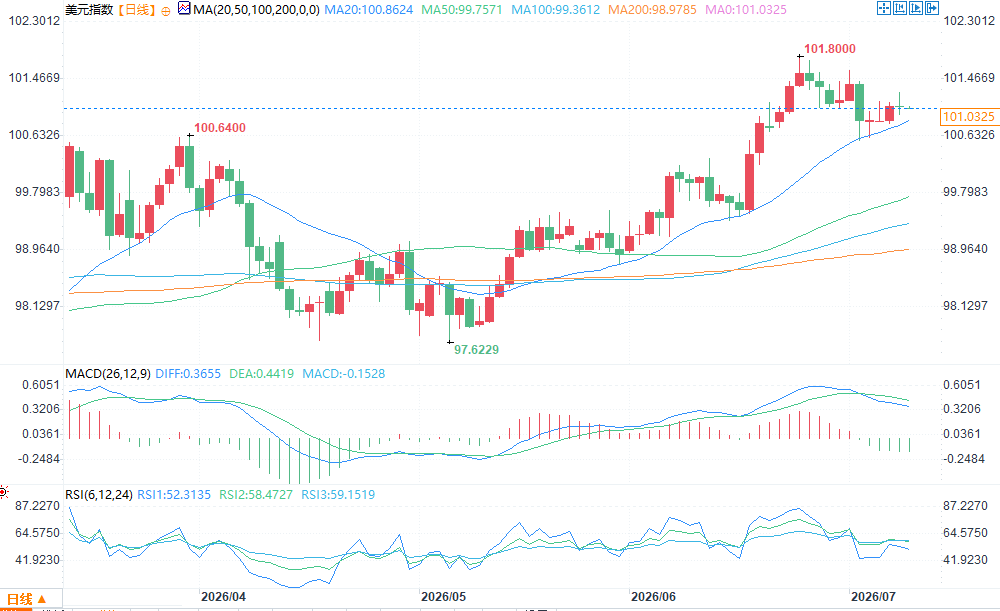
(US Dollar Index Daily Chart, Source: FX678)
At 9:08 AM Beijing time on July 9, the US dollar index was at 100.99.
The minutes of the Federal Reserve’s June 16-17 meeting, released early Thursday morning, showed that policymakers’ concerns about the upside risks to inflation intensified significantly at this meeting.
Although "most participants" still believed that inflation could fall back to the 2% target level on its own, "almost all" reserved officials emphasized that if high inflation persisted, raising interest rates would be necessary.
It is worth noting that a “minority of participants” believed there were sufficient reasons to directly raise borrowing costs at the June meeting, although they ultimately agreed to keep interest rates unchanged.
This is also the first meeting record since Kevin Warsh took over as Chairman of the Federal Reserve. Compared to the Powell era, the document is about 1,000 words shorter (a 20% reduction) and all forward guidance has been completely removed—consistent with Warsh's consistent stance of avoiding commitments regarding future interest rate decisions. The market reaction to the minutes was generally muted, with the interest rate futures market still pricing in a rate hike at the September meeting.
Inflation Debate: Expanding Scope, Increased Stickiness, and New Concerns About AI Investment
The meeting minutes reveal that policymakers' anxieties about the inflation trend are deepening. Participants generally agreed that the upside risks to price stability remain high, while the downside risks to achieving full employment have eased. This assessment itself points to a shift in policy focus—inflation is replacing employment as the primary policy concern.
Specifically, several participants pointed out that price pressures have spread to a wider range of sectors. Prices for most goods and services, including transportation, airfares, petrochemicals, and agricultural inputs, have risen sharply. More worryingly, inflation in services excluding housing has barely declined and remains high—a typical characteristic of sticky inflation and one of the most challenging aspects for policymakers.
The minutes also introduced a new concern: the potential inflationary impact of the investment boom in artificial intelligence. While the long-term productivity gains from AI investment have been widely discussed, its short-term inflationary effects could arise by driving up related asset prices, equipment demand, and energy consumption. This discussion indicates that the Federal Reserve's examination of the sources of inflation has expanded from traditional categories to include the potential impact of a structural investment boom.
Internal factions: The two major factions are diverging, but opposition is gradually diminishing.
The policy views presented at this meeting were divided into two camps—one believing that inflation might subside on its own, and the other arguing that interest rate hikes might be necessary to curb it. This contrasts with the more dispersed spectrum of opinions at the April meeting, when voices supporting rate hikes were just emerging, while former Federal Reserve Governor Milan continued to advocate for immediate rate cuts.
In Warsh's first set of minutes, no support was made for an immediate rate cut. This means that the most dovish end of the policy spectrum has disappeared, and the overall discussion framework has narrowed to a trade-off between "maintaining interest rates" and "raising interest rates," reflecting a more convergent basic consensus within the Federal Reserve on the direction of monetary policy than before—although there are still differences on the specific pace.
Ultimately, nine out of 18 policymakers predicted a slight increase in interest rates by the end of 2026, a 50/50 split that reflects the delicate balance the current policymakers are maintaining regarding the policy path.
Forward guidance ends: Warsh simplifies statements, policy framework moves towards simplification.
Another key topic at the meeting was the reform of the monetary policy communication framework. Policymakers considered Warsh's suggestion to end "forward guidance," which would involve reducing comments on future interest rate decisions in the statements.
The meeting minutes show that a "majority of participants" supported shortening the statement, while a "majority of participants" supported removing language suggesting that the Fed's next policy action was likely to be a rate cut. The final approved policy statement completely removed guidance on interest rates—a move highly consistent with Warsh's overall desire to avoid making commitments on interest rate decisions.
Warsh also outlined his plan to establish five working groups to review the implementation of monetary policy, but the minutes did not mention specific discussions on this plan. This indicates that the reforms are still in the early stages of framework development, and practical details will be filled in at subsequent meetings.
Market Analysis: Certainty Amid Ambiguity, Middle East Situation Becomes Key Variable
Following the release of the minutes, LPL Financial's chief economist, Jeffrey Roach, noted that the minutes contained "some ambiguities," reflecting several conflicting viewpoints at the policy level. However, he also emphasized one certainty: future policy will largely depend on the political situation in the Middle East.
In other words, the Federal Reserve has placed itself in a pattern of "data dependence" combined with "geopolitical dependence"—the committee is studying various possible scenarios, but will not make commitments on any particular scenario until subsequent data and economic conditions provide the necessary clarity.
The market's muted reaction to the minutes confirms this assessment. Since the minutes reflected the economic situation in mid-June (when US employment data had not yet weakened significantly), and the subsequent June non-farm payroll report showed only 57,000 new jobs, the macroeconomic backdrop has been significantly altered. This limits the marginal impact of the hawkish language in the minutes on current market pricing. The interest rate futures market is still betting on a September rate hike, but the sustainability of this expectation is highly correlated with the situation in the Middle East and US economic data in the coming weeks.
Hawkish tone unlikely to change market pricing; September's trajectory depends on two variables.
In summary, the minutes of the Fed's June meeting released a clear, cautiously hawkish signal—increased inflation concerns, renewed discussions about interest rate hikes, and the formal repeal of forward guidance. However, the "time misalignment" effect of these minutes cannot be ignored: they reflect a relatively resilient labor market in mid-June, while current economic data (especially the weak June non-farm payrolls) has added new uncertainties to the policy outlook.
Looking ahead, the policy direction of the Federal Reserve's September meeting will depend on the convergence of two major variables: whether the geopolitical situation in the Middle East will escalate further or ease (directly impacting energy prices and inflation expectations), and whether economic data in the next two months can confirm the disinflationary trend. Under Warsh's leadership, the Fed is transitioning to a simpler, less committed policy communication framework, meaning markets will have to adapt to a forward-looking environment of "greater uncertainty." For asset prices, the minutes themselves will have limited impact, but data and geopolitical developments before September will be the real market drivers.
(US Dollar Index Daily Chart, Source: FX678)
At 9:08 AM Beijing time on July 9, the US dollar index was at 100.99.
- Risk Warning and Disclaimer
- The market involves risk, and trading may not be suitable for all investors. This article is for reference only and does not constitute personal investment advice, nor does it take into account certain users’ specific investment objectives, financial situation, or other needs. Any investment decisions made based on this information are at your own risk.

