













The collapse of the US-Iran ceasefire agreement exacerbated inflation concerns, causing gold to continue its downward trend.
2026-07-09 10:31:44
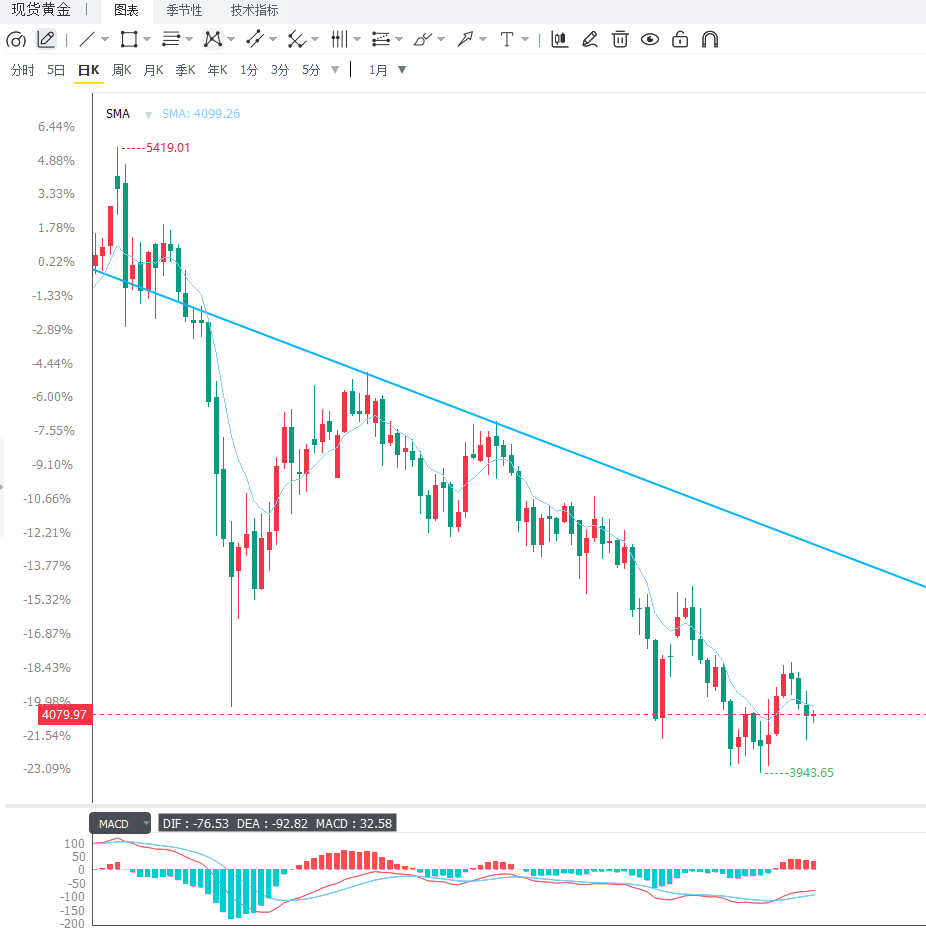
International gold prices continued their downward trend in Asian trading on Thursday, with spot gold (XAU/USD) falling back to around $4075 per ounce , extending the previous day's decline. As tensions between the US and Iran escalate again, the market is reassessing future inflation and monetary policy prospects, with high interest rate expectations becoming the main factor suppressing gold's price movement.

Latest news indicates that US President Trump stated that the interim agreement reached between the US and Iran to ease tensions in the Middle East has ended, meaning that relations between the two sides have re-entered a highly tense phase. Market research shows that Trump also warned that if Iran continues to attack oil tankers transiting the Strait of Hormuz, the US will continue military strikes and may reinstate naval blockade measures against Iran.
The rapidly deteriorating situation in the Middle East has once again increased risks to global energy supply. Since the Strait of Hormuz handles approximately 20% of global seaborne crude oil transport , market concerns are that disruptions to shipping could lead to a significant resurgence in international crude oil prices, thereby pushing up global inflation.
However, unlike previous gold price increases driven by risk aversion, this round of gold price movements has been significantly suppressed by expectations of high interest rates. The market generally believes that if energy prices continue to rise and inflation reignites, the Federal Reserve may need to maintain restrictive monetary policy for a longer period to prevent inflation from spiraling out of control again.
David Meg, head of metals trading at High Ridge Futures, said the main reason for the current pullback in gold is not a decrease in safe-haven demand, but rather that the market is more focused on the potential for renewed inflationary pressures from an escalating conflict between the US and Iran. As the risk of war rises again, risk assets, including stocks, are under pressure, and gold is also adjusting due to expectations of high interest rates.
The latest interest rate pricing also reflects a significant shift in investor sentiment. According to data from the CME Group's FedWatch tool, the market now expects a greater than 30% probability of a rate hike at the next Federal Reserve meeting, compared to less than 20% a week ago. This change indicates that investors are reassessing the future path of monetary policy.
Meanwhile, the minutes of the Federal Reserve's June 16-17 monetary policy meeting further reinforced market caution. The minutes showed that although the committee ultimately decided to keep interest rates unchanged, a few officials believed that conditions for further rate hikes existed. The meeting also noted that, with concerns about the labor market easing, Fed officials' focus on the persistence of inflation had significantly increased.
Given the current market environment, the Federal Reserve's future policies will remain highly dependent on economic data, particularly changes in inflation, employment, and energy prices. If international oil prices continue to rise due to the situation in the Middle East, inflationary pressures in the United States may increase again, thus delaying future policy adjustments. This is not beneficial for gold, which has no fixed income.
Furthermore, the recent strength of the US dollar index and the persistently high yields on US Treasury bonds have also diminished the appeal of gold. For international investors, higher real interest rates have increased the returns on dollar-denominated assets, causing some safe-haven funds to flow into the dollar rather than gold, putting short-term pressure on gold prices.
From a daily chart perspective, spot gold, after a continuous pullback, is still trading near its medium- to long-term moving averages. The overall upward trend has not been completely broken, but short-term downward pressure has increased. The MACD is above the zero line, but the two lines are gradually converging, and the red momentum bars are continuously shortening , indicating a weakening of bullish momentum. If the gold price breaks below the $4050 support level, it may further test the $4000 psychological level. On the upside, key resistance areas to watch are $4105 and $4140 ; a break above these levels could lead to a resumption of the upward trend.
From a 4-hour chart perspective, gold prices have broken below short-term moving averages, indicating a shift to a weak and volatile short-term trend. The MACD has formed a death cross near the zero line, with the green momentum bars gradually expanding , reflecting increased bearish pressure. If the market continues to reinforce expectations that the Federal Reserve will maintain high interest rates, gold prices may further test the $4050 support level; if geopolitical risks continue to escalate and trigger a rapid increase in safe-haven demand, gold may still have a chance to regain $4105 and challenge the resistance level near $4140 .
Editor's Summary : The gold market is currently influenced by both geopolitical risks and monetary policy expectations. While the escalating US-Iran conflict has increased safe-haven demand, rising energy prices and inflationary pressures have strengthened market expectations that the Federal Reserve will maintain high interest rates or even further tighten policies, keeping the US dollar and US Treasury yields strong and putting greater downward pressure on gold. In the short term, gold's performance will still largely depend on the development of the Middle East situation, changes in international oil prices, and US inflation and employment data. If inflation expectations continue to rise, gold may continue to be under pressure; if safe-haven demand significantly expands and exceeds the impact of interest rate factors, gold prices may regain upward momentum.
Latest news indicates that US President Trump stated that the interim agreement reached between the US and Iran to ease tensions in the Middle East has ended, meaning that relations between the two sides have re-entered a highly tense phase. Market research shows that Trump also warned that if Iran continues to attack oil tankers transiting the Strait of Hormuz, the US will continue military strikes and may reinstate naval blockade measures against Iran.
The rapidly deteriorating situation in the Middle East has once again increased risks to global energy supply. Since the Strait of Hormuz handles approximately 20% of global seaborne crude oil transport , market concerns are that disruptions to shipping could lead to a significant resurgence in international crude oil prices, thereby pushing up global inflation.
However, unlike previous gold price increases driven by risk aversion, this round of gold price movements has been significantly suppressed by expectations of high interest rates. The market generally believes that if energy prices continue to rise and inflation reignites, the Federal Reserve may need to maintain restrictive monetary policy for a longer period to prevent inflation from spiraling out of control again.
David Meg, head of metals trading at High Ridge Futures, said the main reason for the current pullback in gold is not a decrease in safe-haven demand, but rather that the market is more focused on the potential for renewed inflationary pressures from an escalating conflict between the US and Iran. As the risk of war rises again, risk assets, including stocks, are under pressure, and gold is also adjusting due to expectations of high interest rates.
The latest interest rate pricing also reflects a significant shift in investor sentiment. According to data from the CME Group's FedWatch tool, the market now expects a greater than 30% probability of a rate hike at the next Federal Reserve meeting, compared to less than 20% a week ago. This change indicates that investors are reassessing the future path of monetary policy.
Meanwhile, the minutes of the Federal Reserve's June 16-17 monetary policy meeting further reinforced market caution. The minutes showed that although the committee ultimately decided to keep interest rates unchanged, a few officials believed that conditions for further rate hikes existed. The meeting also noted that, with concerns about the labor market easing, Fed officials' focus on the persistence of inflation had significantly increased.
Given the current market environment, the Federal Reserve's future policies will remain highly dependent on economic data, particularly changes in inflation, employment, and energy prices. If international oil prices continue to rise due to the situation in the Middle East, inflationary pressures in the United States may increase again, thus delaying future policy adjustments. This is not beneficial for gold, which has no fixed income.
Furthermore, the recent strength of the US dollar index and the persistently high yields on US Treasury bonds have also diminished the appeal of gold. For international investors, higher real interest rates have increased the returns on dollar-denominated assets, causing some safe-haven funds to flow into the dollar rather than gold, putting short-term pressure on gold prices.
From a daily chart perspective, spot gold, after a continuous pullback, is still trading near its medium- to long-term moving averages. The overall upward trend has not been completely broken, but short-term downward pressure has increased. The MACD is above the zero line, but the two lines are gradually converging, and the red momentum bars are continuously shortening , indicating a weakening of bullish momentum. If the gold price breaks below the $4050 support level, it may further test the $4000 psychological level. On the upside, key resistance areas to watch are $4105 and $4140 ; a break above these levels could lead to a resumption of the upward trend.
From a 4-hour chart perspective, gold prices have broken below short-term moving averages, indicating a shift to a weak and volatile short-term trend. The MACD has formed a death cross near the zero line, with the green momentum bars gradually expanding , reflecting increased bearish pressure. If the market continues to reinforce expectations that the Federal Reserve will maintain high interest rates, gold prices may further test the $4050 support level; if geopolitical risks continue to escalate and trigger a rapid increase in safe-haven demand, gold may still have a chance to regain $4105 and challenge the resistance level near $4140 .
Editor's Summary : The gold market is currently influenced by both geopolitical risks and monetary policy expectations. While the escalating US-Iran conflict has increased safe-haven demand, rising energy prices and inflationary pressures have strengthened market expectations that the Federal Reserve will maintain high interest rates or even further tighten policies, keeping the US dollar and US Treasury yields strong and putting greater downward pressure on gold. In the short term, gold's performance will still largely depend on the development of the Middle East situation, changes in international oil prices, and US inflation and employment data. If inflation expectations continue to rise, gold may continue to be under pressure; if safe-haven demand significantly expands and exceeds the impact of interest rate factors, gold prices may regain upward momentum.
- Risk Warning and Disclaimer
- The market involves risk, and trading may not be suitable for all investors. This article is for reference only and does not constitute personal investment advice, nor does it take into account certain users’ specific investment objectives, financial situation, or other needs. Any investment decisions made based on this information are at your own risk.

