Rising expectations of potential Japanese intervention in the currency market fueled a rebound in the yen, causing the dollar to retreat from its highs against the yen.
2026-07-09 13:22:31
The US dollar fell against the Japanese yen in Asian trading on Thursday, briefly dropping to around 162.45 . While the dollar remained supported by expectations of high US interest rates, escalating concerns about potential intervention in the foreign exchange market by the Japanese government fueled a temporary rebound in the yen.

The recent sustained trading of the USD/JPY exchange rate near multi-decade highs has drawn significant attention from the Japanese government and market participants. As the exchange rate has approached and repeatedly held above the 162 level , Japanese officials have become increasingly wary of a rapid depreciation of the yen. On Wednesday, May, Japanese Finance Minister Katayama stated that the Japanese government is maintaining close communication with the United States regarding foreign exchange market issues and will take appropriate action to address abnormal market fluctuations if necessary. This statement was interpreted by the market as another signal of government intervention, prompting some investors to reduce their long USD/JPY positions.
Market participants believe that the yen's current exchange rate has gradually deviated from Japan's economic fundamentals. Michael Nizadeh, head of multi-asset management at Edmond de Rothschild Asset Management in France, stated that the current yen depreciation is excessive and fails to accurately reflect the state of the Japanese economy. If the exchange rate imbalance widens further, the possibility of coordinated action by major central banks to stabilize the market cannot be ruled out.
In fact, the Bank of Japan raised its policy rate to 1.00% in June, signaling further tightening of monetary policy. However, due to the significant interest rate differential between the US and Japan, funds continue to flow into dollar assets, keeping the yen generally weak. Regarding the dollar, the minutes of the Federal Reserve's June monetary policy meeting, recently released, have also become a focus of market attention. This was the first Federal Open Market Committee meeting chaired by Fed Chairman Kevin Warsh since taking office. The minutes revealed significant disagreement among policymakers regarding future inflation trends and the interest rate outlook.
The minutes show that some officials believe the federal funds rate may remain at or slightly below its current level of around 3.60% by the end of the year , reflecting concerns among some members about the risks of slowing economic growth and a cooling job market. However, a significant number of officials believe that the rate may be higher by the end of the year , due to the potential for escalating tensions in the Middle East and rising energy prices to reignite inflationary pressures.
The escalating conflict between the US and Iran has kept international oil prices high, significantly increasing market uncertainty regarding future inflation trends. Against this backdrop, the Federal Reserve lacks a clear policy direction in the short term, and the market remains cautiously cautious about the future path of interest rates. Furthermore, investors are awaiting the upcoming release of US initial jobless claims data. The previously released June non-farm payrolls figure was only 57,000 , lower than market expectations, indicating that the US job market is gradually cooling. If initial jobless claims continue to rise this week, it could further weaken the dollar's performance; conversely, if the data remains robust, it is expected to continue to provide support for the dollar.
From a market structure perspective, the USD/JPY exchange rate is currently influenced by two main factors. Firstly, the Japanese government's warnings about exchange rate volatility have increased market concerns about intervention. Secondly, US interest rates remain significantly higher than Japanese rates, and demand for carry trades continues to support the dollar. The interplay of these two forces is keeping the exchange rate oscillating at a high level.
From a daily chart perspective, the USD/JPY pair remains within a clear upward channel, with the price consistently trading above major moving averages. The MACD maintains a golden cross structure, and the momentum bars remain in positive territory , indicating that the medium- to long-term bullish trend has not fundamentally changed. However, as the exchange rate approaches historical highs, the frequency of verbal intervention by the Japanese government has increased significantly, and the market remains wary of policy risks. Key resistance levels to watch are 163.50 and 165.00 ; key support levels are 160.80 and 159.20 .
From a 4-hour chart perspective, the exchange rate has experienced a technical pullback from recent highs, with short-term momentum cooling somewhat. The MACD has formed a death cross above the zero line, and the red momentum bars are continuing to shrink , indicating increasing short-term profit-taking pressure. If it breaks below the 160.80 support level, it may further test the 159.20 area; however, if US economic data continues to be resilient and Japan does not take substantial intervention measures, USD/JPY may still retest 163.50 or even higher.
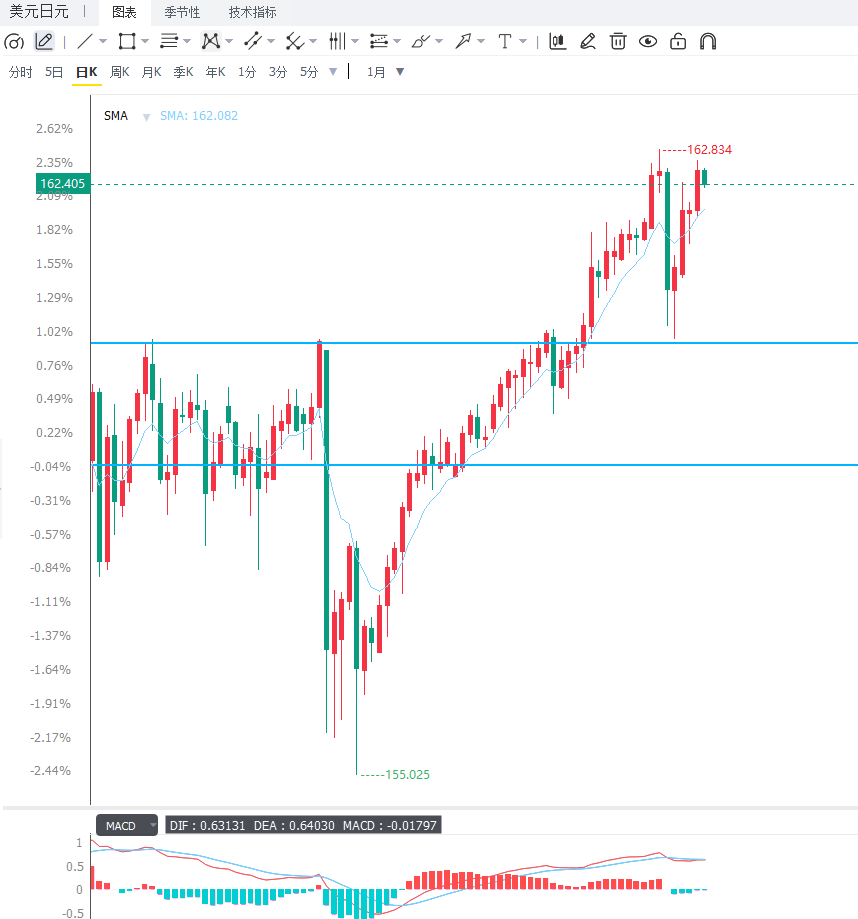
Editor's Summary : The core contradiction in the recent high-level fluctuations of the USD/JPY exchange rate remains the interplay between the high US interest rate environment and expectations of Japanese government intervention. Although the Japanese government has continuously strengthened its warnings about exchange rate volatility and signaled possible action, the overall advantage of the US dollar has not significantly weakened given the still high US-Japan interest rate differential. In the short term, US employment data, Federal Reserve policy expectations, and the Japanese authorities' attitude towards the foreign exchange market will continue to dominate market trends. Investors need to pay close attention to the amplified volatility effect of potential intervention risks, while also being wary of the impact of geopolitical factors on global risk aversion and demand for the US dollar.
The recent sustained trading of the USD/JPY exchange rate near multi-decade highs has drawn significant attention from the Japanese government and market participants. As the exchange rate has approached and repeatedly held above the 162 level , Japanese officials have become increasingly wary of a rapid depreciation of the yen. On Wednesday, May, Japanese Finance Minister Katayama stated that the Japanese government is maintaining close communication with the United States regarding foreign exchange market issues and will take appropriate action to address abnormal market fluctuations if necessary. This statement was interpreted by the market as another signal of government intervention, prompting some investors to reduce their long USD/JPY positions.
Market participants believe that the yen's current exchange rate has gradually deviated from Japan's economic fundamentals. Michael Nizadeh, head of multi-asset management at Edmond de Rothschild Asset Management in France, stated that the current yen depreciation is excessive and fails to accurately reflect the state of the Japanese economy. If the exchange rate imbalance widens further, the possibility of coordinated action by major central banks to stabilize the market cannot be ruled out.
In fact, the Bank of Japan raised its policy rate to 1.00% in June, signaling further tightening of monetary policy. However, due to the significant interest rate differential between the US and Japan, funds continue to flow into dollar assets, keeping the yen generally weak. Regarding the dollar, the minutes of the Federal Reserve's June monetary policy meeting, recently released, have also become a focus of market attention. This was the first Federal Open Market Committee meeting chaired by Fed Chairman Kevin Warsh since taking office. The minutes revealed significant disagreement among policymakers regarding future inflation trends and the interest rate outlook.
The minutes show that some officials believe the federal funds rate may remain at or slightly below its current level of around 3.60% by the end of the year , reflecting concerns among some members about the risks of slowing economic growth and a cooling job market. However, a significant number of officials believe that the rate may be higher by the end of the year , due to the potential for escalating tensions in the Middle East and rising energy prices to reignite inflationary pressures.
The escalating conflict between the US and Iran has kept international oil prices high, significantly increasing market uncertainty regarding future inflation trends. Against this backdrop, the Federal Reserve lacks a clear policy direction in the short term, and the market remains cautiously cautious about the future path of interest rates. Furthermore, investors are awaiting the upcoming release of US initial jobless claims data. The previously released June non-farm payrolls figure was only 57,000 , lower than market expectations, indicating that the US job market is gradually cooling. If initial jobless claims continue to rise this week, it could further weaken the dollar's performance; conversely, if the data remains robust, it is expected to continue to provide support for the dollar.
From a market structure perspective, the USD/JPY exchange rate is currently influenced by two main factors. Firstly, the Japanese government's warnings about exchange rate volatility have increased market concerns about intervention. Secondly, US interest rates remain significantly higher than Japanese rates, and demand for carry trades continues to support the dollar. The interplay of these two forces is keeping the exchange rate oscillating at a high level.
From a daily chart perspective, the USD/JPY pair remains within a clear upward channel, with the price consistently trading above major moving averages. The MACD maintains a golden cross structure, and the momentum bars remain in positive territory , indicating that the medium- to long-term bullish trend has not fundamentally changed. However, as the exchange rate approaches historical highs, the frequency of verbal intervention by the Japanese government has increased significantly, and the market remains wary of policy risks. Key resistance levels to watch are 163.50 and 165.00 ; key support levels are 160.80 and 159.20 .
From a 4-hour chart perspective, the exchange rate has experienced a technical pullback from recent highs, with short-term momentum cooling somewhat. The MACD has formed a death cross above the zero line, and the red momentum bars are continuing to shrink , indicating increasing short-term profit-taking pressure. If it breaks below the 160.80 support level, it may further test the 159.20 area; however, if US economic data continues to be resilient and Japan does not take substantial intervention measures, USD/JPY may still retest 163.50 or even higher.
Editor's Summary : The core contradiction in the recent high-level fluctuations of the USD/JPY exchange rate remains the interplay between the high US interest rate environment and expectations of Japanese government intervention. Although the Japanese government has continuously strengthened its warnings about exchange rate volatility and signaled possible action, the overall advantage of the US dollar has not significantly weakened given the still high US-Japan interest rate differential. In the short term, US employment data, Federal Reserve policy expectations, and the Japanese authorities' attitude towards the foreign exchange market will continue to dominate market trends. Investors need to pay close attention to the amplified volatility effect of potential intervention risks, while also being wary of the impact of geopolitical factors on global risk aversion and demand for the US dollar.
- Risk Warning and Disclaimer
- The market involves risk, and trading may not be suitable for all investors. This article is for reference only and does not constitute personal investment advice, nor does it take into account certain users’ specific investment objectives, financial situation, or other needs. Any investment decisions made based on this information are at your own risk.