Rising expectations of Japanese intervention coupled with a weakening dollar caused the USD/JPY pair to fall below the 162 level, maintaining a high level of fluctuation.
2026-07-10 11:16:52
The US dollar fell sharply against the Japanese yen in early Asian trading on Friday, breaking below the 162.00 level, as the market reassessed the risks of Japanese government intervention in the exchange rate, the dollar's performance, and the impact of global risk aversion on the yen.

The recent continued weakness of the yen has drawn attention from Japanese policymakers, and the market has begun to increase expectations that the government may take measures to stabilize the yen. With the USD/JPY pair near multi-year highs, traders remain highly vigilant about the risk of potential intervention, which has become a significant factor driving the short-term yen rebound.
Meanwhile, the recent weakening of the US dollar index has also increased downward pressure on USD/JPY. The latest minutes of the Federal Reserve meeting revealed a clear division among policymakers regarding the future direction of interest rates. Some officials favored a gradual reduction in interest rates, while others remained concerned about inflation risks and believed that maintaining higher interest rates was necessary.
As a result, the dollar index fell to near its lowest level this week. However, the market remains cautious about the Fed's future policies, with current market pricing indicating a roughly 65% probability of a rate adjustment in September , meaning the dollar still has some support. Furthermore, escalating global geopolitical risks may also drive safe-haven flows into the dollar, thus limiting further declines in the dollar against the yen.
The situation in the Middle East remains a significant factor influencing the foreign exchange market. Recent tensions between the US and Iran have led to market concerns about potential disruptions to energy supplies, particularly the shipping risks through the Strait of Hormuz, which could exacerbate volatility in crude oil prices. Given Japan's heavy reliance on Middle Eastern energy supplies— with over 90% of its crude oil imports coming from the region —rising energy prices could increase pressure on the Japanese economy and impact the yen's performance.
Furthermore, the interest rate differential between Japan and the United States remains a significant factor influencing the exchange rate. Despite the Bank of Japan's gradual adjustments to monetary policy, Japan's financing costs remain significantly lower than those of major economies like the United States, and arbitrage trading demand persists. This makes investors hesitant to confirm that the USD/JPY exchange rate has formed a long-term top. From a market sentiment perspective, USD/JPY is currently in a tug-of-war between policy risk and interest rate differential logic. On one hand, expectations of Japanese intervention and a weakening dollar are driving exchange rate adjustments; on the other hand, the USD/JPY interest rate differential, safe-haven demand, and energy risks may still provide support for the dollar.
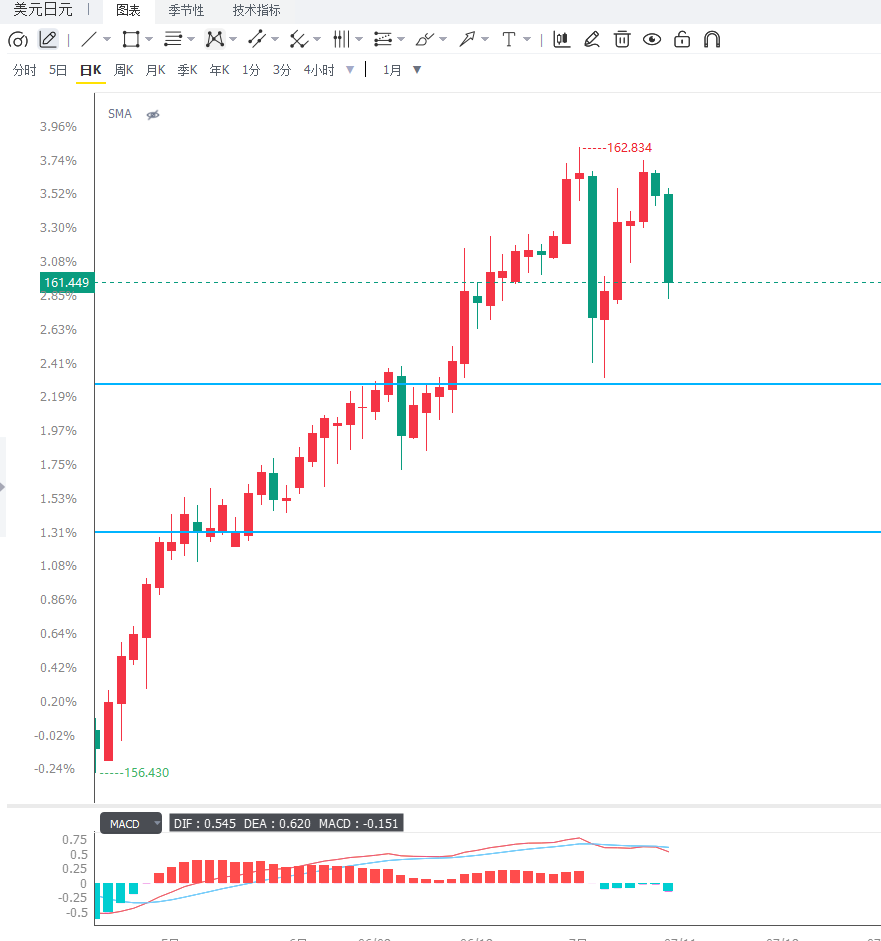
From a daily chart perspective, USD/JPY has recently pulled back from its highs, with short-term pressure increasing after the price broke below 162.00. The daily moving average structure indicates that the exchange rate remains in a long-term uptrend, but short-term momentum has weakened. Resistance is seen in the 162.50-163.00 area; a break above this area could lead to a retest of the 164.00 level. Support is seen at 161.00 and the psychological level of 160.00; a break below 160.00 could lead to a further decline to the 158.50 area. The MACD indicator shows declining bullish momentum, suggesting the market has entered a high-level consolidation phase.
From a 4-hour chart perspective, USD/JPY is showing a short-term downward trend, with the price trading below short-term moving averages, indicating increased selling pressure. The RSI indicator has retreated from its highs, reflecting a cooling of short-term buying interest. However, the current decline has not completely altered the medium-term trend. If support around 160.00 holds, the exchange rate may regain upward momentum. Short-term focus will be on the US dollar's performance, Japanese policy signals, and subsequent statements from Federal Reserve officials.
Editor's Summary
The recent pullback in USD/JPY was mainly driven by rising expectations of Japanese intervention and a weakening US dollar, but the USD/JPY interest rate differential remains a key factor supporting the exchange rate. The Bank of Japan's policy normalization process and changes in US interest rate expectations will continue to determine the medium-term direction. In the short term, if the US dollar remains weak while the Japanese government signals a desire to stabilize the exchange rate, USD/JPY may further test the 160 level. However, if escalating geopolitical risks drive a resurgence in demand for the US dollar as a safe haven, or if the Federal Reserve maintains a tight policy stance, USD/JPY may regain upward momentum. The market should pay close attention to the risks of policy intervention, changes in energy prices, and adjustments in the USD/JPY interest rate differential.
The recent continued weakness of the yen has drawn attention from Japanese policymakers, and the market has begun to increase expectations that the government may take measures to stabilize the yen. With the USD/JPY pair near multi-year highs, traders remain highly vigilant about the risk of potential intervention, which has become a significant factor driving the short-term yen rebound.
Meanwhile, the recent weakening of the US dollar index has also increased downward pressure on USD/JPY. The latest minutes of the Federal Reserve meeting revealed a clear division among policymakers regarding the future direction of interest rates. Some officials favored a gradual reduction in interest rates, while others remained concerned about inflation risks and believed that maintaining higher interest rates was necessary.
As a result, the dollar index fell to near its lowest level this week. However, the market remains cautious about the Fed's future policies, with current market pricing indicating a roughly 65% probability of a rate adjustment in September , meaning the dollar still has some support. Furthermore, escalating global geopolitical risks may also drive safe-haven flows into the dollar, thus limiting further declines in the dollar against the yen.
The situation in the Middle East remains a significant factor influencing the foreign exchange market. Recent tensions between the US and Iran have led to market concerns about potential disruptions to energy supplies, particularly the shipping risks through the Strait of Hormuz, which could exacerbate volatility in crude oil prices. Given Japan's heavy reliance on Middle Eastern energy supplies— with over 90% of its crude oil imports coming from the region —rising energy prices could increase pressure on the Japanese economy and impact the yen's performance.
Furthermore, the interest rate differential between Japan and the United States remains a significant factor influencing the exchange rate. Despite the Bank of Japan's gradual adjustments to monetary policy, Japan's financing costs remain significantly lower than those of major economies like the United States, and arbitrage trading demand persists. This makes investors hesitant to confirm that the USD/JPY exchange rate has formed a long-term top. From a market sentiment perspective, USD/JPY is currently in a tug-of-war between policy risk and interest rate differential logic. On one hand, expectations of Japanese intervention and a weakening dollar are driving exchange rate adjustments; on the other hand, the USD/JPY interest rate differential, safe-haven demand, and energy risks may still provide support for the dollar.
From a daily chart perspective, USD/JPY has recently pulled back from its highs, with short-term pressure increasing after the price broke below 162.00. The daily moving average structure indicates that the exchange rate remains in a long-term uptrend, but short-term momentum has weakened. Resistance is seen in the 162.50-163.00 area; a break above this area could lead to a retest of the 164.00 level. Support is seen at 161.00 and the psychological level of 160.00; a break below 160.00 could lead to a further decline to the 158.50 area. The MACD indicator shows declining bullish momentum, suggesting the market has entered a high-level consolidation phase.
From a 4-hour chart perspective, USD/JPY is showing a short-term downward trend, with the price trading below short-term moving averages, indicating increased selling pressure. The RSI indicator has retreated from its highs, reflecting a cooling of short-term buying interest. However, the current decline has not completely altered the medium-term trend. If support around 160.00 holds, the exchange rate may regain upward momentum. Short-term focus will be on the US dollar's performance, Japanese policy signals, and subsequent statements from Federal Reserve officials.
Editor's Summary
The recent pullback in USD/JPY was mainly driven by rising expectations of Japanese intervention and a weakening US dollar, but the USD/JPY interest rate differential remains a key factor supporting the exchange rate. The Bank of Japan's policy normalization process and changes in US interest rate expectations will continue to determine the medium-term direction. In the short term, if the US dollar remains weak while the Japanese government signals a desire to stabilize the exchange rate, USD/JPY may further test the 160 level. However, if escalating geopolitical risks drive a resurgence in demand for the US dollar as a safe haven, or if the Federal Reserve maintains a tight policy stance, USD/JPY may regain upward momentum. The market should pay close attention to the risks of policy intervention, changes in energy prices, and adjustments in the USD/JPY interest rate differential.
- Risk Warning and Disclaimer
- The market involves risk, and trading may not be suitable for all investors. This article is for reference only and does not constitute personal investment advice, nor does it take into account certain users’ specific investment objectives, financial situation, or other needs. Any investment decisions made based on this information are at your own risk.