With a supply of 4.1 million barrels per day returning, why is the oil market still hesitant to relax?
2026-07-10 18:36:36
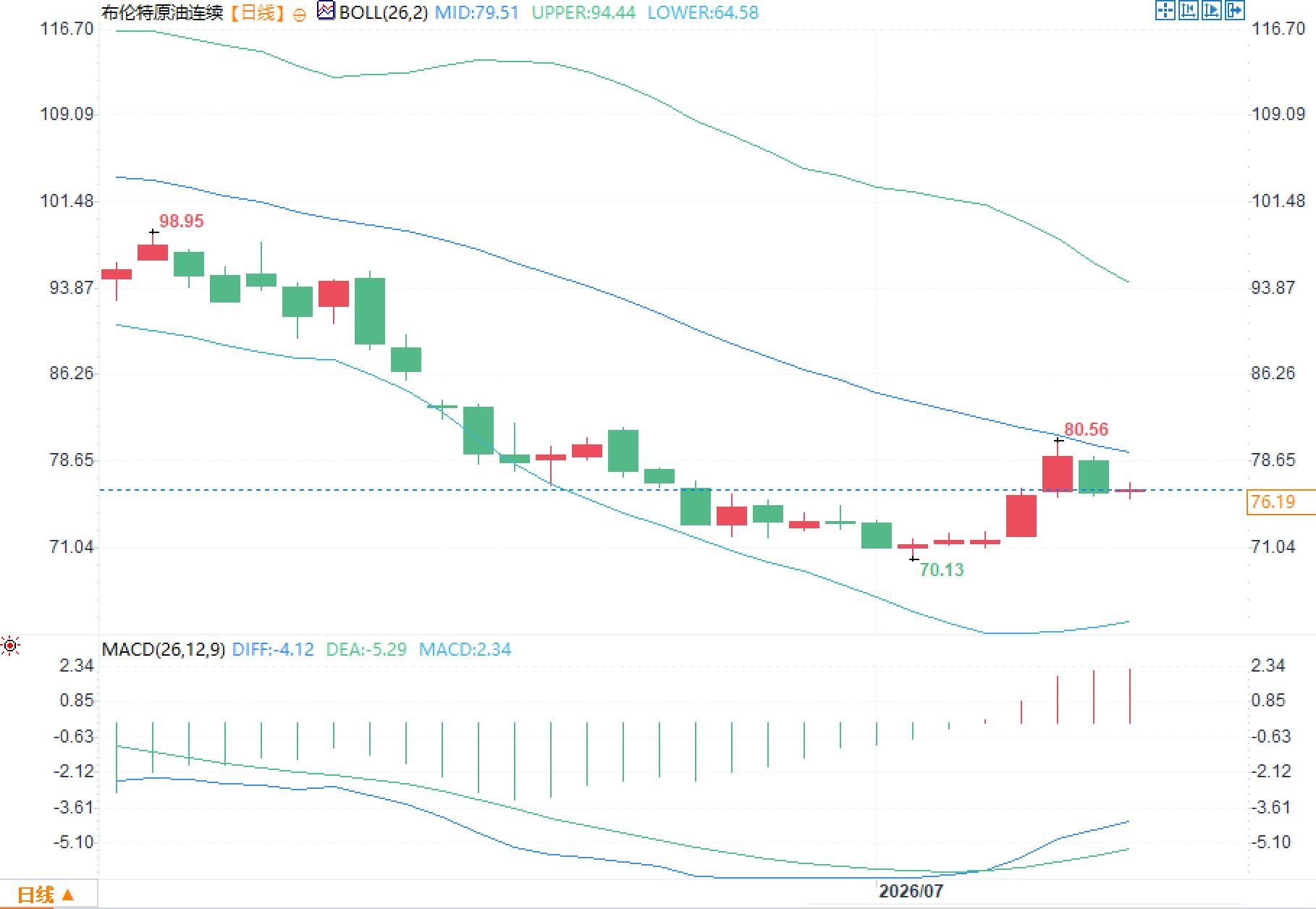
On Friday, July 10th, the main theme in the crude oil market was not simply price stabilization, but rather the repricing between expectations of supply recovery and risks associated with the Strait of Hormuz crossings. Brent crude is currently trading around $76 per barrel, with little intraday volatility, but it has still fallen 15.8% over the past month. The daily chart shows that Brent rebounded from a low of $70.13 to $80.56 before falling back to around $76, with the price still below the Bollinger Middle Band at $79.51, indicating short-term volatility rather than trend confirmation.

The core contradiction in current oil prices lies in the fact that traders are not lacking in imagination regarding conflict risks, but are more concerned about whether actual logistics are being continuously disrupted. Ship tracking information shows that on the morning of July 9, only two oil tankers passed through the Strait of Hormuz, indicating a significant slowdown in traffic. Subsequently, some LNG and oil tanker-related vessels resumed passage, indicating that the logistics system is still operating tentatively. In other words, the market is not pricing in a "complete shutdown," but rather in "increased passage discounts."
This explains why Brent crude still saw a nearly 6% increase this week, but failed to return to its previous highs. If the Straits Exchange Foundation's passage is only intermittently slowed, oil prices are more likely to reflect a stronger near-month contract and a relatively restrained far-month contract; however, if the passage risk spreads further, it will affect not only spot crude oil but also freight rates, insurance, refinery purchasing schedules, and refined product exports. In other words, the current seemingly calm market is actually pricing in logistical uncertainty.
The International Energy Agency's July report showed that global oil supply increased by 4.1 million barrels per day to 98.8 million barrels per day in June, but remained 9.4 million barrels per day lower than pre-conflict levels. If traffic continues to improve, supply could increase by 7.5 million barrels per day next year. The problem is that this forecast is highly dependent on Strait of Hormuz traffic and the resumption of regional facilities; any new conflict could delay the pace of inventory recovery.
More importantly, global watchable oil inventories rose by 21 million barrels in June for the first time in four months, but this was mainly due to an increase of 117 million barrels in offshore oil production, while onshore inventories still decreased by about 96 million barrels. OECD inventories continued to decline by 62 million barrels in June, of which about 44 million barrels came from government reserve releases. This means that what the market is seeing is "oil on the way," not "oil safely stored in storage tanks."
Weekly data from the U.S. Energy Information Administration also suggests that inventory quality is not ample. For the week ending July 3, U.S. commercial crude oil inventories increased by 3 million barrels to 411.4 million barrels, but remained about 6% below the five-year average for the same period; distillate fuel inventories decreased by 5 million barrels, about 12% below the five-year average for the same period. More importantly for traders, this data indicates that the slight replenishment of crude oil inventories has not relieved constraints on refined product inventories.
This round of market movements cannot be judged solely by the absolute price of Brent crude. The International Energy Agency stated that in early July, refined product crack spreads and refining margins rose to four-year highs due to increased crude oil supply putting downward pressure on crude oil prices, but the markets for products such as gasoline and diesel remained tight. Global refinery throughput increased by 1.5 million barrels per day in June, but was still 6 million barrels per day lower year-on-year. Full-year refinery throughput is projected to decline by 2.4 million barrels per day, and may not recover to 3.1 million barrels per day until 2027.
This explains a seemingly contradictory market situation: crude oil prices have fallen from their highs, but the product side has not eased in tandem. Export-oriented refineries have not fully recovered, refinery operations in some regions are constrained, and the recovery of transportation routes and product shipments is slower than that of crude oil loading. If crude oil prices only reflect "supply recovery," while crack spreads reflect "product shortages," this divergence will change the cross-commodity spread structure. Currently, the real tightness lies in deliverable products, not in the paper-based forward crude oil supply.
The UAE is one of the most noteworthy variables in this round of supply-side changes. Public data shows that its crude oil production in June rose to over 3.8 million barrels per day, a more than six-year high. Previously, the International Energy Agency also predicted that the UAE's total oil product production could reach 5.2 million barrels per day in 2027, an increase of 730,000 barrels per day from the previous year. Its current crude oil production capacity is close to 4.4 million barrels per day, with an additional 1.1 million barrels per day of condensate and natural gas liquids production capacity.
This means that future oil prices will depend not only on conflict risks but also on whether low-cost oil-producing countries can convert spare capacity into exports more quickly. If cross-strait traffic resumes, the market will again face year-end supply replenishment pressure. The U.S. Energy Information Administration's July outlook also predicts that global inventories may still decline by 2.2 million barrels per day in the third quarter, but may increase by 2.7 million barrels per day in the fourth quarter and by 5 million barrels per day by 2027, thus putting pressure on oil prices.
Short-term pricing: Risks in the Taiwan Strait are resurfacing, but have not yet spiraled out of control.
The core contradiction in current oil prices lies in the fact that traders are not lacking in imagination regarding conflict risks, but are more concerned about whether actual logistics are being continuously disrupted. Ship tracking information shows that on the morning of July 9, only two oil tankers passed through the Strait of Hormuz, indicating a significant slowdown in traffic. Subsequently, some LNG and oil tanker-related vessels resumed passage, indicating that the logistics system is still operating tentatively. In other words, the market is not pricing in a "complete shutdown," but rather in "increased passage discounts."
This explains why Brent crude still saw a nearly 6% increase this week, but failed to return to its previous highs. If the Straits Exchange Foundation's passage is only intermittently slowed, oil prices are more likely to reflect a stronger near-month contract and a relatively restrained far-month contract; however, if the passage risk spreads further, it will affect not only spot crude oil but also freight rates, insurance, refinery purchasing schedules, and refined product exports. In other words, the current seemingly calm market is actually pricing in logistical uncertainty.
Inventory recovery remains fragile: supply recovery does not equate to inventory safety.
The International Energy Agency's July report showed that global oil supply increased by 4.1 million barrels per day to 98.8 million barrels per day in June, but remained 9.4 million barrels per day lower than pre-conflict levels. If traffic continues to improve, supply could increase by 7.5 million barrels per day next year. The problem is that this forecast is highly dependent on Strait of Hormuz traffic and the resumption of regional facilities; any new conflict could delay the pace of inventory recovery.
More importantly, global watchable oil inventories rose by 21 million barrels in June for the first time in four months, but this was mainly due to an increase of 117 million barrels in offshore oil production, while onshore inventories still decreased by about 96 million barrels. OECD inventories continued to decline by 62 million barrels in June, of which about 44 million barrels came from government reserve releases. This means that what the market is seeing is "oil on the way," not "oil safely stored in storage tanks."
Weekly data from the U.S. Energy Information Administration also suggests that inventory quality is not ample. For the week ending July 3, U.S. commercial crude oil inventories increased by 3 million barrels to 411.4 million barrels, but remained about 6% below the five-year average for the same period; distillate fuel inventories decreased by 5 million barrels, about 12% below the five-year average for the same period. More importantly for traders, this data indicates that the slight replenishment of crude oil inventories has not relieved constraints on refined product inventories.
Refined oil products are tighter than crude oil: Cracking margins reflect the real bottleneck.
This round of market movements cannot be judged solely by the absolute price of Brent crude. The International Energy Agency stated that in early July, refined product crack spreads and refining margins rose to four-year highs due to increased crude oil supply putting downward pressure on crude oil prices, but the markets for products such as gasoline and diesel remained tight. Global refinery throughput increased by 1.5 million barrels per day in June, but was still 6 million barrels per day lower year-on-year. Full-year refinery throughput is projected to decline by 2.4 million barrels per day, and may not recover to 3.1 million barrels per day until 2027.
This explains a seemingly contradictory market situation: crude oil prices have fallen from their highs, but the product side has not eased in tandem. Export-oriented refineries have not fully recovered, refinery operations in some regions are constrained, and the recovery of transportation routes and product shipments is slower than that of crude oil loading. If crude oil prices only reflect "supply recovery," while crack spreads reflect "product shortages," this divergence will change the cross-commodity spread structure. Currently, the real tightness lies in deliverable products, not in the paper-based forward crude oil supply.
Supply-side divergence: Gulf production recovery and marginal competition occur simultaneously.
The UAE is one of the most noteworthy variables in this round of supply-side changes. Public data shows that its crude oil production in June rose to over 3.8 million barrels per day, a more than six-year high. Previously, the International Energy Agency also predicted that the UAE's total oil product production could reach 5.2 million barrels per day in 2027, an increase of 730,000 barrels per day from the previous year. Its current crude oil production capacity is close to 4.4 million barrels per day, with an additional 1.1 million barrels per day of condensate and natural gas liquids production capacity.
This means that future oil prices will depend not only on conflict risks but also on whether low-cost oil-producing countries can convert spare capacity into exports more quickly. If cross-strait traffic resumes, the market will again face year-end supply replenishment pressure. The U.S. Energy Information Administration's July outlook also predicts that global inventories may still decline by 2.2 million barrels per day in the third quarter, but may increase by 2.7 million barrels per day in the fourth quarter and by 5 million barrels per day by 2027, thus putting pressure on oil prices.
- Risk Warning and Disclaimer
- The market involves risk, and trading may not be suitable for all investors. This article is for reference only and does not constitute personal investment advice, nor does it take into account certain users’ specific investment objectives, financial situation, or other needs. Any investment decisions made based on this information are at your own risk.