Escalating concerns about Japanese energy have pushed the USD/JPY pair back above the 162 level, maintaining its high level.
2026-07-13 13:32:43
On Monday during Asian trading hours, the USD/JPY pair continued its rebound from the end of last week, breaking through the 162.00 level again and shaking off the previous downward pressure around 161.30 . The market focus remains on the escalating tensions in the Middle East and the impact of the divergence in US-Japan monetary policy on the exchange rate.

The United States launched another round of military strikes against Iran over the weekend, after Iran announced the closure of the Strait of Hormuz and subsequently launched missile attacks on U.S. military facilities in the Gulf region. This escalation of military confrontation has further exacerbated uncertainty in the global energy market and kept international oil prices high.
For Japan, changes in the Middle East situation have a significant impact. Japan relies on the Strait of Hormuz for over 90% of its crude oil imports . Prolonged disruptions to the strait could not only drive up Japan's energy costs but also further increase production pressures on businesses and burden consumer spending, thus dragging down economic growth prospects. This concern has weakened market demand for the yen and driven funds towards safe-haven assets such as the US dollar.
Meanwhile, the divergence in monetary policy between the US and Japan remains a core factor influencing exchange rate movements. The market currently expects the Federal Reserve to maintain its benchmark interest rate range of 3.50%-3.75% in July, while the Bank of Japan, although raising its policy rate to 1.0% in June—the highest level since 1995—still maintains an interest rate differential of approximately 250 to 275 basis points between the US and Japan. This keeps carry trades involving yen-backed purchases of high-yield assets active, exerting sustained pressure on the yen.
Furthermore, rising international oil prices have reignited market concerns about global inflation. Investors expect that rising energy prices may slow the decline in US inflation, thereby increasing the likelihood that the Federal Reserve will maintain its high-interest-rate policy. The market has already re-priced in the expectation of at least one more rate hike by the Fed in 2026, which further supports the dollar's performance.
However, yen bears are not entirely without concerns. As the USD/JPY exchange rate continues to approach multi-year highs, market concerns have clearly intensified regarding potential intervention in the foreign exchange market by the Japanese government and the Bank of Japan. Japanese authorities have intervened on numerous occasions in the past when the exchange rate depreciated sharply, thus this factor has limited further upside potential for the USD/JPY.
This week, market focus will shift to the US June Consumer Price Index (CPI) data and Federal Reserve Chairman Kevin Warsh's testimony before Congress. If US inflation is stronger than expected, market expectations for the Fed to maintain high interest rates may further intensify, thus pushing the dollar higher. Conversely, if inflation data is weaker, it may ease upward pressure on the dollar and provide some breathing room for the yen.
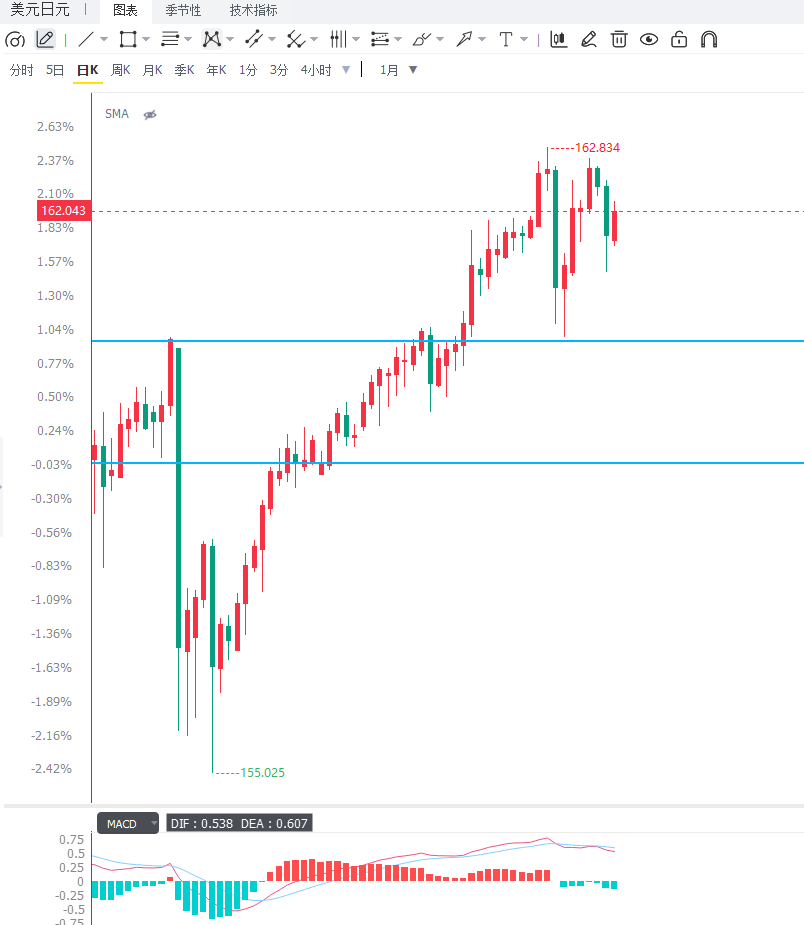
From a technical perspective, the USD/JPY pair maintains a clear upward trend on the daily chart, with the price regaining its position above major moving averages, indicating that the bullish structure remains dominant. The MACD indicator remains above the zero line, with the red bars continuing to expand, showing that the market's upward momentum has strengthened. The RSI is near the high zone, indicating that the bullish force remains strong, but also suggesting some overbought risk in the short term. If the exchange rate breaks through 162.50 , it is expected to further test the 163.50 and 164.80 areas; on the downside, key support areas to watch are 161.30 , 160.50 , and 159.80 .
From a 4-hour chart perspective, USD/JPY has returned to trading above its short-term moving averages, the MACD has formed a golden cross and continues to diverge upwards, and the RSI has risen above 60, indicating that short-term buying power has regained the upper hand. If US inflation data continues to support the dollar, the exchange rate is expected to further challenge the resistance above 162.50; however, given that expectations of official Japanese intervention still exist, the exchange rate may also experience a significant pullback should policy signals or market sentiment shift occur.
Editor's Summary : The recent USD/JPY exchange rate movement has been primarily driven by geopolitical risks, the USD/JPY interest rate differential, and changes in the energy market. Rising shipping risks in the Strait of Hormuz pose a challenge to Japan's heavy reliance on energy imports, while the persistently high interest rate differential continues to weaken the yen's attractiveness . Meanwhile, rising US inflation expectations and safe-haven inflows further strengthen the dollar's advantage. Looking ahead, the US June CPI data, Federal Reserve policy expectations, and potential foreign exchange market intervention by Japanese authorities will be key factors determining the next phase of the USD/JPY exchange rate movement.
The United States launched another round of military strikes against Iran over the weekend, after Iran announced the closure of the Strait of Hormuz and subsequently launched missile attacks on U.S. military facilities in the Gulf region. This escalation of military confrontation has further exacerbated uncertainty in the global energy market and kept international oil prices high.
For Japan, changes in the Middle East situation have a significant impact. Japan relies on the Strait of Hormuz for over 90% of its crude oil imports . Prolonged disruptions to the strait could not only drive up Japan's energy costs but also further increase production pressures on businesses and burden consumer spending, thus dragging down economic growth prospects. This concern has weakened market demand for the yen and driven funds towards safe-haven assets such as the US dollar.
Meanwhile, the divergence in monetary policy between the US and Japan remains a core factor influencing exchange rate movements. The market currently expects the Federal Reserve to maintain its benchmark interest rate range of 3.50%-3.75% in July, while the Bank of Japan, although raising its policy rate to 1.0% in June—the highest level since 1995—still maintains an interest rate differential of approximately 250 to 275 basis points between the US and Japan. This keeps carry trades involving yen-backed purchases of high-yield assets active, exerting sustained pressure on the yen.
Furthermore, rising international oil prices have reignited market concerns about global inflation. Investors expect that rising energy prices may slow the decline in US inflation, thereby increasing the likelihood that the Federal Reserve will maintain its high-interest-rate policy. The market has already re-priced in the expectation of at least one more rate hike by the Fed in 2026, which further supports the dollar's performance.
However, yen bears are not entirely without concerns. As the USD/JPY exchange rate continues to approach multi-year highs, market concerns have clearly intensified regarding potential intervention in the foreign exchange market by the Japanese government and the Bank of Japan. Japanese authorities have intervened on numerous occasions in the past when the exchange rate depreciated sharply, thus this factor has limited further upside potential for the USD/JPY.
This week, market focus will shift to the US June Consumer Price Index (CPI) data and Federal Reserve Chairman Kevin Warsh's testimony before Congress. If US inflation is stronger than expected, market expectations for the Fed to maintain high interest rates may further intensify, thus pushing the dollar higher. Conversely, if inflation data is weaker, it may ease upward pressure on the dollar and provide some breathing room for the yen.
From a technical perspective, the USD/JPY pair maintains a clear upward trend on the daily chart, with the price regaining its position above major moving averages, indicating that the bullish structure remains dominant. The MACD indicator remains above the zero line, with the red bars continuing to expand, showing that the market's upward momentum has strengthened. The RSI is near the high zone, indicating that the bullish force remains strong, but also suggesting some overbought risk in the short term. If the exchange rate breaks through 162.50 , it is expected to further test the 163.50 and 164.80 areas; on the downside, key support areas to watch are 161.30 , 160.50 , and 159.80 .
From a 4-hour chart perspective, USD/JPY has returned to trading above its short-term moving averages, the MACD has formed a golden cross and continues to diverge upwards, and the RSI has risen above 60, indicating that short-term buying power has regained the upper hand. If US inflation data continues to support the dollar, the exchange rate is expected to further challenge the resistance above 162.50; however, given that expectations of official Japanese intervention still exist, the exchange rate may also experience a significant pullback should policy signals or market sentiment shift occur.
Editor's Summary : The recent USD/JPY exchange rate movement has been primarily driven by geopolitical risks, the USD/JPY interest rate differential, and changes in the energy market. Rising shipping risks in the Strait of Hormuz pose a challenge to Japan's heavy reliance on energy imports, while the persistently high interest rate differential continues to weaken the yen's attractiveness . Meanwhile, rising US inflation expectations and safe-haven inflows further strengthen the dollar's advantage. Looking ahead, the US June CPI data, Federal Reserve policy expectations, and potential foreign exchange market intervention by Japanese authorities will be key factors determining the next phase of the USD/JPY exchange rate movement.
- Risk Warning and Disclaimer
- The market involves risk, and trading may not be suitable for all investors. This article is for reference only and does not constitute personal investment advice, nor does it take into account certain users’ specific investment objectives, financial situation, or other needs. Any investment decisions made based on this information are at your own risk.