Escalating tensions in Iran push up US Treasury yields, while rising expectations of a September rate hike by the Federal Reserve support the dollar.
2026-07-13 15:42:56
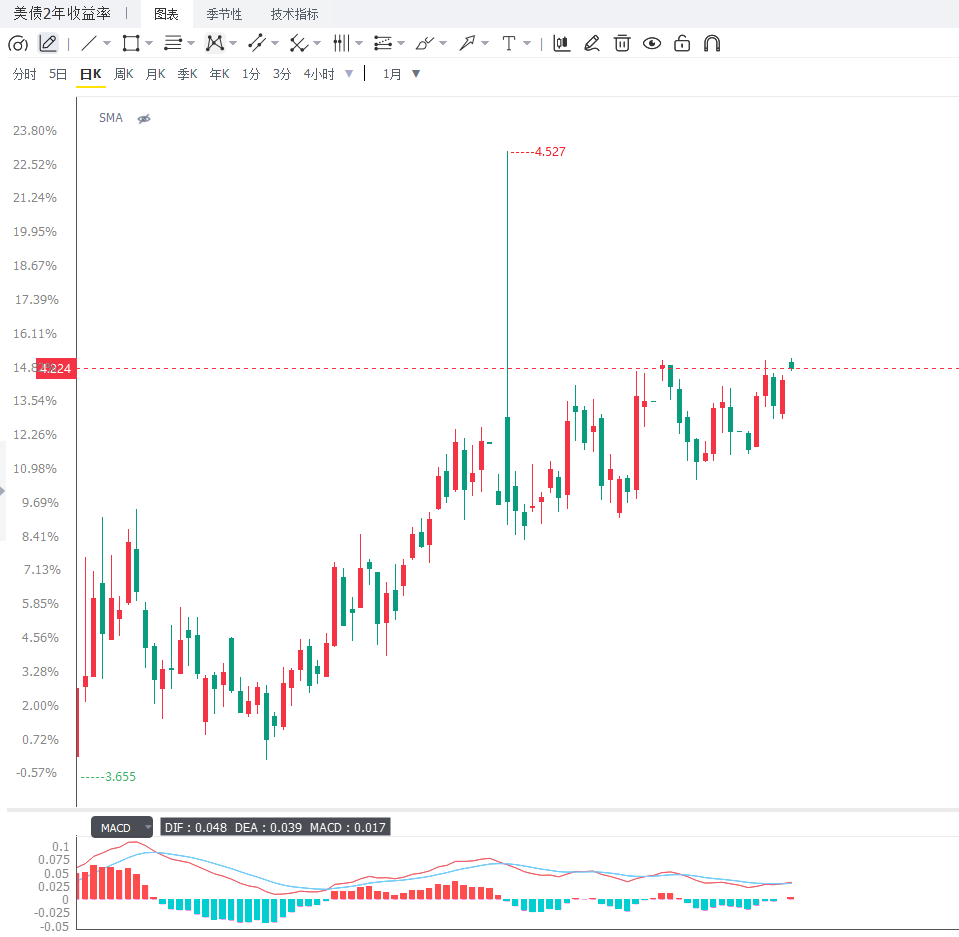
On Monday, global bond markets continued their downward trend, with U.S. Treasury yields rising across the board. As the military conflict between the U.S. and Iran escalated, international oil prices rose significantly, reigniting market concerns that rising energy prices could exacerbate inflationary pressures in the U.S., thus prompting investors to further escalate their expectations for the Federal Reserve to tighten monetary policy.  Data shows that the yield on the two-year US Treasury bond, which is most sensitive to monetary policy, rose to 4.24% at one point , up about 3 basis points from the previous trading day, reaching its highest level since February 2025. Meanwhile, the yield on the 10-year US Treasury bond rose to 4.59% , also up about 3 basis points, reflecting a continued upward shift in the overall market interest rate level. The recent situation in the Middle East has become a significant variable affecting global financial markets. Market surveys indicate that the continued military conflict between the US and Iran over the weekend has raised concerns about the impact on shipping safety in the Strait of Hormuz. The Strait of Hormuz handles approximately 20% of global seaborne crude oil transport ; continued disruptions to this transport will further push up international oil prices and increase global inflationary pressures. Rising international oil prices mean that energy, transportation, and manufacturing costs may rise simultaneously, leading to market concerns that previously easing inflationary pressures may rebound. Against this backdrop, investors are readjusting their assessments of the Federal Reserve's monetary policy path. The latest interest rate swap market data shows that the market has almost fully priced in a September rate hike by the Federal Reserve , compared to a 66% probability a week ago, reflecting a significant shift in investor expectations regarding future policy. The continued rise in US Treasury yields has further supported the dollar's performance. With short-term yields rising rapidly, dollar assets have become more attractive, and funds continue to flow into US Treasuries and the dollar, impacting global foreign exchange and commodity markets. For non-interest-bearing assets like gold, the high-yield environment increases holding costs, while providing strong support for currency pairs such as USD/JPY and USD/CAD. Market participants believe that the financial markets are now significantly more sensitive to the situation in the Middle East. Kenneth Crompton, head of interest rate strategy at National Australia Bank, stated that investors did not previously expect a return to the high levels of tension seen in March, but with the escalating military action over the weekend and renewed disruptions to energy infrastructure, market risk appetite has clearly declined, and investors are beginning to factor in more geopolitical risks. This week, the market focus will be on the US June Consumer Price Index (CPI) . If inflation data continues to exceed market expectations, it will further strengthen market bets on a Federal Reserve rate hike, potentially pushing up US Treasury yields and the US dollar. Conversely, if inflation slows significantly, it could alleviate market concerns about further policy tightening, pushing bond yields down and improving the performance of global risk assets. From a technical perspective, the US two-year Treasury yield broke through its previous consolidation range and continued to rise, maintaining a strong upward trend in the short term, indicating a continued adjustment in market expectations for monetary policy. The 10-year Treasury yield has also stabilized at a relatively high level, with the medium- to long-term yield curve generally rising, suggesting that market risk appetite remains cautious. In the short term, bond yields are expected to remain volatile at high levels before the release of US CPI data. If inflation continues to exceed expectations, yields may further reach new highs; if inflation cools, yields may experience a technical correction.
  Editor's Summary: The renewed rise in US Treasury yields reflects a market reassessment of the impact of geopolitical risks on global inflation and monetary policy. Escalating tensions in the Middle East have pushed up international oil prices, prompting investors to further increase their expectations for a September rate hike by the Federal Reserve, becoming a major driving force behind the recent strengthening of the US dollar and adjustments in the global bond market. Looking ahead, US June CPI data, statements from Federal Reserve officials, and developments in the Middle East will continue to dominate market sentiment. If energy prices continue to rise and inflation remains resilient, US Treasury yields and the US dollar are likely to remain strong, while global risk assets may continue to face some pressure.
Data shows that the yield on the two-year US Treasury bond, which is most sensitive to monetary policy, rose to 4.24% at one point , up about 3 basis points from the previous trading day, reaching its highest level since February 2025. Meanwhile, the yield on the 10-year US Treasury bond rose to 4.59% , also up about 3 basis points, reflecting a continued upward shift in the overall market interest rate level. The recent situation in the Middle East has become a significant variable affecting global financial markets. Market surveys indicate that the continued military conflict between the US and Iran over the weekend has raised concerns about the impact on shipping safety in the Strait of Hormuz. The Strait of Hormuz handles approximately 20% of global seaborne crude oil transport ; continued disruptions to this transport will further push up international oil prices and increase global inflationary pressures. Rising international oil prices mean that energy, transportation, and manufacturing costs may rise simultaneously, leading to market concerns that previously easing inflationary pressures may rebound. Against this backdrop, investors are readjusting their assessments of the Federal Reserve's monetary policy path. The latest interest rate swap market data shows that the market has almost fully priced in a September rate hike by the Federal Reserve , compared to a 66% probability a week ago, reflecting a significant shift in investor expectations regarding future policy. The continued rise in US Treasury yields has further supported the dollar's performance. With short-term yields rising rapidly, dollar assets have become more attractive, and funds continue to flow into US Treasuries and the dollar, impacting global foreign exchange and commodity markets. For non-interest-bearing assets like gold, the high-yield environment increases holding costs, while providing strong support for currency pairs such as USD/JPY and USD/CAD. Market participants believe that the financial markets are now significantly more sensitive to the situation in the Middle East. Kenneth Crompton, head of interest rate strategy at National Australia Bank, stated that investors did not previously expect a return to the high levels of tension seen in March, but with the escalating military action over the weekend and renewed disruptions to energy infrastructure, market risk appetite has clearly declined, and investors are beginning to factor in more geopolitical risks. This week, the market focus will be on the US June Consumer Price Index (CPI) . If inflation data continues to exceed market expectations, it will further strengthen market bets on a Federal Reserve rate hike, potentially pushing up US Treasury yields and the US dollar. Conversely, if inflation slows significantly, it could alleviate market concerns about further policy tightening, pushing bond yields down and improving the performance of global risk assets. From a technical perspective, the US two-year Treasury yield broke through its previous consolidation range and continued to rise, maintaining a strong upward trend in the short term, indicating a continued adjustment in market expectations for monetary policy. The 10-year Treasury yield has also stabilized at a relatively high level, with the medium- to long-term yield curve generally rising, suggesting that market risk appetite remains cautious. In the short term, bond yields are expected to remain volatile at high levels before the release of US CPI data. If inflation continues to exceed expectations, yields may further reach new highs; if inflation cools, yields may experience a technical correction. Editor's Summary: The renewed rise in US Treasury yields reflects a market reassessment of the impact of geopolitical risks on global inflation and monetary policy. Escalating tensions in the Middle East have pushed up international oil prices, prompting investors to further increase their expectations for a September rate hike by the Federal Reserve, becoming a major driving force behind the recent strengthening of the US dollar and adjustments in the global bond market. Looking ahead, US June CPI data, statements from Federal Reserve officials, and developments in the Middle East will continue to dominate market sentiment. If energy prices continue to rise and inflation remains resilient, US Treasury yields and the US dollar are likely to remain strong, while global risk assets may continue to face some pressure.
- Risk Warning and Disclaimer
- The market involves risk, and trading may not be suitable for all investors. This article is for reference only and does not constitute personal investment advice, nor does it take into account certain users’ specific investment objectives, financial situation, or other needs. Any investment decisions made based on this information are at your own risk.