Why did oil prices stall around $80 amid renewed Hormuz crisis?
2026-07-13 18:14:10
On Monday (July 13) in early European trading, the international crude oil market exhibited a typical pattern of weak upward momentum despite geopolitical gains. Brent crude hovered between $77 and $79 per barrel, while WTI crude remained stable with slight fluctuations between $73 and $75 per barrel. The core driver of this round of oil price rebound came from the escalation of geopolitical tensions in the Middle East. Iran officially announced the "closure" of the Strait of Hormuz, coupled with recent clashes between the US and Iran, leading to a rapid increase in geopolitical risk sentiment and pushing international oil prices up by nearly 5% last week, achieving a temporary strengthening.  Despite the strong geopolitical stimulus this time, oil prices have consistently failed to break through the $80 mark, a far cry from the highs of over $100 per barrel seen earlier this year during the peak of the Middle East conflict. This has only driven a short-term, rapid price increase, failing to achieve a sustained upward trend. Actual supply disruptions are limited, and the market lacks a basis for extreme shortages . Looking at navigation data from key shipping lanes, while the Strait of Hormuz's transport efficiency has declined significantly, a complete closure has not occurred. Data from the maritime information platform Shipfinder shows that the daily number of vessels navigating the strait has plummeted from the normal level of 100-140 to a low level. On July 12th, only 21-23 vessels navigated the strait, with some trading periods even seeing single-digit numbers, indicating a significant reduction in channel throughput. However, this sharp decline in traffic volume does not equate to a substantial, complete supply disruption; the actual supply gap is far smaller than the initial market panic expectations. On the one hand, under the coordination of the US military, the Strait of Hormuz retains limited navigation channels, and the US Central Command continues to emphasize the normalization of freedom of navigation operations to ensure the basic smooth flow of core energy transportation channels. On the other hand, Iran's recent "sea blockade" statement is more of a bargaining chip in geopolitical games, leaning towards strategic deterrence rather than a complete military blockade of the waterway, and has not taken comprehensive navigation ban measures. At the same time, the resilience of the global crude oil supply system has further offset the risk of waterway disturbances. Major oil-producing countries in the Gulf region have started compensatory production increases, and the actual export flow of regional crude oil has recovered to a high level close to pre-war levels, with the overall supply gap remaining at a manageable level of only one million barrels per day. Coupled with global commercial crude oil inventories being within a reasonable buffer zone, effectively absorbing short-term supply disturbances, the market generally believes that the worst-case scenario of "a long-term complete closure of the Strait and an extreme global crude oil shortage" has not materialized, significantly suppressing the space for panic premiums. Fundamentals and Macroeconomic Factors Exacerbate Pressures, with a Clear Upper Limit Compared to periodic geopolitical conflicts, the global oil supply and demand fundamentals and the macroeconomic and financial environment have exerted a stronger and more lasting downward pressure on oil prices, fundamentally limiting the current round of price increases. Weak demand remains a prominent feature, with domestic refining activities continuing to slow, the economic recovery pace weak, and insufficient support for end-user oil consumption. Simultaneously, the periodic rebound in oil prices has also triggered some demand suppression, with downstream procurement becoming more cautious, further weakening demand-side support. Expectations of supply easing continue to ferment, offsetting geopolitical gains. OPEC+ is steadily implementing its planned production increases, with capacity release proceeding in an orderly manner; US shale oil production remains stable, with continued incremental releases, and global oil supply reserves are generally ample. Multiple non-geopolitical factors have combined to create a generally loose supply and demand situation in the oil market. At the macroeconomic level, the continued strength of the US dollar has significantly suppressed the overall upward potential of commodities, and as a core commodity, oil's upward momentum remains limited. The latest July update to the US Energy Information Administration's Short-Term Energy Outlook further reinforced the market's accommodative expectations. The report explicitly predicts a gradual recovery in global crude oil supply and an accumulation cycle in market inventories. This medium- to long-term logic of ample supply and demand completely offsets the short-term bullish support from geopolitical conflicts. Investment banks are pricing risk rationally, with premiums remaining low . Currently, mainstream investment banks' crude oil pricing systems still primarily reference market judgments made after the signing of the US-Iran memorandum in mid-June. Regarding the escalation of geopolitical conflicts in July, institutions have not yet initiated large-scale, comprehensive upward revisions to their forecasts, indicating a generally rational and conservative risk pricing approach. Goldman Sachs lowered its Q4 Brent crude oil price forecast to $80/barrel in June, while predicting an average Brent crude oil price of $75/barrel in 2027. The core logic focuses on the steady recovery of global crude oil supply. Goldman Sachs also retained its extreme scenario, explicitly stating that if the Strait of Hormuz crisis becomes protracted and achieves a complete closure within 30 days, oil prices could receive an additional $10-15 geopolitical premium, leaving room for price increases, but this is not a baseline forecast. JPMorgan Chase's forecast is more conservative, predicting an average Brent crude oil price of around $60 per barrel for 2026. Their core assessment is that global oil supply growth will continue to outpace demand growth, highlighting a significant medium- to long-term risk of oversupply. Furthermore, several leading institutions, including Morgan Stanley and Citigroup, lowered their Q3 and Q4 oil price targets in late June, unanimously agreeing that the risk of oversupply in the oil market far outweighs the risk of sustained price increases due to geopolitical conflicts. Only Barclays maintained a relatively neutral to slightly higher price forecast, but continues to closely monitor global inventory changes, remaining cautious about a bullish market. Overall, institutional pricing reflects the market's baseline assumption of a "de-escalation," suggesting that the current escalation of conflict may only lead to a slight upward revision of expectations, with no consensus on a broad bullish outlook. The current geopolitical risk premium is stable in the low range of $4-8, without the extremely high premiums seen in a full-blown war, indicating a rational and restrained pricing system. Market Desensitization and Capital Flow Suppress Short-Term Gains Having weathered numerous Middle East geopolitical conflicts, the crude oil market has become significantly desensitized to related risk news. Capital flows have become more rational, completely moving away from the previous surges driven solely by geopolitical news. Before the current rally began, hedge funds and quantitative trading institutions had already completed large-scale profit-taking at previous oil price highs, resulting in a significant decline in long positions and insufficient buying power to sustain further price increases. From the derivatives market perspective, crude oil options volatility did not experience extreme spikes, indicating that the market did not price in extreme risk events, and investors' overall risk appetite remained stable. The typical "buy the rumor, sell the fact" market characteristic is evident: after geopolitical conflict news materialized, the short-term rally was quickly followed by profit-taking, further limiting the upside potential of oil prices and making the $80 mark a strong short-term resistance level.
 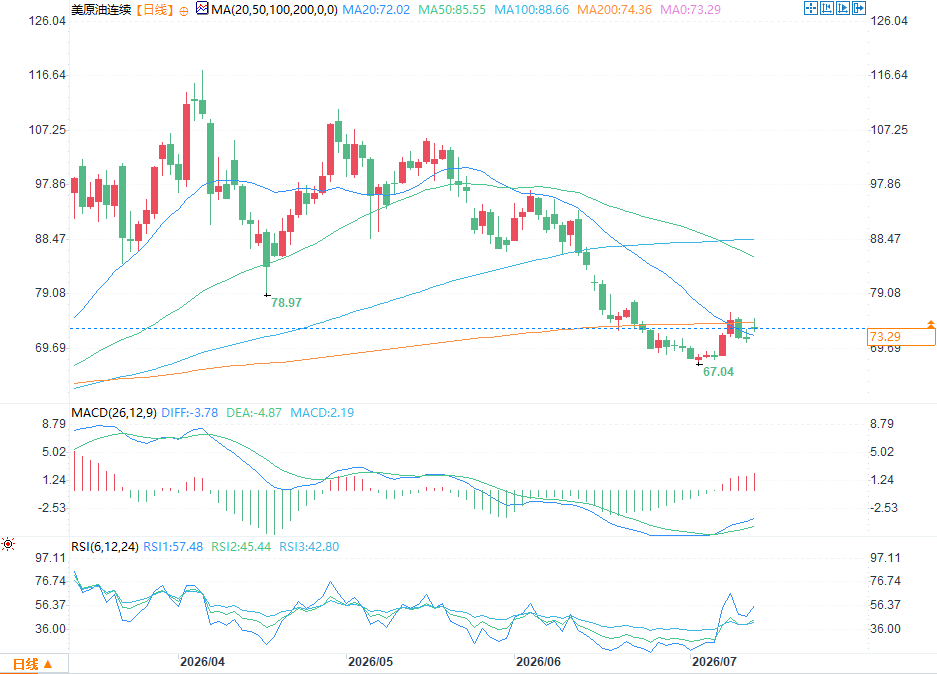 (WTI Crude Oil Daily Chart Source: EasyTrade) Key Variables to Watch Next The current oil market is experiencing intense competition between bulls and bears, with prices in a sensitive equilibrium of high volatility and low premiums. Future price movements will heavily depend on four core variables, as single geopolitical news can no longer dominate the market: First, daily navigation data in the Taiwan Strait. The actual number of ships passing through and the stability of navigation are core indicators for judging the true strength of supply disruptions. Compared to verbal statements from various parties, actual logistics data is more valuable. Second, the pace of compensatory production increases by oil-producing countries. Whether core Gulf oil-producing countries such as Saudi Arabia and the UAE can maintain high production output will directly determine the speed and extent to which the global supply gap is filled. Third, the window for US-Iran diplomatic negotiations. The current game between the two sides remains uncertain. The possibility and progress of restarting negotiations will directly affect the pace of cooling geopolitical risk sentiment. Market interpretations of this are divergent and require continuous monitoring. Fourth, the risk of escalating conflict. Currently, the conflict is mainly concentrated on shipping lane friction. If the situation escalates further, and the scope of the attack expands to core oil-producing facilities and crude oil export infrastructure, the geopolitical premium will expand rapidly and significantly, and oil prices are expected to break through the current range. Summary The current limited rise in the crude oil market is the result of multiple factors, including manageable supply disruptions, a relatively loose global supply and demand fundamentals, rational institutional risk pricing, and market desensitization. The $80 mark presents strong resistance in the short term. However, the current balance in the oil market is extremely fragile, with major institutions such as Goldman Sachs explicitly maintaining a bullish outlook. If the Strait of Hormuz experiences a prolonged and substantial blockade, or if geopolitical conflicts escalate, oil prices could quickly surge to $85-90 per barrel or even higher. For investors, it is crucial to abandon a trading logic solely reliant on geopolitical news and maintain a flexible trading approach. Focus should be placed on cross-validating the progress of the Strait of Hormuz's reopening, global crude oil inventory data, and changes in macroeconomic demand to accurately grasp the shifts between bullish and bearish trends in the oil market.
Despite the strong geopolitical stimulus this time, oil prices have consistently failed to break through the $80 mark, a far cry from the highs of over $100 per barrel seen earlier this year during the peak of the Middle East conflict. This has only driven a short-term, rapid price increase, failing to achieve a sustained upward trend. Actual supply disruptions are limited, and the market lacks a basis for extreme shortages . Looking at navigation data from key shipping lanes, while the Strait of Hormuz's transport efficiency has declined significantly, a complete closure has not occurred. Data from the maritime information platform Shipfinder shows that the daily number of vessels navigating the strait has plummeted from the normal level of 100-140 to a low level. On July 12th, only 21-23 vessels navigated the strait, with some trading periods even seeing single-digit numbers, indicating a significant reduction in channel throughput. However, this sharp decline in traffic volume does not equate to a substantial, complete supply disruption; the actual supply gap is far smaller than the initial market panic expectations. On the one hand, under the coordination of the US military, the Strait of Hormuz retains limited navigation channels, and the US Central Command continues to emphasize the normalization of freedom of navigation operations to ensure the basic smooth flow of core energy transportation channels. On the other hand, Iran's recent "sea blockade" statement is more of a bargaining chip in geopolitical games, leaning towards strategic deterrence rather than a complete military blockade of the waterway, and has not taken comprehensive navigation ban measures. At the same time, the resilience of the global crude oil supply system has further offset the risk of waterway disturbances. Major oil-producing countries in the Gulf region have started compensatory production increases, and the actual export flow of regional crude oil has recovered to a high level close to pre-war levels, with the overall supply gap remaining at a manageable level of only one million barrels per day. Coupled with global commercial crude oil inventories being within a reasonable buffer zone, effectively absorbing short-term supply disturbances, the market generally believes that the worst-case scenario of "a long-term complete closure of the Strait and an extreme global crude oil shortage" has not materialized, significantly suppressing the space for panic premiums. Fundamentals and Macroeconomic Factors Exacerbate Pressures, with a Clear Upper Limit Compared to periodic geopolitical conflicts, the global oil supply and demand fundamentals and the macroeconomic and financial environment have exerted a stronger and more lasting downward pressure on oil prices, fundamentally limiting the current round of price increases. Weak demand remains a prominent feature, with domestic refining activities continuing to slow, the economic recovery pace weak, and insufficient support for end-user oil consumption. Simultaneously, the periodic rebound in oil prices has also triggered some demand suppression, with downstream procurement becoming more cautious, further weakening demand-side support. Expectations of supply easing continue to ferment, offsetting geopolitical gains. OPEC+ is steadily implementing its planned production increases, with capacity release proceeding in an orderly manner; US shale oil production remains stable, with continued incremental releases, and global oil supply reserves are generally ample. Multiple non-geopolitical factors have combined to create a generally loose supply and demand situation in the oil market. At the macroeconomic level, the continued strength of the US dollar has significantly suppressed the overall upward potential of commodities, and as a core commodity, oil's upward momentum remains limited. The latest July update to the US Energy Information Administration's Short-Term Energy Outlook further reinforced the market's accommodative expectations. The report explicitly predicts a gradual recovery in global crude oil supply and an accumulation cycle in market inventories. This medium- to long-term logic of ample supply and demand completely offsets the short-term bullish support from geopolitical conflicts. Investment banks are pricing risk rationally, with premiums remaining low . Currently, mainstream investment banks' crude oil pricing systems still primarily reference market judgments made after the signing of the US-Iran memorandum in mid-June. Regarding the escalation of geopolitical conflicts in July, institutions have not yet initiated large-scale, comprehensive upward revisions to their forecasts, indicating a generally rational and conservative risk pricing approach. Goldman Sachs lowered its Q4 Brent crude oil price forecast to $80/barrel in June, while predicting an average Brent crude oil price of $75/barrel in 2027. The core logic focuses on the steady recovery of global crude oil supply. Goldman Sachs also retained its extreme scenario, explicitly stating that if the Strait of Hormuz crisis becomes protracted and achieves a complete closure within 30 days, oil prices could receive an additional $10-15 geopolitical premium, leaving room for price increases, but this is not a baseline forecast. JPMorgan Chase's forecast is more conservative, predicting an average Brent crude oil price of around $60 per barrel for 2026. Their core assessment is that global oil supply growth will continue to outpace demand growth, highlighting a significant medium- to long-term risk of oversupply. Furthermore, several leading institutions, including Morgan Stanley and Citigroup, lowered their Q3 and Q4 oil price targets in late June, unanimously agreeing that the risk of oversupply in the oil market far outweighs the risk of sustained price increases due to geopolitical conflicts. Only Barclays maintained a relatively neutral to slightly higher price forecast, but continues to closely monitor global inventory changes, remaining cautious about a bullish market. Overall, institutional pricing reflects the market's baseline assumption of a "de-escalation," suggesting that the current escalation of conflict may only lead to a slight upward revision of expectations, with no consensus on a broad bullish outlook. The current geopolitical risk premium is stable in the low range of $4-8, without the extremely high premiums seen in a full-blown war, indicating a rational and restrained pricing system. Market Desensitization and Capital Flow Suppress Short-Term Gains Having weathered numerous Middle East geopolitical conflicts, the crude oil market has become significantly desensitized to related risk news. Capital flows have become more rational, completely moving away from the previous surges driven solely by geopolitical news. Before the current rally began, hedge funds and quantitative trading institutions had already completed large-scale profit-taking at previous oil price highs, resulting in a significant decline in long positions and insufficient buying power to sustain further price increases. From the derivatives market perspective, crude oil options volatility did not experience extreme spikes, indicating that the market did not price in extreme risk events, and investors' overall risk appetite remained stable. The typical "buy the rumor, sell the fact" market characteristic is evident: after geopolitical conflict news materialized, the short-term rally was quickly followed by profit-taking, further limiting the upside potential of oil prices and making the $80 mark a strong short-term resistance level. (WTI Crude Oil Daily Chart Source: EasyTrade) Key Variables to Watch Next The current oil market is experiencing intense competition between bulls and bears, with prices in a sensitive equilibrium of high volatility and low premiums. Future price movements will heavily depend on four core variables, as single geopolitical news can no longer dominate the market: First, daily navigation data in the Taiwan Strait. The actual number of ships passing through and the stability of navigation are core indicators for judging the true strength of supply disruptions. Compared to verbal statements from various parties, actual logistics data is more valuable. Second, the pace of compensatory production increases by oil-producing countries. Whether core Gulf oil-producing countries such as Saudi Arabia and the UAE can maintain high production output will directly determine the speed and extent to which the global supply gap is filled. Third, the window for US-Iran diplomatic negotiations. The current game between the two sides remains uncertain. The possibility and progress of restarting negotiations will directly affect the pace of cooling geopolitical risk sentiment. Market interpretations of this are divergent and require continuous monitoring. Fourth, the risk of escalating conflict. Currently, the conflict is mainly concentrated on shipping lane friction. If the situation escalates further, and the scope of the attack expands to core oil-producing facilities and crude oil export infrastructure, the geopolitical premium will expand rapidly and significantly, and oil prices are expected to break through the current range. Summary The current limited rise in the crude oil market is the result of multiple factors, including manageable supply disruptions, a relatively loose global supply and demand fundamentals, rational institutional risk pricing, and market desensitization. The $80 mark presents strong resistance in the short term. However, the current balance in the oil market is extremely fragile, with major institutions such as Goldman Sachs explicitly maintaining a bullish outlook. If the Strait of Hormuz experiences a prolonged and substantial blockade, or if geopolitical conflicts escalate, oil prices could quickly surge to $85-90 per barrel or even higher. For investors, it is crucial to abandon a trading logic solely reliant on geopolitical news and maintain a flexible trading approach. Focus should be placed on cross-validating the progress of the Strait of Hormuz's reopening, global crude oil inventory data, and changes in macroeconomic demand to accurately grasp the shifts between bullish and bearish trends in the oil market.
- Risk Warning and Disclaimer
- The market involves risk, and trading may not be suitable for all investors. This article is for reference only and does not constitute personal investment advice, nor does it take into account certain users’ specific investment objectives, financial situation, or other needs. Any investment decisions made based on this information are at your own risk.