The US imposed a 20% protection fee, but Iran seized the opportunity to pass legislation, suggesting oil prices may have already peaked.
2026-07-14 15:52:12
On Tuesday (July 14), during the Asian and European sessions, international oil prices continued to rise sharply. WTI crude oil prices rose another 2% after rising 9% overnight, currently trading around 80.66. With the US launching a new round of large-scale airstrikes against the Iranian coast, the 60-day "temporary ceasefire agreement" between the US and Iran, originally intended to resolve differences and with the window of opportunity just past its halfway point, was shattered amidst a barrage of missiles and explosions. The situation in the Middle East appears to be spiraling out of control, with Trump claiming to impose a 20% toll on passage, and Iranian officials stating that they have completed the Straits of Hormuz management law. In this conflict concerning 20% of the world's energy lifeline, the US-Iran rivalry has evolved from a traditional "freedom of navigation confrontation" into an absurd tug-of-war over "Straits jurisdiction and toll rights." However, amidst this complex environment, the future trajectory of oil prices has become clearer. 
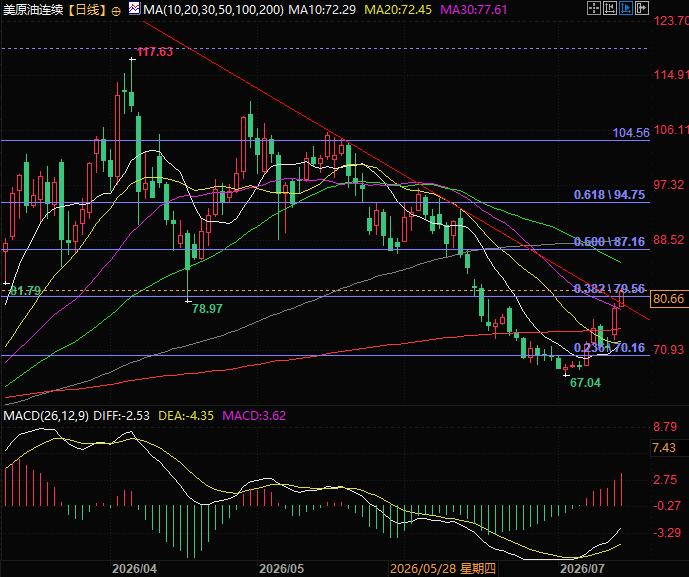 (WTI crude oil futures daily chart, source: EasyTrade) At 15:49 Beijing time, WTI crude oil futures were trading at $80.40 per barrel.
War Recap: US Blitzkrieg, Iran's Widespread Retaliation
The immediate trigger for this oil price surge was US President Trump's public announcement hours earlier of the reinstatement of the blockade mechanism on Iranian shipping lanes, along with the shocking proposal to impose a 20% "security passage fee" on transit merchant ships. In retaliation for Iran's control of the Strait of Hormuz, US Central Command swiftly launched a large-scale airstrike, targeting key Iranian military positions along the coast, including Abu Musa Island, Bandar Abbas, Bushehr, and Chabahar, aiming to systematically destroy Iran's shore-based missile defense systems, missile and drone sites, and fast attack craft. However, Iran's retaliation was swift and fierce: the Iranian Revolutionary Guard Corps subsequently launched two cruise missiles in the Strait of Hormuz, precisely striking the supertankers "Mombasa" and "Al-Bashir," both owned by a UAE shipping company. The attack resulted in the death of one Indian crew member and injuries to eight others. Iranian missile and drone fire also covered Bahrain (triggering multiple air raid sirens) and US military bases in Jordan, achieving multiple strikes. The UAE reacted strongly, quickly issuing a tough statement as the economic pillar of the Gulf region, reserving the right to retaliate in kind. Fighter jets roared over Dubai, and the US consulate has urgently suspended its offline operations.The exorbitant 20% "protection fee": Trump's calculations, however, unwittingly aided Iran.
Trump's proposed 20% security fee on transit cargo not only completely reversed his previous stance of not charging transit fees , but also directly overturned the diplomatic cornerstone of the United States' "advocacy of freedom of navigation in the world's oceans," a principle that has been upheld for over two centuries since the Barbary War and the War of 1812. Can the United States really collect this 20% fee? The answer is: absolutely not. Behind this is more of a political show and a "maximum pressure" tactic by Trump, the true intention of which can be broken down as follows: First, to force allies to "take over" and share the military costs: Trump knows that a full-scale invasion of Iran is a bottomless pit. By imposing a sky-high 20% transit fee, he is actually blackmailing wealthy allies such as Japan, South Korea, India, and Europe, who are highly dependent on this sea route—either they pay for US military escorts, or they send their own warships to take the hits. Second, to use as a bargaining chip to divert domestic conflicts : After the temporary ceasefire agreement broke down and Iran failed its "strategic test," Trump attempted to push the price to the "maximum," forcing Iran to accept even harsher conditions when it returns to the negotiating table in the future. However, the US inadvertently suffered a major setback on both legal and moral grounds. Under the framework of the United Nations Convention on the Law of the Sea (UNCLOS), international waters enjoy the "right of transit," and any unilateral checkpoint and toll collection is illegal . This move by the US has completely shattered its long-standing image as a "guardian of freedom of navigation," directly surrendering its moral advantage in international public opinion.Iran is forced to free-ride: Legalizing fees gains moral support
Trump may not have anticipated that his casually offered "protection fee," born of business instinct, would inadvertently provide Iran with the perfect logical ammunition. Just as a US drone was shot down Monday evening, Ibrahim Azizi, chairman of the Iranian parliament's National Security and Foreign Policy Committee, formally submitted a draft law entitled "Strategic Action Act for Ensuring Security and Sustainable Development of the Strait of Hormuz and the Persian Gulf." Azizi stated firmly, "We will firmly defend our red lines, especially our position regarding jurisdiction over the Strait of Hormuz. This is only the first step; subsequent supporting measures will be introduced soon." Trump's comments on fees have inadvertently paved the way for Iran: since the US has publicly acknowledged that "whoever provides security should charge," then Iran, as the de facto controller of the strait, can rightfully take over the "autonomous governance" of the strait and introduce its own navigation fee scheme. Iranian Foreign Minister Araqchi subsequently stated that the US president's remarks were entirely correct, and all entities providing guarantees for the safe passage of merchant ships through the Strait of Hormuz should rightfully receive corresponding service fees. Iran has been the guardian of the Strait of Hormuz since ancient times and will continue to shoulder this responsibility. A 20% cut is clearly too high, and we will adhere to the principles of fairness and impartiality in handling related matters. Because of the US's "20% robbery price," the moral and public pressure Iran faces has instantly vanished. To demonstrate its legitimacy as the "true master of the Strait," Iran is highly likely to introduce a "cheaper and more respectable" toll-based navigation plan in the near future.Cost sharing comparison: If a "median compromise scheme" is adopted...
Taking WTI crude oil as an example, let's assume a VLCC carrying 2 million barrels of crude oil, with the market betting that oil prices would fall to around $68 after the Strait of Hormuz was fully opened, even if Iran levied a $2 million passage fee on each VLCC, it would only add $1-2 to the price per barrel, bringing the cost to around $70. However, the US's exorbitant 20% protection fee is equivalent to an additional $14 per barrel, bringing the WTI crude oil price to around $84, meaning a total fee of $28 million for the entire ship. If Iran were to follow this logic and implement a similar plan, setting the fee at the midpoint between the US and normal fees—that is, a $14 million security passage fee for the entire ship—the oil price would be around $78, compared to the current price of $80. Although the fee is seven times higher than the initial $2 million, compared to the US's 14 times, this plan is not only commercially acceptable to buyers, but also firmly establishes Iran's "de facto jurisdiction" over the Strait of Hormuz both legally and geopolitically.Summary and Technical Analysis:
Regardless of whether this staggering toll ultimately goes to Washington or Tehran, the increased energy costs resulting from the toll are a given, inevitably leading to higher oil prices. However, this also legally and morally pushes forward the process of managing tolls in the Strait of Hormuz. In other words, although the situation is tense, once the Hormuz passage mechanism is implemented, for every fully loaded VLCC, whether the toll is $2 million or the $28 million claimed by the US, as long as the toll rules are clear, oil prices will be easier to calculate, and expectations of rising oil prices will be easier to control. Currently, even after calculating the extreme scenario of a 20% toll, WTI oil prices are only around $85, and there isn't much panic about further price increases. Therefore, $80-$85 should be the high point range for this round of oil price rebound for WTI. Technically, oil prices have broken through the 0.382 Fibonacci retracement level and the downtrend line, indicating a need for a pullback. If prices can hold above this level, a further rebound is possible, but this price area is still considered a resistance zone. (WTI crude oil futures daily chart, source: EasyTrade) At 15:49 Beijing time, WTI crude oil futures were trading at $80.40 per barrel.
- Risk Warning and Disclaimer
- The market involves risk, and trading may not be suitable for all investors. This article is for reference only and does not constitute personal investment advice, nor does it take into account certain users’ specific investment objectives, financial situation, or other needs. Any investment decisions made based on this information are at your own risk.